


Tooling shows you the bill in high resolution, and a bill you can see is still a bill you have not changed, which is why the decision that matters is who owns the number.
Three things get bought whenever a company decides to take its cloud bill seriously. A cost dashboard, a tagging convention, and a savings target for the quarter. One of the three decides whether the bill is actually different in six months, and it is not the dashboard.
Cloud cost management is the practice of attributing cloud spend to the teams, products and customers that cause it, then governing the decisions that create it. Tools are strong at the attributing. Nobody has shipped a tool that does the governing, because governing is a person.
That is the argument of this piece, the fifth chapter in our six-part series on cloud cost. Buy the tooling, and buy it with clear eyes about what it is for. Then answer the question no vendor will answer for you: when a service's cost doubles next quarter, whose problem is it?
Key takeaways
- Cloud cost management is four jobs, not one: visibility, allocation, optimization and governance. Software owns the first two. It cannot touch the second two.
- Native provider tooling is free, already installed, and enough for a large share of companies. Start there and prove you have outgrown it before you buy anything.
- Third-party platforms are worth real money when allocation is genuinely hard: many accounts, shared clusters, per-customer cost, chargeback across teams.
- Open source exists because containers hide the bill. A Kubernetes cluster is one invoice line and twenty teams, and no native console will break that apart for you.
- Without a named owner and tags enforced at provisioning time, a dashboard is a more expensive way to be surprised.
Four jobs hide behind the phrase cloud cost management
Say "cost management" in a leadership meeting and four different activities collapse into one word. They have different mechanisms, different price tags, and different owners, and conflating them is how companies end up paying a platform fee to watch their bill grow.
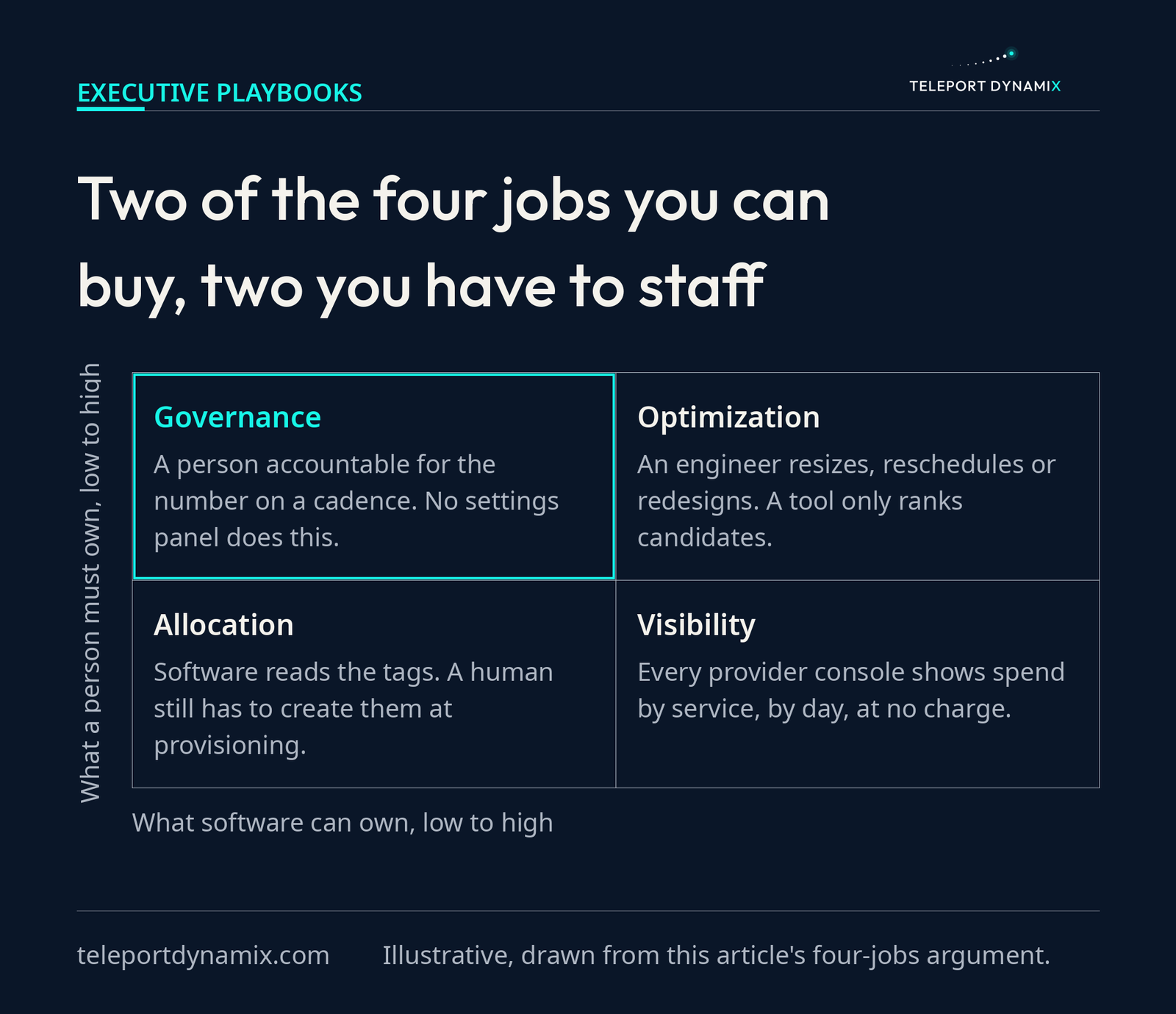
The four jobs of cloud cost management, what each one is, and whether software or a person carries it:
| Job | What it is | Can software do it | Who owns the outcome |
|---|---|---|---|
| Visibility | Knowing what you spent | Yes, every provider console ships it free | The tool, with no human in the loop |
| Allocation | Knowing which team or product caused it | Yes, if the resources carry tags | The tool, once tagging is enforced |
| Optimization | Changing the thing that caused the cost | No, it can only rank candidates | An engineer with context |
| Governance | Making sure the change stays made | No, accountability is not a setting | One named leader on a fixed cadence |
The two jobs software can genuinely own
Visibility is solved. Every provider ships a console that will show you spend by service, by account, by day, with forecasting attached, and none of it costs extra.
Allocation is nearly solved, with one condition. A tool can attribute spend to a team, a product or a customer only if the resources carry the tags that say so. Feed it clean metadata and it is remarkable. Feed it a `shared-prod` bucket holding 30% of the bill and it will faithfully report that 30% of your money went somewhere.
Software cannot invent the tag. It can only read it.
The two jobs software cannot do at all
Optimization is an engineering change. Something gets resized, rescheduled, retiered or redesigned, and a human with context decides that the change is safe. A tool can rank the candidates. It cannot merge the pull request. That optimization is engineering work rather than a line item is the case the pillar makes in full, in cloud cost optimization is engineering, not billing.
Governance is worse, because governance is organizational. It means somebody is accountable for a number on a fixed cadence, and accountability is not a feature you can turn on in a settings panel.
That is the split. Two halves you can buy. Two halves you have to staff.
Native provider tooling is better than its reputation
Consultants skip past the built-in tools quickly, because there is nothing to sell there. That is a disservice, and it costs companies money before they have spent a cent on a platform.
What the native consoles genuinely do well
The built-in consoles cover more than their reputation suggests, and none of it carries a fee:
- Spend by service, account and tag. AWS Cost Explorer shows it with forecasting and anomaly detection, and Azure Cost Management does the same across subscriptions and resource groups, next to Microsoft's free cost management best practices.
- A billing export to a warehouse. Google Cloud will stream detailed billing data into BigQuery, so your cost data becomes a table you can join against your own product data.
- Cost per tenant, feature or API call. Once that export lands, each is a SQL query away, and none of it required a purchase order.
That is the ceiling nobody talks about. It is high. If AWS is the bulk of your bill, the AWS cost optimization checklist for scaling teams turns Cost Explorer into a weekly routine rather than a screen you open in a panic, and on Azure the biggest lever is usually the contract itself, which is why Azure cost optimization starts with your licensing before it touches a resource.
Where the native consoles stop
The built-in tools stop in three predictable places, and each one is where a bigger question begins:
- At the account boundary. Run five AWS accounts, two Azure subscriptions and a GCP project inherited from an acquisition, and you now have four consoles and a spreadsheet, and the spreadsheet is the product.
- At the container. A cluster arrives as a few instance lines, and no native console will split it back into the teams sharing it.
- At the provider edge. Ask a question that spans clouds and the consoles cannot answer, which is where a third-party platform starts to be worth its fee rather than merely available.
Third-party platforms buy you allocation, not judgment
The platform market is real and the products are good. Datadog's cloud cost product correlates spend with the telemetry you already collect, so a cost spike sits next to the deploy that caused it. CloudZero built its whole position around cost per customer and cost per feature. Vantage publishes serious engineering work on provider pricing, and IBM's cost management material is a fair primer on the category.
Their best argument deserves stating before anybody starts picking holes in it, because it holds.
What the fee buys, and where it stops
The fee buys a set of pipelines you would otherwise have to build:
- Multi-cloud normalization, so one dollar means the same thing across three providers.
- Anomaly detection that fires in hours rather than at the invoice.
- Chargeback and showback reports that finance will accept without re-keying.
- Kubernetes allocation and per-customer unit cost, without you standing up the pipeline.
Each of those is a real engineering project you are choosing not to run. That is what you are paying for, and for a company past a certain size it is straightforwardly cheaper than building it.
Then the limit arrives, and it arrives fast. A platform reports. It does not decide, and it does not merge.
Buy one and you will know, in beautiful detail, that the data platform team's spend rose, say, 40% last month. The tool will not tell you whether that was a bad quarter or a good investment, because it does not know what the team shipped. Only an engineer with context can answer that, and if no engineer is accountable for answering it, you have bought a very expensive newsletter about your own money.
Open source exists because containers hide the bill
Kubernetes was designed to abstract the machine away. It succeeded, and in succeeding it abstracted away the price of the machine.
A cluster arrives on the invoice as a handful of instance lines. Twenty teams share it. Every one of them believes their namespace is cheap, and none of them can prove it, which means none of them can be held to it.
OpenCost exists precisely for that gap, and cost allocation became a governed concern under the Cloud Native Computing Foundation rather than a proprietary feature for exactly the reason you would hope: a workload that cannot see its own cost has no feedback loop.
The mechanism is unglamorous, and that is the point. It reads what each workload asked the scheduler for, reads what the underlying nodes cost, and attaches the result to a namespace or a label. Nothing about that requires a vendor.
What it produces is a figure a service owner can argue with, and an argument about a number is where accountability starts. If you run Kubernetes at any scale and you cannot break the cluster down by namespace, this is the first thing to fix, and it is free.
Which of the three tiers fits your bill
Native consoles, commercial platforms and open source, compared on price, strength and limit:
| Tier | What it costs | Best at | Where it stops |
|---|---|---|---|
| Native consoles | Free, already installed | Visibility and single-account allocation | The account boundary and the container |
| Third-party platforms | A recurring fee | Multi-cloud allocation, chargeback, per-customer cost | Reporting, with no power to decide or merge |
| Open source, OpenCost | Free, self-hosted | Splitting a Kubernetes cluster by namespace | Everything outside the cluster |
Those three tiers stack rather than compete. None of them carries you past the two jobs that need a person.
Buy by stage, and only after one test
Tool selection is where cost programs burn their credibility, usually by buying a platform to solve a problem that was actually a tagging problem. The Thoughtworks Technology Radar is a useful discipline to borrow here: adopt a tool when you have felt the pain it removes, not when you have read about the pain.
The one test that decides it
Ask your team to attribute last month's bill to the top five services, by owner, with a number next to each. Give them a day.
If they come back with an answer, your allocation is working and a platform will make it prettier rather than possible. If they come back with a shrug and a shared bucket, buying a platform will not fix that. You have a tagging problem, and a platform will simply render the tagging problem at higher resolution.
Fix the input before you buy the reporting layer.
A read by stage
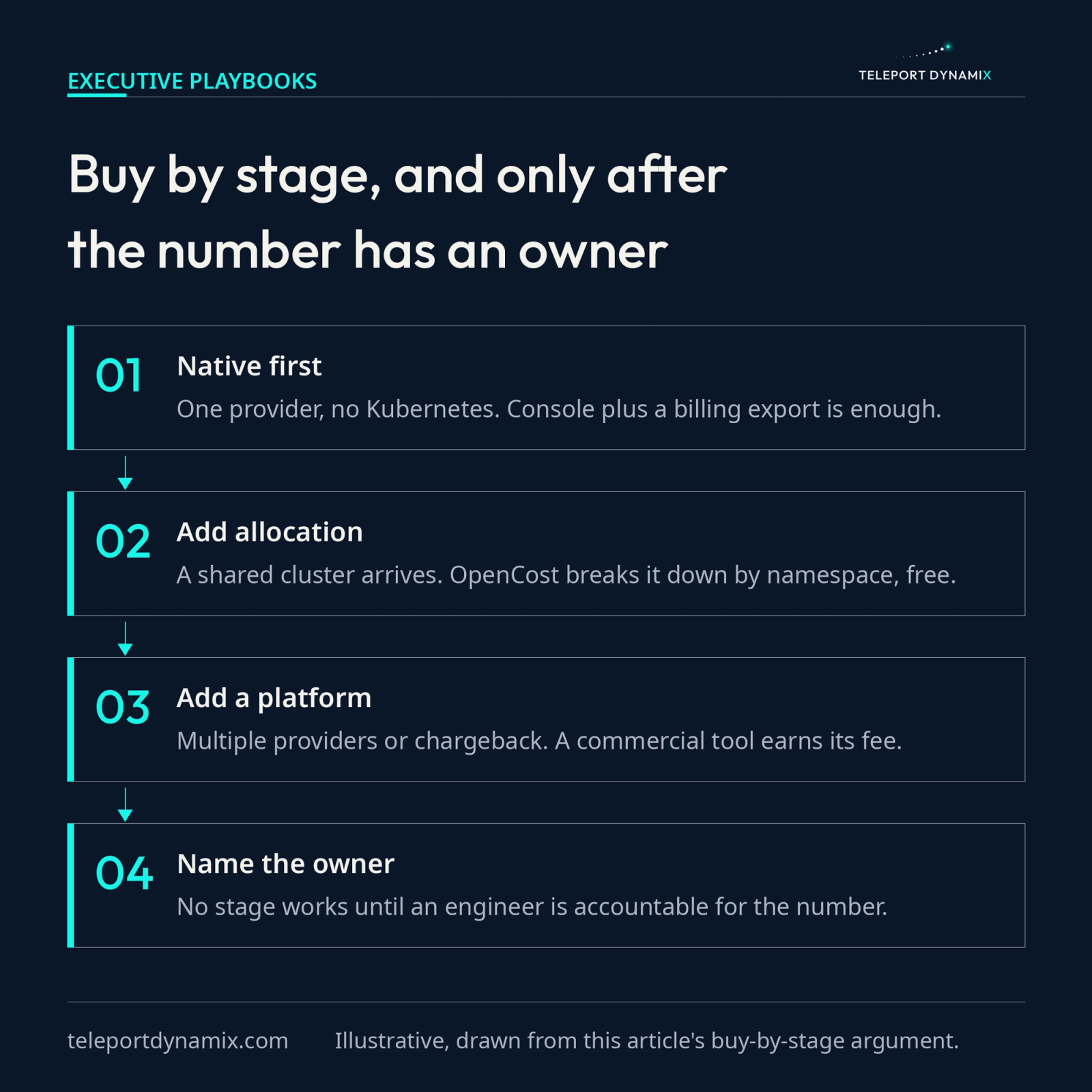
Under roughly $1 million a year in cloud spend, on one provider, with no Kubernetes: native tooling plus a billing export is genuinely enough, and the money is better spent on an engineer's week than on a license.
Add a shared cluster and you need allocation, which is where OpenCost or its commercial descendants earn their place. Add multiple providers, chargeback to teams, or a board asking for cost per customer, and a commercial platform stops being a luxury.
That sequence tracks the difficulty of the four jobs. A feature comparison will never tell you where on it you currently sit.
Whatever the stage, the discipline that keeps a cost program from quietly taxing delivery is a subject of its own, worked through in reduce cloud costs without losing engineering speed.
Three gaps no cloud cost tool will ever close
Every cost program eventually arrives at the same wall, and it is always in the same place. Tooling is on one side of it. Ownership is on the other.
The three gaps that survive any purchase, what the tooling will give you in each case, and what actually closes it:
| Gap | What the tooling gives you | What actually closes it |
|---|---|---|
| Untagged resources | A large bucket labeled shared or unknown | Tag enforcement in code at provisioning time |
| No unit-cost number | Total spend, which grows with the company | A named leader reporting cost per unit of value |
| Architecture as the cost | A billing line that reads as a config problem | A design review that redraws the boundary |
Each of the three fails for a different reason, and the reason is what tells you where to spend the effort.
Tags have to be enforced where the resource is born
A tagging policy that depends on human diligence has a half-life measured in weeks. Enforcement in code works because an untagged resource never comes into existence in the first place, which removes the diligence from the loop entirely. AWS's cost allocation tag documentation is explicit that tags must be activated and applied consistently to mean anything, and consistency is what infrastructure as code is for. Ask nicely in Slack and you will get compliance for a month.
Somebody has to own a unit-cost number
The number that survives contact with a board is cost per unit of value: per active user, per transaction, per tenant. It can fall while the invoice climbs, which is exactly the story a growing company needs to be able to tell.
The practice puts financial accountability into engineering decisions, and the accountability part is the load-bearing word. Installing a product where the job called for a practice is the same error in a different aisle, taken apart in FinOps is an operating discipline, not a cost tool.
The ownership model that works is the one Martin Fowler describes for services generally, where the team that builds a thing runs it and lives with its consequences. Cost is a consequence. A system nobody owns degrades, and a bill nobody owns grows the same way.
Not a committee. A person.
Some findings are architecture, and no dashboard will say so
A tool will show you that egress accounts for something like 18% of the bill. It will not tell you that the topology is the cost, and that the fix is a service boundary drawn in the wrong place three years ago.
Those findings look like cost findings and behave like design findings, which is why they belong in a scalability review or surface uncomfortably during technical due diligence. The billing line is the symptom and the design is the cause, and no console will ever say so.
Ownership changes what the cost review sounds like
Six months after a company names an owner, the tooling looks identical. The meeting does not.
Before, the monthly cost review is forensics. Somebody exports a spreadsheet, somebody else disputes the allocation, and the hour ends with an action item to investigate. Nothing gets decided in the room, because nobody in the room is accountable for deciding it.
After, the same review takes fifteen minutes. Every material line has a name against it, and the person holding the name explains the movement in one sentence: we shipped the thing, it costs more, here is the revenue attached to it. Occasionally the answer is that the number is genuinely wrong, and that person already has the change in flight.
Nothing in the dashboard changed to produce that. The reporting was always there. What changed is that a question now has an address.
The cloud cost audit we run ends in a 90-day roadmap with ROI per action for exactly that reason: the actions are the product, and the tool is the instrument that lets you see whether the actions worked. Our advisory practice sits next to the studio because the engineers who build our own ventures are the ones who audit other people's, and they have all made this mistake once.
Buy the instrument. Then hire, name, or appoint the person who reads it and is accountable for what it says.
Frequently Asked Questions
What is cloud financial management?
Cloud financial management is the practice of attributing cloud spend to the teams, products and customers that cause it, then governing the decisions that create it. It covers four jobs: visibility, allocation, optimization and governance. Tools handle visibility and allocation well. Optimization and governance require engineers and a named owner.
Is cloud financial management the same as FinOps?
Broadly yes, with FinOps being the named operating model for it. FinOps, as defined by the FinOps Foundation, runs on a cycle of inform, optimize and operate, and it puts financial accountability into engineering decisions rather than into a monthly finance report. Cloud financial management is the general term for the same discipline.
Which four areas does cloud financial management cover?
Visibility, allocation, optimization and governance. Visibility is knowing what you spent, and every provider console gives it away free. Allocation is knowing who caused it, which depends entirely on tagging discipline. Optimization is the engineering change that removes the cost. Governance is the ownership and cadence that stops savings eroding.
How do you choose a cloud cost management tool?
Run one test first. Ask your team to attribute last month's bill to its top five services by owner, with numbers. If they can, a platform makes reporting prettier. If they cannot, you have a tagging problem, and buying software will render that problem at higher resolution without solving it.
Who should own cloud cost management inside a company?
One named engineering leader, reporting a unit-cost number on a fixed cadence. Not a committee, and not finance alone. Finance sets the target and holds the review, but every actual saving is a change an engineer makes to a resource or a design, so the accountability belongs where the decisions are made.
Can a tool alone reduce your cloud bill?
No. A tool reports the bill, ranks candidates, and detects anomalies, all of which are useful. It cannot resize an instance, delete an orphaned volume, redraw a service boundary, or decide that a 40% spend increase was a good investment. Every one of those needs an engineer with context.
Continue Reading:
More In This Series:
- Cloud Cost Optimization Is Engineering, Not Billing
- AWS Cost Optimization Checklist for Scaling Teams
- Reduce Cloud Costs Without Losing Engineering Speed
- FinOps Is an Operating Discipline, Not a Cost Tool
- Azure Cost Optimization Starts With Your Licensing
More from Teleport Dynamix:
- Hospitality Software Was Built for Someone Else
- Startup Fundraising Is a Purchase, Not a Milestone
- Pitch Deck Is a Trailer, Not the Film Investors Buy
- Hospitality Management Platform Built for the Shift
Explore the Insights Categories:


