


Decks do not close rounds, they buy meetings, and almost every deck that fails was built to do the first job instead of the second.
Pitch decks do not win investment. Nobody has ever wired money because of a slide, and a deck built as though they might is optimizing for an outcome the document was never asked to produce.
Its actual job is narrower and far more useful. Get the next meeting. It is a trailer, not the film, and the nine slides inside it run problem, insight, product, evidence, why now, market, model, team and ask.
We say that from the side of the table this article is rarely written from. Teleport Dynamix co-founds companies and holds equity in them, so we sit on the cap table rather than pitching into it, and this fourth piece in the fundraising series is about what an investor is actually doing while they read, why the sequence decides more than the content, and what each slide has to prove before it earns its place.
Key takeaways
- A pitch deck has one job: to get the next meeting. Every slide is judged against that and nothing else.
- Investors read a deck hunting for the reason to stop. Each slide is either a reason to keep reading or a reason to close the file.
- Order carries the argument. Excellent slides in the wrong sequence still die on slide two.
- Every slide has a cut test: what it must prove, and what a weak version of it silently signals about the founder who made it.
- The deck you send and the deck you present are two different products. Using one document for both costs meetings.
Investors read a deck hunting for the reason to stop
A partner opening your deck is running a filter rather than an evaluation, and the filter is looking for a disqualifier, because a fast no is the cheapest thing in the business and a yes costs them years.
That sounds cynical, and it is really just arithmetic. A fund with a concentrated portfolio has to decline almost everything it sees, so the default answer is already loaded before the file opens, and your slides are being asked to dislodge it.
The scarce resource is not capital. It is meeting slots. Watch how the people closest to this market describe the way investors actually screen and engage founders, and the pattern is obvious: partners are triaging constantly against everything else on the desk, and the deck is the instrument of that triage. The deck is only the opening move, which is why pitching investors while they are triaging you is a separate skill that starts once the meeting is booked.
So the question a slide has to survive is "does this remove my reason to stop?" rather than "is this good?" Founders write for the second. Investors read for the first, which is why a deck built to impress loses to one that never hands the reader an exit.
Thirty seconds, and the four things that end it there
Nothing about a deck is decided slowly. The opening moments are spent on the title, the standfirst line and the first slide, and there are four reliable ways to lose the reader before anything you care about is even on screen.
- No plain-language line. A deck that does not say what the company does gets inferred by nobody. The partner forwards it to an analyst and forgets it.
- Market before company. A first slide about the market answers a question the reader has not been given a reason to ask yet.
- Unreadable density. The wall of eight-point text announces a founder who could not decide what mattered.
- A visible exaggeration. A claim in the first ten words that the reader knows is untrue retro-discounts every number that follows it.
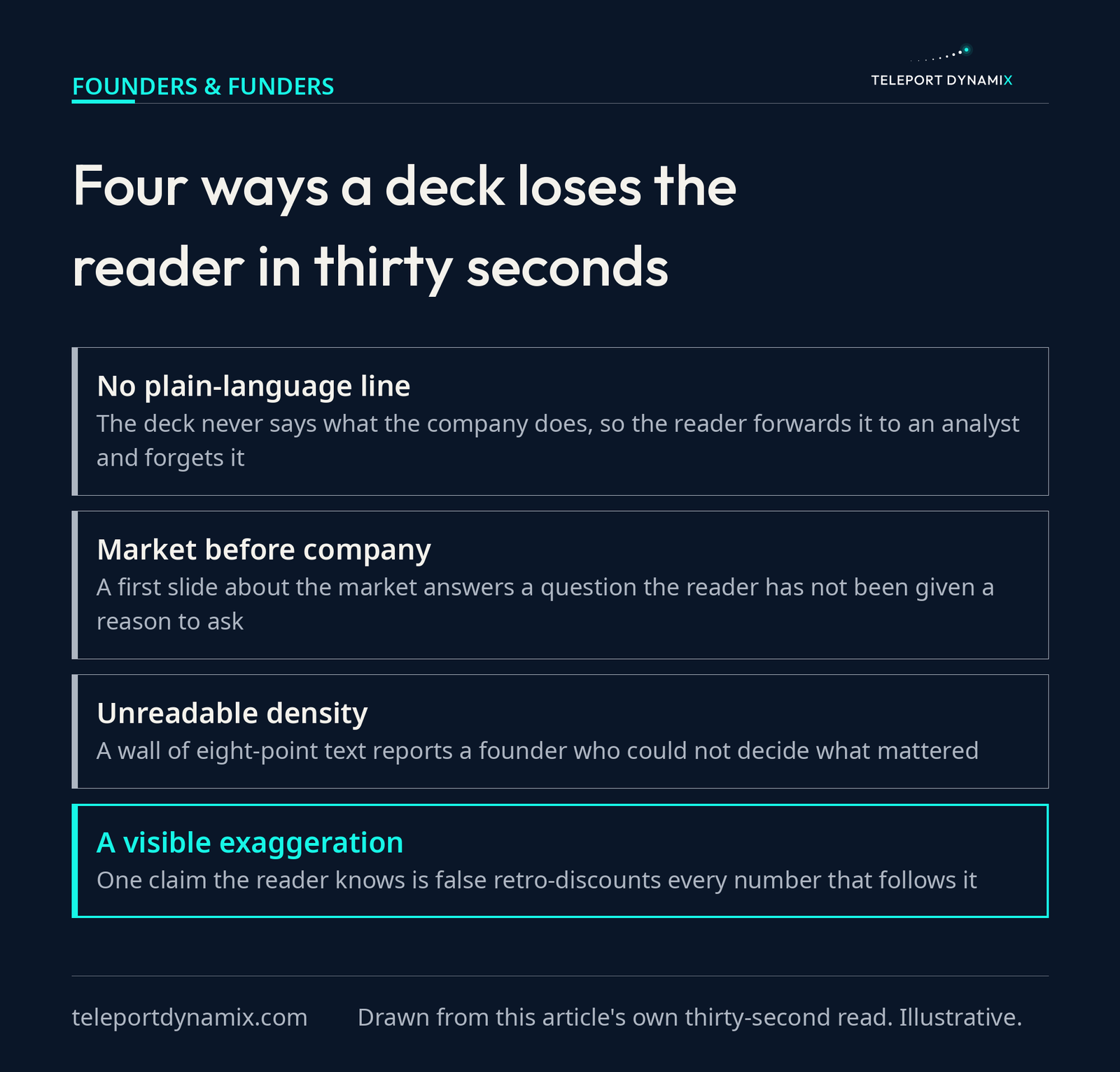
None of those four failures is fixed by better design. Each one is a decision the founder had not made yet, and the slide simply reported it. No template ships with the decision already taken.
One job rewrites what belongs on a slide
Once the job is the meeting, the test for every element on every slide becomes a single sentence: does this earn the next conversation, or does it replace it?
Explanation replaces it. Founders explain because explaining feels like work, and because a fully explained company feels safer than an intriguing one. A deck that answers every question has removed the reason to book time with you, and one that answers none has removed the reason to care.
Three tests sort every element on a slide:
- Earns the meeting. A number, a screen or a claim that makes the reader want detail the page cannot give.
- Replaces the meeting. A full explanation so complete there is no reason left to book time with you.
- Belongs in the data room. The exhaustive version, opened only after a partner commits real time.
Kevin Hale's work on deck design at Y Combinator makes the mechanical version of the argument: one idea per slide, legible at a glance, no slide that requires a second read. That is not a design preference. It is a concession to how the document is consumed.
Pitch deck templates hold the slides and none of the decisions
A template holds the slides everyone already expects, and expectation was never the constraint. The constraint is that a reader looking for an exit has to be denied one nine times in a row, and no container can decide which of your facts does that.
NFX keeps a weekly library for pre-seed and seed founders and returns to pitch decks constantly. The deck is downstream of the story, and the story is downstream of what you know about the customer.
The deck gets you to the room where the explaining happens, and nothing more is being asked of it.
Order is the argument, and the argument usually dies early
Content gets the attention. Sequence does the persuading: each slide buys the attention the next one needs, and an investor who stops caring on slide three never reaches the good slide on eight.
The order that works runs problem, insight, product, evidence, why now, market, model, team, ask. It runs that way because every slide answers the question the previous slide just created in the reader's head.
Two inversions kill decks for exactly this reason:
- Opening on market size. The $40 billion number answers a question nobody has asked yet, because the reader has no reason to want a piece of that market from you specifically. You led with the prize and skipped the claim.
- Opening on the team. Credentials answer whether these people can execute, a question that only becomes interesting once "is this worth executing" has been settled.
There is one defensible exception. A founder with a rare track record can open on the team, because then the team is the insight. That is the founder Accel means by first partner to exceptional teams everywhere. If you have to ask whether this applies to you, it does not.
Sequence carries the argument, and the content only supplies the words.
Nine slides, and every one of them has a cut test
The sequence only works if each slide survives on its own. A partner hunting for a reason to stop will take the weakest slide as the answer, whichever one it happens to be.
The first five slides run problem, insight, product, evidence and why now, and every one of them carries the same three tests.
| Slide | What it must prove | What to cut | What a weak version signals |
|---|---|---|---|
| Problem | A named workflow costs someone real money today | Statistics about the size of the problem | You have not spoken to enough operators |
| Insight | Something true, non-obvious and yours about this market | Anything a competitor could write just as easily | You have a project rather than a company |
| Product | One screen of the real thing doing the real job | Architecture diagrams and the product roadmap | The product does not exist in showable form |
| Evidence | Behavior you measured, with the definitions stated | Signups, downloads, waitlists and dead pilots | Thin traction dressed up, and reporting to match |
| Why now | Something outside the company changed recently | General claims that technology moves fast | The timing is an accident a competitor also has |
Problem, where the weak version says you have not met anyone
A named workflow beats a category. "Reconciling channel bookings against the property system is a manual job someone does with a spreadsheet and a coffee" beats "operational inefficiency in hospitality."
Our own line runs 50 or more real customer interviews in weeks 3 to 6 before there is anything to demo, and the reason is not diligence theater. You cannot write this slide without them.
Insight, the slide no template has
Why has the obvious incumbent not built this, and what do you believe about this market that they do not?
This slide is missing from nearly every pitch deck example you will find online, because it cannot be filled in from a form. It is the only slide that carries a genuine idea, and it is the one an investor repeats to their partners when you are not in the room.
Product, where a screenshot beats a paragraph
Show the thing, annotated with what the user is achieving rather than with what the feature is called.
The architecture diagram and the roadmap earn their airing in the meeting you are trying to book, which is the whole reason they come off the slide that books it.
A slide of icons with no interface gets read in about a second, and the read is almost always correct.
Evidence, the only slide they cannot argue with
Retention, cohort behavior, cost to acquire a user that you measured rather than estimated. The definitions matter more than the numbers, which is why a plain-language rundown of the SaaS metrics themselves and the growth benchmarks in Bessemer's work on scaling revenue are worth reading before you draw the chart, not after you are asked about it.
Volume without behavior proves nothing. The operating numbers underneath a chart are the argument, and a curve with no definition under it is decoration.
If you have no evidence, say so in one line and move on. A deck that inflates thin traction fails harder than one that admits it is pre-traction, because inflation tells the reader how you will report to them for the next eight years. The proof a seed slide needs is not the proof a later round needs, since a Series A buys a different kind of proof, so match the chart to the round you are raising now.
Why now, the slide that has to name what changed
Something outside the company has to have moved recently enough to make this buildable now: a price that fell, a rule that came in, a model that got good enough to ship. Every deck claims technology is moving fast, and no deck has ever been believed for saying it.
Why now is the only slide whose answer sits outside the company, which is exactly why founders skip it. It is also the slide that makes a round urgent rather than merely possible.
Market, model, team and ask are read as one argument about money
The last four slides run market, model, team and ask, and a partner reads them as a single question about whether the money has somewhere to go.
| Slide | What it must prove | What to cut | What a weak version signals |
|---|---|---|---|
| Market | A reachable number built from customers and prices | Three concentric circles and top-down totals | You cannot name your first hundred customers |
| Model | Who pays, what they pay, and what serving them costs | Five-year revenue projections | Pricing has never met a real buyer |
| Team | Founder-market fit, and what you know that others do not | The advisor grid | The founders treat the company as a job |
| Ask | The specific evidence the money buys | A round size stated without a purpose | No plan sits behind the number |
Market, and why the big number makes you smaller
Show the wedge you take first. Bottom-up beats top-down every time, because a number built from customers and prices can be interrogated and a number built from an analyst report cannot.
We hold equity in the ventures we co-build, so we read this slide as owners, and an owner funds the wedge rather than the total. The reachable number you show here also seeds the valuation you will later have to grow into, so an honest wedge now saves a hard conversation at the term sheet.
Model and ask, the two slides founders soften
Say what you charge and what the money buys. Not how much: what for. The round is a purchase of a specific piece of evidence, which is the whole argument that startup fundraising is a purchase, not a milestone, and the ask slide should name the evidence you are buying.
Vagueness here is not modesty, it is a tell. SVB's startup insights hub collects fundraising and operating advice from founders, VCs and advisors, and the operating half is where an ask slide is actually judged.
From the cap table the ask reads differently. Every month it fails to buy is a month of our own equity spent on nothing.
What survives the cut is an eighteen-month plan with named milestones and the burn to reach them, which is also the sanity check on whether you are selling equity to fund something a technology and cost review in the advisory practice would have taken off the burn permanently.
Team, which is read for exactly one thing
Why are you the people who cannot help but solve this problem, and what do you know that a smart generalist would take two years to learn?
An unpaid advisor with a famous face signals borrowed credibility, and every investor has learned to discount it. Seed programs publish their reasoning in the open, Techstars' founder interviews and Seedcamp's why-we-invested posts among them, and those write-ups turn on the founders themselves.
Sending a deck and presenting a deck are two different products
Both are called the pitch deck. They have different readers, different failure modes, and they cannot be the same file.
The sent deck is read alone, with no narrator, and it has to survive that.
The presented deck is the opposite. You are the narration, so the slides drop to a handful of words and a single image, and anything you would read aloud comes off the slide entirely. Written material has to carry itself, which is why Speedinvest and Creandum can publish founder posts in the open and a presentation deck cannot be read the same way.
Reader, word density, format and failure mode all separate the deck you send from the deck you present.
| Dimension | Sent deck | Presented deck |
|---|---|---|
| Reader | A partner alone, in silence, often one you never meet | You, narrating live to a room |
| Word density | More words, self-contained, explains its own charts | A handful of words and one image per slide |
| Format | A PDF that renders identically everywhere and resists editing in transit | Whatever you drive on screen while you talk |
| Failure mode | Ambiguity becomes an objection you are not present to answer | The audience reads ahead and stops listening |
Build both. It is one afternoon of work and it is the highest return afternoon in the entire raise.
The sent deck also gets forwarded, so write it for the partner who was never in the room. That partner is usually the one who decides.
What this looks like when it works
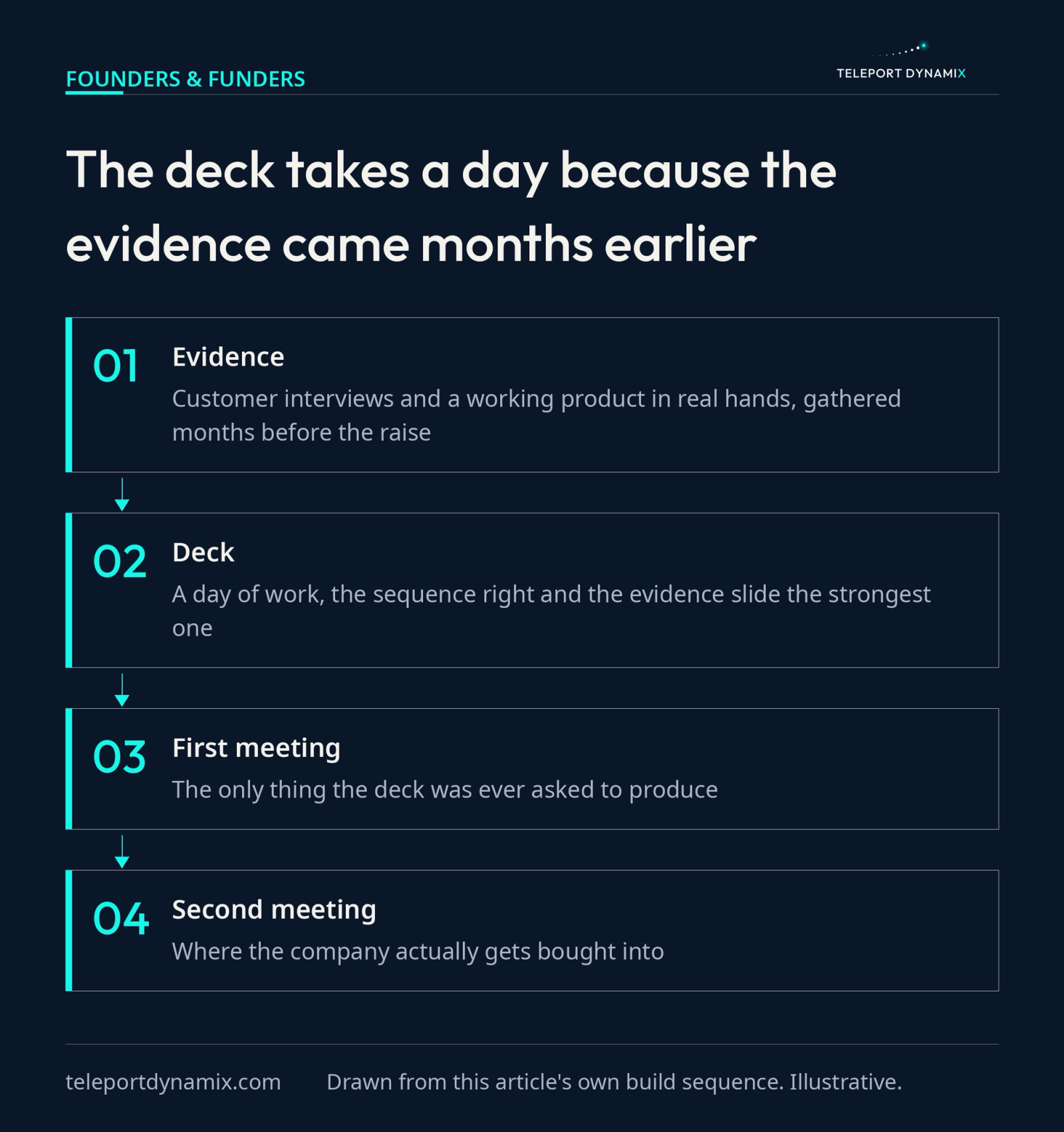
Good decks are boring to build, because the hard part happened months earlier.
The founder already has the evidence, so the deck is a compression of things that are true rather than a construction of things that might be. We co-build on a four-month clock for exactly this reason, and the process is front-loaded on purpose, with customer interviews first and a working product in real hands by month 3.
The deck then takes a day. It is short, the sequence is right, the evidence slide is the strongest one, and the ask names what the money buys. The first meeting produces a second meeting, which is the only thing it was ever asked to do, and the second meeting is where the company gets bought into.
You can feel the difference in the room. A founder with evidence is not asking anyone to believe a forecast, they are asking them to look at something that already happened, and the conversation stops being a performance. Whether that way of building is the right fit for you is a decision worth making long before there is a deck to write, because by the time the deck is due, the deck can only report what is already there.
Ownership is still intact when the round closes
A full-time founder co-building with us keeps 65 to 75% under our published equity model, which means they arrive at a seed conversation still able to say no, and the ability to say no is the only negotiating position that has ever mattered. Protecting that position is the whole point of raising a seed round without losing the company, and the deck is where it is quietly won or lost.
That is the whole method behind how we build, and it is the position we take because we are diluted alongside the founder. The investor view of the studio is simply that our equity is on the line in every venture, so a deck that wins a meeting we do not deserve costs us more than it costs anyone.
Evidence first. Deck second. Never the reverse.
Frequently Asked Questions
What is a pitch deck?
A pitch deck is a short slide document that a founder sends or presents to investors to secure the next meeting. It carries the problem, the insight, the product, the evidence, the market, the model, the team and the ask. It is a summary argument, not a business plan or a data room.
Does the 10 20 30 rule work for a pitch deck?
Partly. Guy Kawasaki's rule of ten slides, twenty minutes and thirty-point type is a useful discipline on length and legibility, and the slide count is close to right. Treat the numbers as a ceiling rather than a target, and never add a slide simply because the rule allows one.
Is a pitch deck just a PowerPoint?
Technically yes, though the tool is irrelevant. Send it as a PDF so it renders identically everywhere and cannot be altered in transit. What matters is the sequence and the cut test on each slide, not whether it was built in PowerPoint, Keynote, Google Slides or anything else.
Can ChatGPT create a pitch deck?
Yes, and the result will read like every other AI pitch deck, because a model can only rearrange what you already know. AI is genuinely useful for tightening language and pressure-testing an argument. It cannot supply the insight slide, and the insight slide is the one investors actually remember.
What should you avoid in a pitch deck?
Avoid anything that answers a question the reader has not asked yet. That means no five-year projections, no top-down market circles, no architecture diagrams, no advisor grid, and no vanity metrics. Each one gives an investor a reason to stop reading, which is precisely what they opened the file looking for.
How many slides should a pitch deck have?
Around ten for the sent version, and fewer for the presented one. Anything beyond twelve is usually a sign that explanation has crept in where intrigue belongs. Push detail into an appendix the reader can choose to open, and keep the main sequence tight enough to read in three minutes.
Continue Reading:
More In This Series:
- Startup Fundraising Is a Purchase, Not a Milestone
- How to Raise a Seed Round Without Losing the Company
- Series A Fundraising Buys a Different Kind of Proof
- How to Pitch Investors When They Are Triaging You
- Startup Valuation Is a Price You Have to Grow Into
More from Teleport Dynamix:
- Hospitality Software Was Built for Someone Else
- Cloud Cost Optimization Is Engineering, Not Billing
- FinOps Is an Operating Discipline, Not a Cost Tool
- Hospitality Management Platform Built for the Shift
Explore the Insights Categories:


