


Early-stage valuation is a negotiated price with a story attached, and the things that actually set it are the round size, the ownership the buyer needs, and the bar you will have to clear at the next round.
We publish the equity we take, which means we publish our own price, and it costs us deals. A full-time founder co-building with us keeps 65 to 75%, so we hold 25 to 35%. The part-time domain expert, the operator who has the problem but not twenty spare hours a week, keeps 45 to 60%, so we hold 40 to 55%. Some founders read those bands and walk.
We keep publishing them anyway, and here is the part that matters for you. Nobody calculated them. They came out of a negotiation about what each side brings and what each side risks, and dressing that up as a formula would be dishonest for a firm that sells evidence over decks.
Your startup valuation works the same way. It is a price, and this piece, the sixth and last in the series, is about how that price actually gets set.
Key takeaways
- Startup valuation at pre-seed is a negotiation, not a calculation. There is no revenue to discount, so the models are judgment with arithmetic bolted on.
- The round size and the ownership sold derive the valuation. Decide those two and the number is already fixed, whatever the model says.
- Investors are solving for their fund's ownership target, not for your company's worth. That constraint sets your price more reliably than any comparable.
- The option pool is expanded before the money lands, so the existing holders pay for it. That is a real cut to your price, presented as housekeeping.
- A valuation you cannot grow into is a debt, not a trophy. It sets the bar for the next round, and a down round costs more than money.
Pre-seed has no revenue to discount, so nothing to calculate
Valuation models are real tools. Discounted cash flow takes future cash and prices it today. Comparables take what similar companies traded for and apply that to you.
At pre-seed there is no revenue line. Discounting nothing gives you nothing. What the investor is pricing instead is evidence, and the frameworks the best seed funds publish for judging whether a product has found its market are closer to what is happening in the room than any spreadsheet you bring into it.
Where the models do real work, and where they do not
Comparables only turn genuinely informative once a company has about two years of revenue and a retention curve behind it. That is our working number rather than a market convention, and it holds because by then investors are pricing companies with your shape.
The inputs behind those comparables are metrics rather than narrative. By Series A an investor will rebuild yours from your raw data anyway. The metrics that sit underneath it, cohort behavior, churn, the unit economics beneath the revenue line, are where the price actually gets argued. That shift in what a round is buying is the subject of what Series A fundraising actually buys, and it is a different kind of proof from the one a seed investor will accept. None of it helps a company with eleven users and a demo.
Scorecard and Berkus are judgment with arithmetic bolted on
The scorecard method adjusts against the team, the market size, the product and the competition. The Berkus method assigns a fixed value to each of five things a pre-revenue company can have: a sound idea, a prototype, a quality team, strategic relationships, and a product rollout.
Both are useful. Neither is arithmetic.
Every input in them is a judgment someone made and then multiplied, so the output inherits the judgment and hides it behind a decimal point. Do not try to win a negotiation with one, because the investor across the table is not running it.
Which valuation method applies at pre-seed?
Four methods get used to price an early-stage company, and each one does something different once the revenue line is missing.
| Method | Where it earns its keep | What it delivers at pre-seed |
|---|---|---|
| Discounted cash flow | Series B, with years of cash flow to discount | No cash flow to discount, so no number falls out |
| Comparables | After revenue and retention have enough history to read | A read on market conditions rather than your price |
| Scorecard | Structuring a first conversation about the round | A stage average nudged up or down by judgment |
| Berkus | Framing what a pre-revenue team already has | Fixed values across five assets, then added together |
Round size and dilution derive the number before anyone argues about it
A valuation is derived, and it is derived from two decisions that get made before any investor opens your deck.
You do not negotiate a valuation and then work out how much you can raise. You decide how much you need to raise, the market decides roughly what share it expects to buy at that stage, and the valuation falls out of those two numbers as a consequence.
That is what it means to treat a raise as something you buy, which is the case startup fundraising is a purchase, not a milestone sets out in full. Anything you buy carries a price, and this is where the price is set.
Work the arithmetic backwards, because your investor already has
An investor who needs to own a fifth of the company and can write a $2 million check has priced you at 10 million post-money before they have opened the deck. If they can only write 1 million, the same ownership target prices you at 5 million. Same company, same team, same product, half the price, and nothing about you changed.
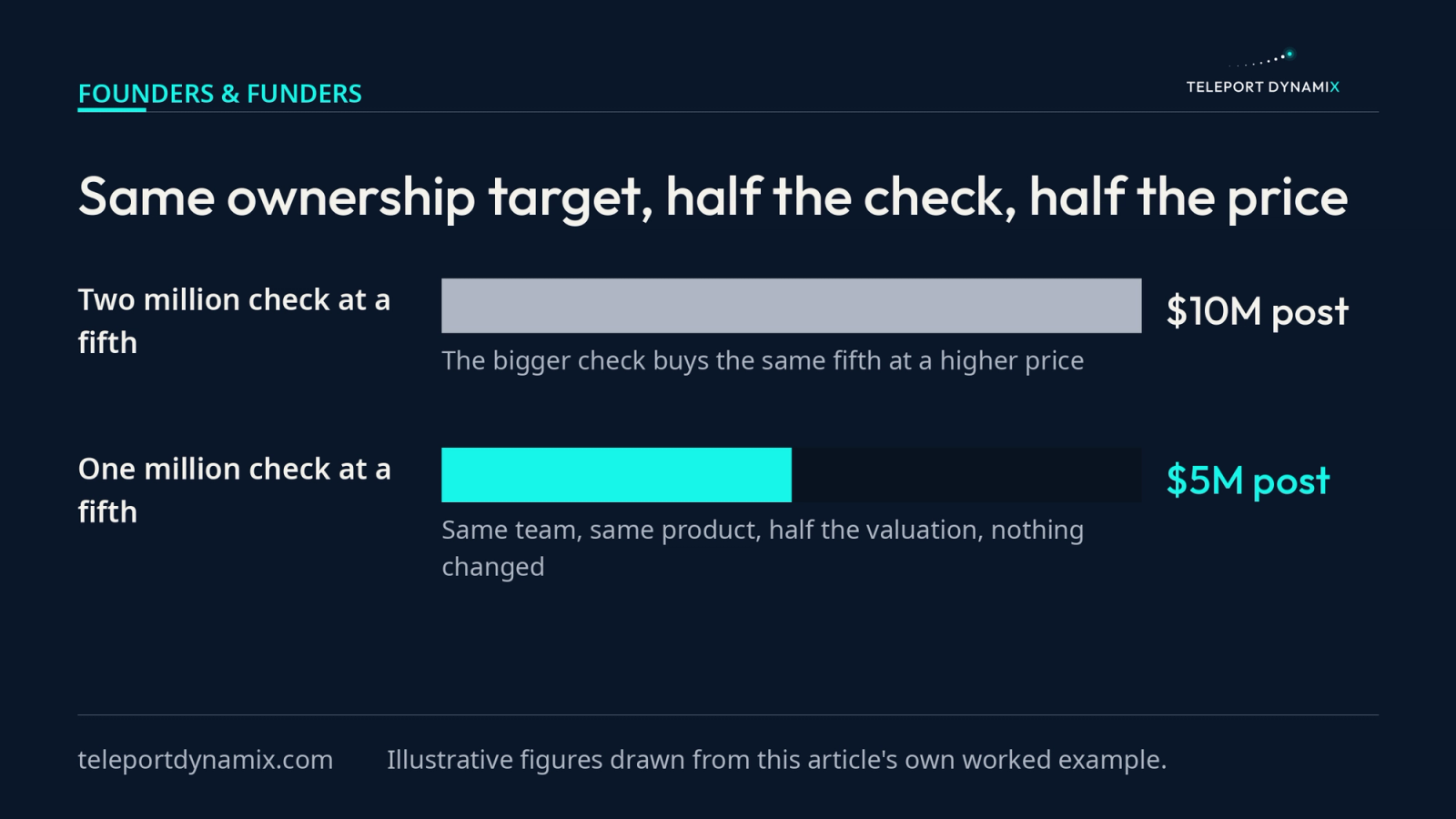
Run your own number. Take the cash you need to reach the next piece of proof, divide it by the ownership you are willing to sell, and you have your post-money. That is your valuation. Everything after that is a negotiation about the edges of it.
Fund math is the constraint you are actually negotiating against
The ownership target has nothing to do with you personally, or with anyone's opinion of your company. It comes out of the arithmetic of the fund on the other side of the table.
A fund has to return itself several times over from a handful of winners, and the ownership stake it takes at entry is the only lever it controls. Take too little of the one company that works and it cannot pay for the ones that did not. That is why the ownership number is the thing an investor will not move on, and the valuation is the thing they will.
Understand that and the negotiation stops feeling like an insult. You are not being told what you are worth. You are being told what a fund needs to own to survive its own model. The same clarity earns its keep in the room itself, where pitching investors who are triaging you is less about persuasion than about fitting their model before their attention moves on.
Comparables tell you the temperature, not your price
What similar companies raised at is useful information, and it is worth having. It is also the piece founders misuse more often than any other.
The comparable you read about was a specific company with a specific team raising in a specific month from a specific fund with a specific amount of money left to deploy. You are none of those things.
The four specifics hiding inside a comparable
Four particulars sat behind the round you read about, and each one moved the number before you ever saw it.
| Specific | Why it does not transfer to you | What it did to the number |
|---|---|---|
| The team | Investors price the team hardest at the earliest stage | Set a premium that belonged to that team alone |
| The month | Money is dearer or cheaper by the quarter | Priced the round in a market that has since moved |
| The fund | Dry powder left to deploy decided the check size | Fixed the price before anyone met the founder |
| The market | Fund sizes, round conventions and exits differ by region | A Bay Area figure lands wrong on a European cap table |
Read the write-ups funds publish about the companies they backed and the particularity is obvious. Every one of them tells you about a moment that has already passed.
Can you read your valuation off funding news?
The rounds in your feed arrive as they close, and the funding news that covers them delivers individual outcomes one at a time. Nobody is publishing a price curve you can read your own number off. Scroll the portfolio page of any fund and you are looking at the ones that got picked, listed after the fact. The rounds that priced badly, and the ones that never priced at all, are not on the page.
Geography is the specific founders import with the least care, and the funds in each market publish their own data rather than borrowing anyone else's. European investors run their own compensation and equity benchmarks for exactly that reason, and the press that covers European startups is covering a different set of companies raising from a different set of funds.
Use comparables to know the weather. Do not use them to claim you are the exception, because everyone raising this quarter is making the same claim with the same slide. A slide only carries the claim, which is the point of a pitch deck being a trailer, not the film investors buy; the number still has to survive the room after the deck closes.
Somebody pays for the option pool, and the term sheet hides who
Your term sheet will say the company must have an employee option pool of a given size at closing. Read carefully where that pool comes from. It is carved out of the pre-money, which means it dilutes the existing shareholders before the new money arrives, and you are paying for the shares that will be granted to hires the new investor wants you to make.
That is standard practice, and the pool is negotiable in a way the headline price rarely is. There are two moves worth making before you sign:
- Argue the pool into the post-money. Shift it after the money and you move real value without touching the number on the front page.
- Size it to a real hiring plan. A pool built from the roles you will actually fill in the next eighteen months is one you can defend seat by seat.
Both are really about not signing away the company by accident, which is the through-line of how to raise a seed round without losing the company.
Founders negotiate the valuation for weeks and then sign the pool in an afternoon, which is the wrong way round.
SAFE caps are a valuation you agreed to without noticing
Raising on a SAFE feels like deferring the valuation conversation. In practice it holds that conversation early, with less information and less ceremony.
The cap is a price. When the priced round comes, that cap converts, and if you stacked several SAFEs at several caps you will discover the real dilution on the day you can least afford the surprise. The instrument rarely causes that. Nobody modeled the conversion, so the founder finds out what they sold at the same moment they sign the round that reveals it.
Before you sign the second SAFE, put every instrument you have issued into one sheet and convert them all at the round you are actually planning to raise. Three checks catch the surprise early:
- List every instrument. Each SAFE, each cap, each discount, on one sheet before you sign another one.
- Convert at the real round. Use the priced round you realistically plan to raise, and leave the optimistic one out of the sheet.
- Read the whole stack. Several caps at several prices hide the true dilution until conversion day arrives.
Know what else is on the shelf while you are there. Lending against a venture prices the money rather than the company, so it arrives with covenants and a repayment schedule instead of dilution. That is the right tool when you are bridging to one specific piece of proof, and the wrong one when you cannot yet say what the proof costs.
High valuations are a debt that comes due at the next round
Getting the highest possible number feels like winning. It is the single most expensive mistake available to you at seed, and it is expensive later, quietly, when you have forgotten you made it.
Price the round at a number and you have committed to growing into it. The next investor will not pay a premium to your last premium. They will price you off your traction, and if your traction has not caught up with the number you talked your last investor into, you are having a very different conversation.
The arithmetic of the next round is where the cost surfaces. A Series A investor has to believe the company is worth several times the seed price, on evidence gathered in the time since the seed closed. Every extra point you win now raises the multiple you have to deliver later, against a market that will have moved by then. Founders meet that multiple a year and a half after the decision that created it, which is why a high price feels free on the day it is agreed.
What a down round costs beyond the shares
The dilution in a down round is the least of it. Five costs follow a price the company could not grow into, and they land on different people at different times.
| Cost | What it does | Who bears it | When it lands |
|---|---|---|---|
| A higher bar at the next round | Traction has to catch up with a price already set | The founder | At the next raise |
| Anti-dilution provisions | Earlier investors are repriced at the company's expense | Founders and common shareholders | The day a lower price is agreed |
| A public price signal | A lower number is visible and colors later conversations | The founder, in every conversation after it | Immediately, and it lingers |
| Underwater option strikes | Strikes set against the old number stop being worth anything | The team | As soon as the new price is set |
| Lost momentum | Best people start answering recruiter calls | The company | Quietly, across the months that follow |
The options are the cost founders see last. The founder's guide to what stock options are supposed to buy you makes plain how much value sits in a strike price, and a repriced company hands its team paper worth less than the offer they turned down to join you. Momentum is the thing a startup runs on and cannot buy back.
Take the valuation you can defend with evidence in eighteen months. Leave the extra ten percent on the table. It is the cheapest insurance in this business.
We price our own ventures by negotiation, and we say so
Nothing above is advice we hand out from a safe distance. We sit on the cap table of the ventures we build, so every point of value we argue for is a point we dilute alongside the founder at every round that follows.
That is why our equity model is published rather than quoted deal by deal. A studio that negotiates a different number with every founder is optimizing against the founder, and a founder without meaningful ownership stops behaving like an owner somewhere in the second hard year.
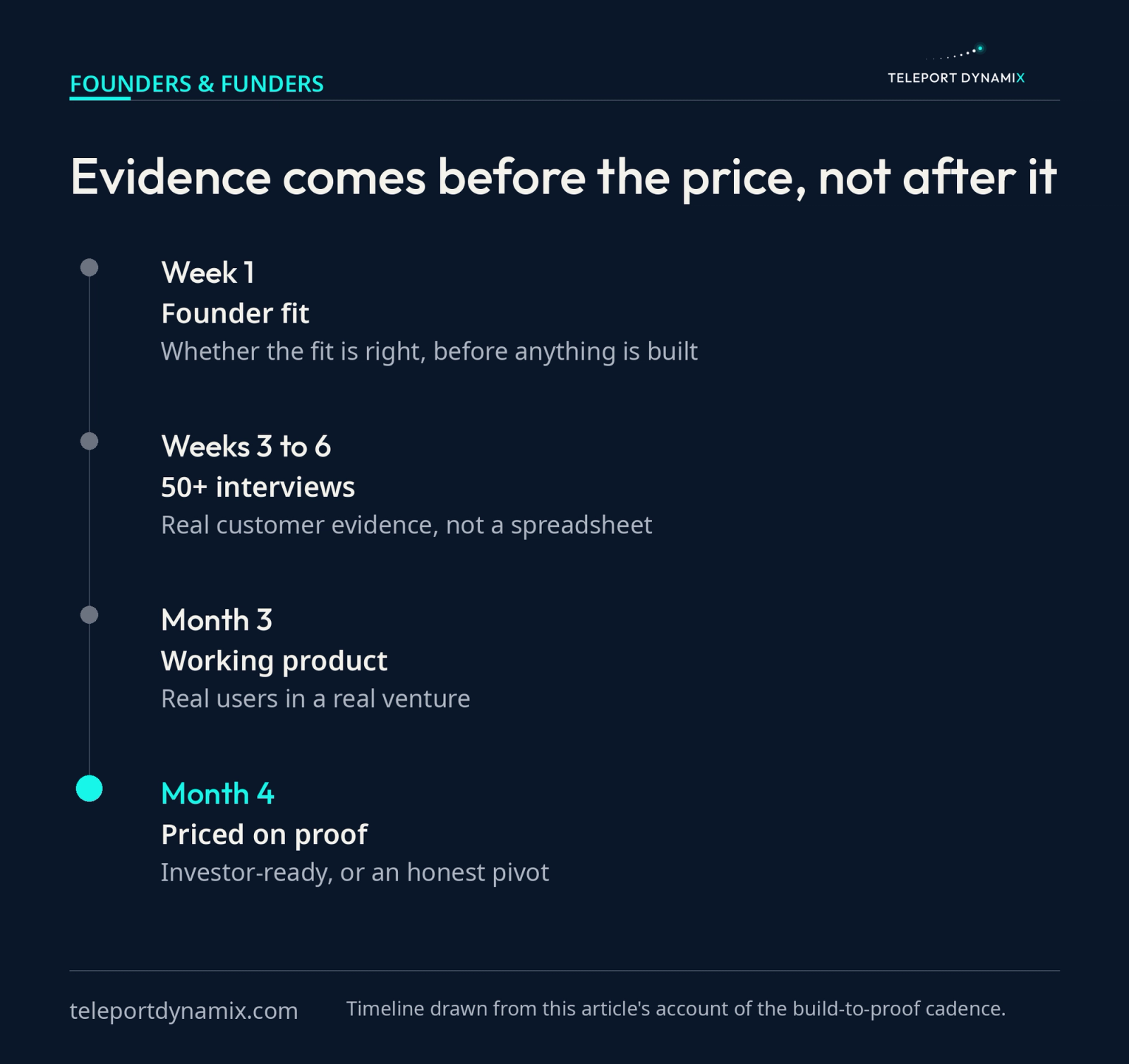
It is also why we build to proof before we price anything. Fifty or more real customer interviews in weeks 3 to 6, a working product with real users by month 3, investor-ready or an honest pivot by month 4. That is the process, and it exists because evidence is the only thing that makes a number defensible. Whether the fit is right for you is a conversation worth having in week one.
What this looks like when it works
Good pricing is unglamorous, and the founders who do it well are usually the ones who can explain the number in one sentence without touching a model.
The number is a consequence of two decisions
They know what the round buys, so they know what it costs. They know the ownership they are prepared to sell, so they know the price. The evidence is already there when the conversation starts, which means the number is being justified rather than invented.
Accelerator programs see hundreds of these conversations a year, and the ones that publish their own standard terms put the structure in front of you before you apply rather than after you have fallen in love with the headline. A well-priced round is a cheaper round for everyone at the table, the fund included, which is why the investors who do this all day are the least interested in talking you up.
The founder can still say no
That is the whole point of not overreaching. A number you can defend leaves you with a company you still control, a team whose options are worth something, and a next round you can raise on your own timetable.
The investors we sit beside know why we hold equity across every venture on the line rather than billing for the work. The best pre-raise work often has nothing to do with the number at all: two weeks inside the advisory practice taking recoverable spend off the burn is capital you do not have to sell anything to get. If you want to argue about your own number with someone who is diluted next to you, start the conversation.
The number is not the trophy. The company underneath it is.
Frequently Asked Questions
How to calculate the valuation of a startup?
You do not calculate it at the earliest stages, you derive it. Take the cash you need to reach your next piece of proof and divide it by the ownership share you are prepared to sell, and the result is your post-money valuation. Models like scorecard and Berkus structure the conversation, but they do not settle it.
How much is a business worth with $500,000 in sales?
Margin, growth rate and retention decide it, and the sales figure barely narrows the range. A business with 500,000 of high-margin recurring revenue growing quickly is worth several times one with the same sales in low-margin one-off work. Buyers price how durable the revenue is, never the headline alone.
Are startups valued at 3 times profit?
Rarely, because venture-backed startups are usually unprofitable by design and get priced on growth, retention and market size instead. A multiple of profit suits a stable small business with predictable earnings and a local buyer. Who is buying decides which method applies, and at pre-seed there is no profit to multiply.
What happens to a SAFE cap when the priced round arrives?
The cap converts into equity at the priced round, normally at whichever price is lower, the cap or the round. Stack several SAFEs at several caps and the combined dilution only becomes visible on conversion day. Put every instrument into one sheet and convert them at the round you actually plan to raise.
Who pays for the option pool in a funding round?
Existing shareholders pay, including you. The pool is almost always created or topped up inside the pre-money valuation, so it dilutes the founders and earlier investors before the new money lands. Negotiating the pool into the post-money, or sizing it to your real hiring plan, recovers value the headline valuation never shows.
Is a high startup valuation always good?
No, a high valuation sets the bar you have to clear at the next round. If your traction does not catch up with the number, you face a down round, which triggers anti-dilution provisions, leaves employee options underwater and makes hiring harder. Take the number you can defend with evidence in eighteen months.
Continue Reading:
More In This Series:
- Startup Fundraising Is a Purchase, Not a Milestone
- How to Raise a Seed Round Without Losing the Company
- Series A Fundraising Buys a Different Kind of Proof
- Pitch Deck Is a Trailer, Not the Film Investors Buy
- How to Pitch Investors When They Are Triaging You
More from Teleport Dynamix:
- Hospitality Software Was Built for Someone Else
- Cloud Cost Optimization Is Engineering, Not Billing
- FinOps Is an Operating Discipline, Not a Cost Tool
- Hospitality Management Platform Built for the Shift
Explore the Insights Categories:


