


A seed round buys 18 to 24 months to make one specific thing true, and everything else about the raise is downstream of naming that thing.
Thirty-nine percent of startups were running on less than six months of cash in 2023, according to Kruze Consulting's runway data, while the average company held around 22 months. That gap is the whole subject of this piece. The founders in the first group are about to raise badly, and the reason has almost nothing to do with their deck.
Seed money buys time. Time is only worth what you make true inside it. A round that funds 18 months of activity and ends with a slightly bigger version of the same uncertainty was a bad purchase at any valuation.
We write this from the wrong side of the table, or the right one, depending on your view. Teleport Dynamix co-founds ventures and holds equity in them, so when a company we build raises a seed round, we get diluted next to the founder. This is the second chapter in a six-part series that starts from one idea, that startup fundraising is a purchase, not a milestone, and the seed round is the chapter where that damage stays invisible for two years.
Key takeaways
- Seed capital is not a prize. It is a purchase of time, priced in permanent ownership, and the time is worthless unless it buys a nameable fact.
- Raising more is not free. Every extra month of runway is bought with equity you cannot buy back, and it lifts the bar you must clear at Series A.
- SAFEs feel cheap because the dilution is invisible until conversion. It is not smaller. It is later.
- Founders negotiate valuation. Investors negotiate ownership. Only one of those two numbers still matters when the cap table is settled.
- At seed, an investor is underwriting the team and its rate of learning, not the model. Evidence of learning is the only asset you can build before the money arrives.
Seed money buys time, and the time has to buy a specific fact
Ask a founder what they are raising and you get a number. Ask what the number is for and you usually get a list of activities: hire two engineers, build the roadmap, start marketing.
Activities are not evidence. Evidence is a sentence that will be true in 18 months and is not true now.
That distinction is easier to see from where we sit. A co-founder holding equity gets nothing on the day the round closes. What we are waiting for is the day that sentence becomes checkable by someone outside the company, and every month bought in between either serves that day or is spent against it.
Name the milestone before you name the number
Write the sentence first. "Two hundred paying properties, 85% retained at month six, acquired at a cost we measured." Then price it. The round is whatever that sentence costs plus a margin for being wrong, and not a dollar more.
Series A investors are underwriting a repeatable engine, and the benchmarks they hold you to are published in the open. Bessemer's Atlas library and David Skok's long-running work on SaaS metrics are two of the places those bars are written down. Read them before you set the size of the seed, because the seed exists to clear them.
Raising more is not free, and you pay the difference
Extra runway feels like safety. It is closer to a loan you repay in expectations.
Take the round from $1.5 million to $3 million and two things happen. You sell roughly twice the ownership, and you commit to a story that justifies a Series A price built on a bigger seed. There is no version where the extra money quietly disappears.
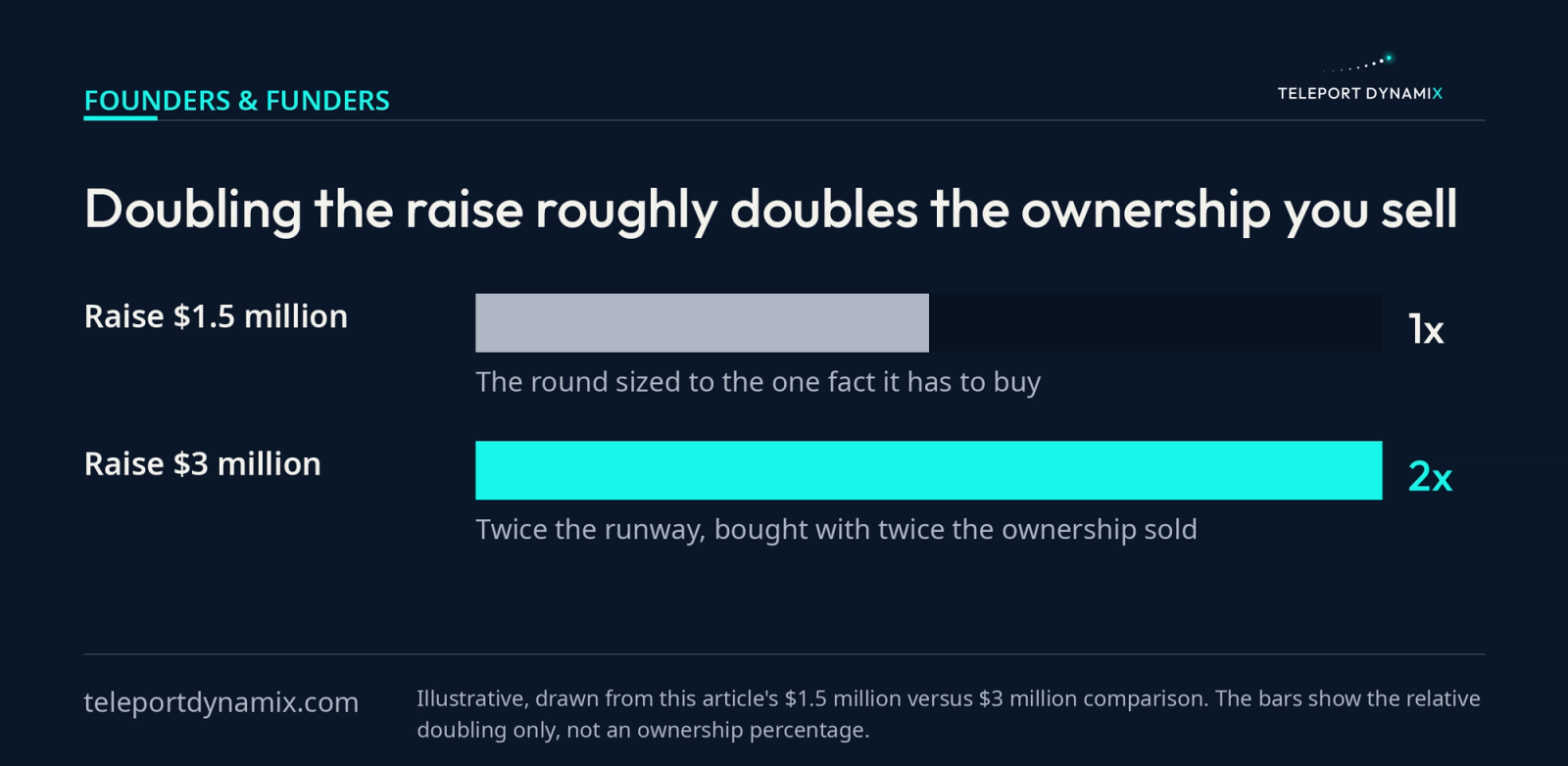
Three routes buy a company the same eighteen months, and each one bills for them differently.
| Way to buy the months | What it costs | What it buys | When it is the right call |
|---|---|---|---|
| Raise the smaller round | A single permanent slice, sold once, at today's price | Enough months to make one named fact true | The fact is named and the burn is already tight |
| Raise double the round | Roughly twice that slice, plus a higher Series A bar | Slack, hiring ahead of the proof, a louder announcement | A real lead is setting terms and the plan needs headcount |
| Cut the infrastructure bill first | Engineering weeks, and no equity at all | Months of runway nobody had to sell anything for | The cloud bill was sized for a scale nobody runs at |
The third row is the one founders skip. The studio's Cloud Cost Audit rests on a published claim: companies running on AWS, GCP or Azure typically have 20 to 40% of cloud spend recoverable through right-sizing, storage, and architecture calibrated to the scale they actually run at.
The argument in cloud cost optimization is engineering, not billing is that same case applied to the infrastructure bill you are about to fund with equity. Equity is the most expensive way anyone has ever paid for an oversized database instance.
Readiness is what a stranger can verify in twenty minutes
Nobody feels ready. The feeling is not the input a seed investor uses. They check a short list of facts they can verify without you in the room, and twenty minutes is usually enough to do it.
Fifty conversations beat one forecast
On our line, weeks 3 to 6 are 50 or more real customer interviews with the actual people who have the actual problem, before there is a product to demo. By month 3 there is a working product with real users on it. By month 4 the venture is either ready to raise or it is honestly redirected. That is the process, and it is shaped that way because everything a seed investor wants to see takes months to accumulate and cannot be assembled at the end.
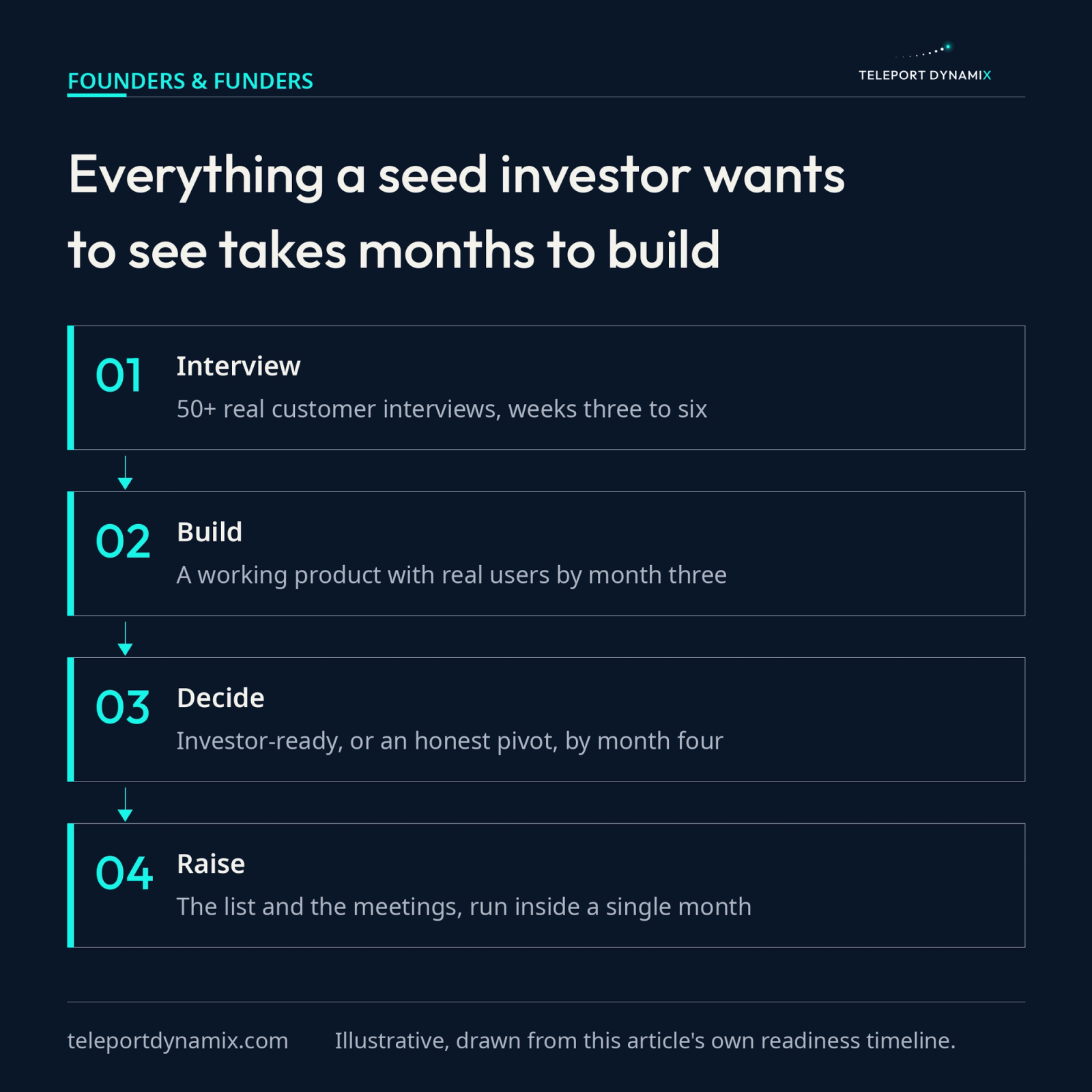
Retention cannot be backfilled. Neither can a cost of acquisition nobody measured. A deck can be assembled in a weekend, which is exactly why it persuades nobody who has done this before.
Month four is the last cheap place to be wrong
What we will not do is take a fee to keep building something the market has already declined. Our equity only pays if the venture does, so a company that raises and then dies takes us down with it, and that posture is the methodology rather than a courtesy extended on brave days.
Stop at month four and the loss is four months. Raise at month four and the company has bought 18 months of institutional commitment to an answer nobody retested since. Sam Altman has written about the asymmetry of upside risk, and seed rounds are where founders invert it: enormous downside risk accepted on a premise, to avoid the small social cost of saying they were wrong.
SAFEs and priced rounds do different things to the same cap table
Both instruments end with an investor owning part of your company. They differ in when you find out how much, and that difference is where founders get hurt.
A SAFE defers the arithmetic, it does not cancel it
Y Combinator publishes the standard SAFE documents for free, and the instrument earned its popularity honestly. It is fast, it is cheap, and it settles nothing you are not ready to settle.
Then the conversions stack. Four SAFEs at four different caps, written over 14 months, all convert at the Series A along with a fresh option pool, and the founder discovers their ownership on the day it is too late to change it. The dilution was never smaller. It was invisible.
Model every SAFE the day you sign it, as if it converted tomorrow. If you cannot bear to look at the number, that is the number.
Priced rounds cost time and buy clarity
A priced round brings a board seat, information rights and a preference stack with it. Law firms that paper these rounds at volume, Cooley among them, publish the term data quarterly, and the terms move more than the prices do.
Three instruments close a seed round, and they differ mainly in when the dilution becomes visible.
| Instrument | What you agree on now | When the dilution shows up | Right when |
|---|---|---|---|
| SAFE | A cap and a discount, with no price set for the company | At the next priced round, every conversion at once | The round is small and no lead is setting terms |
| Priced round | A valuation, with real shares issued against it | On the day the round closes | A large check, a real lead, terms worth papering |
| Convertible note | A cap, a discount, interest, and a maturity date | At conversion, or as a debt that falls due | A bridge between rounds, where the deadline is the point |
Sitting on a cap table, the instrument matters far less than whether the founder can say what it does to their own ownership without opening a spreadsheet. Raising 400,000 from five angels and spending 5% of it on legal fees is a real error. So is stacking four caps nobody ever modeled.
Valuation is the number founders optimize, dilution is the number that pays them
Founders announce a valuation. Investors book an ownership percentage. Those are two sentences describing the same event, and only one of them survives contact with the next round. The price itself is something you have to grow into, not a trophy you carry away from the seed.
Ownership is decided first, the price is derived
A fund that must own 15% to make its model work, writing a 2 million check, has already priced you at 13.3 million post-money before anyone opened a spreadsheet. The narrative arrived afterward to justify the arithmetic.
Which means the negotiation you think you are having about your valuation is usually a negotiation about their ownership target, and it is far more productive to talk about that directly.
A high seed price is a bill that arrives at Series A
Price the seed aggressively and you have set the growth rate you must deliver in 18 months, in public, in front of the same people. Miss it and the next conversation is about a flat round, a bridge or a down round, and every one of those is worse than the slightly cheaper seed you refused. What that next round actually tests is a different thing entirely, which is the argument in Series A fundraising buys a different kind of proof.
Investors and operators have been writing this down for 20 years, from Fred Wilson's archives to Tomasz Tunguz's data posts. The pattern is consistent and founders keep ignoring it, because a bigger number feels like a bigger company.
Our own equity model is published for the same reason. A full-time founder co-building with us keeps 65 to 75%. If the seed is negotiated well, three things are still true when the Series A arrives:
- Largest holder. That founder is still the biggest line on the cap table when the next money lands.
- Still in the chair. Control follows ownership, so the roadmap is still theirs to set.
- Free to refuse. Ownership is the ability to say no to a term, a hire, or a buyer.
A founder holding the largest line can still lose an argument. A founder without one never gets to have it.
Run the raise as one process with a hard stop, not a trickle
Fundraising is a phase. Enter it, finish it, leave it. The failure mode is a raise that dribbles across five months while the product stops moving.
We watch this from an unusual seat. The round dilutes us on the same line it dilutes the founder, and our slice is priced by what the product proves, so a raise that runs for five months costs us the dilution and four months of stalled proof on top of it. That arithmetic is why the studio treats the raise as a fixed window rather than an open state.
The fund list gets shorter before it gets used
Sixty to a hundred names is the starting list we work from, and that is our own working figure rather than a published benchmark. The list earns its keep in the names it removes. Four cuts do the work quickly:
- Stage. A fund that leads Series A rounds will not lead your seed, whatever the intro promised.
- Check size. A fund whose typical entry is four times your round will not write a quarter of it.
- Sector. A fund with no thesis in your space converts a warm introduction into nothing at all.
- Competitor conflict. A fund already behind a direct rival cannot take the meeting in good faith.
From the cap table the cost of a bad name on that list is easy to price. Every meeting that was never going to convert is a week the product did not move, and the product is the only thing our equity is priced on. European seed funds publish their theses openly, Seedcamp and Speedinvest among them, and the Antler blog is explicit about what pre-seed and seed checks are actually buying. Read them and cut half the list before a warm intro goes to a fund that was never going to invest.
Who makes the introduction is an incentive question
The best introduction comes from a founder that partner has already made money with. The second best comes from someone whose own money is already inside the company, because the motive prices itself: a shareholder asking you to look at a round is asking you to price something that dilutes them too. We hold equity in the ventures we co-build, so that is the first thing we read in an introduction rather than the name on it.
A cold email carries none of that signal and converts accordingly, which is an argument for spending the warm ones where the fit is highest rather than where the relationship is oldest. Run the meetings in parallel, inside a three to four week window, so the fifth conversation is competing with the first rather than learning from it.
Investors triage continuously against a market that is public in TechCrunch and Sifted, and a founder in no hurry reads as a founder nobody else wants. Because they are triaging, the meeting itself has to be built for a distracted reader, which is the subject of how to pitch investors when they are triaging you.
Investors at seed underwrite the team and the rate of learning
Nobody believes your model. Nobody has believed a seed-stage financial model in the history of venture capital, including the partner who asked you to send it.
At seed there is no engine to inspect, so the diligence lands on the founders and on how fast they convert reality into changed behavior. Startup Genome's research keeps arriving in the same place: the companies that survive are the ones that learned faster, not the ones that planned better.
Rate of learning is testable, and four artifacts carry the evidence for it. Each one has a moment in the build where it had to start.
| Evidence | What a stranger can check in twenty minutes | When it had to start |
|---|---|---|
| Fifty customer interviews | Names, dates, and what changed in the plan after each | Weeks three to six, before a product exists |
| Real users on a shipped product | Sign-ups, usage, and who came back in month two | By month three of the build |
| A measured cost of acquisition | The channel, the spend, and the number it produced | The first day money went into a channel |
| A documented wrong turn | What you believed, when you stopped, what replaced it | The moment the evidence contradicted the plan |
None of the four is expensive to produce. All four are slow, and slowness is the whole difficulty. Nothing in that table can be bought in the month before a raise, which is the real reason a seed process that starts with the deck starts eight months late.
A founder who says "we were wrong about this in March, and here is what we changed" is showing the only asset that exists at this stage. Which is why the studio takes equity rather than fees. We are underwriting the same thing they are, with the same instrument, and the investor view of that is simply that our money is where our advice is.
What this looks like when it works
Watched from the cap table, a good seed raise is undramatic to the point of dull, and the dullness is the signal. A few things are already true before it starts:
- The evidence is in hand. Retention, a measured cost of acquisition and real users exist before the first meeting is booked.
- The fact fits in one sentence. The founder can name what the round buys without reaching for a slide.
- The process is compressed. The list is built, the meetings run inside a month, and two funds want the same allocation, which is the only mechanism that has ever set a fair price.
Then the money lands and nothing changes about the plan, because the plan was made before the money and did not depend on it. Whether that way of working suits you at all is worth deciding before the money is on the table, not after.
Eighteen months later the sentence is true. That is the whole job.
Frequently Asked Questions
What does seed funding actually mean?
Seed funding is the first substantial outside capital a startup raises, usually to fund 18 to 24 months of work toward a specific proof point. Investors buy newly issued equity, or a right to it via a SAFE. The money is spent and gone. The ownership sold is permanent.
Do you pay back seed funding?
No, equity investment is not a loan and carries no repayment obligation. Investors are repaid only if the company is acquired or goes public, and their liquidation preference sits ahead of founders in that payout. Convertible notes are the exception, since they are technically debt until they convert.
Who qualifies for seed funding?
Teams that can show evidence rather than intent. In practice that means a working product with real users, measured retention, a cost of acquisition you calculated rather than estimated, and founders who can explain what they got wrong and changed. Institutional investors also usually require a C corporation before wiring funds.
Why is seed funding riskiest?
Because there is no engine to inspect yet. At seed the product may work and the market may still not exist, so the investor is underwriting the team and its rate of learning rather than a proven model. Failure rates are highest here, which is why seed investors price for ownership.
How much should a startup founder pay himself?
Enough to stop worrying about rent, and no more. Seed-stage founder salaries typically sit well below market for the role, because every dollar of salary is runway you sold equity to buy. Underpaying yourself into distraction is a false economy, so set a number and stop negotiating with yourself.
Should you raise on a SAFE or a priced seed round?
Take a SAFE when the round is small, there is no lead investor, and legal costs would eat a real share of the money. Take a priced round when the check is large, a lead is setting terms, and you want the cap table settled. Model the dilution either way.
Continue Reading:
More In This Series:
- Startup Fundraising Is a Purchase, Not a Milestone
- Series A Fundraising Buys a Different Kind of Proof
- Pitch Deck Is a Trailer, Not the Film Investors Buy
- How to Pitch Investors When They Are Triaging You
- Startup Valuation Is a Price You Have to Grow Into
More from Teleport Dynamix:
- Hospitality Software Was Built for Someone Else
- Cloud Cost Optimization Is Engineering, Not Billing
- FinOps Is an Operating Discipline, Not a Cost Tool
- Hospitality Management Platform Built for the Shift
Explore the Insights Categories:


