


Raising money sells a permanent piece of your company to buy a temporary amount of time, and the only question that decides whether the round was worth doing is what the time bought.
Decks, warm intros, term sheets, and the announcement post are the packaging of startup fundraising, and founders spend months on them. Packaging expires the week the money lands. The exchange underneath it sits on the cap table until the company is sold or shut.
Founders are taught to treat the close as a finish line. Judge it the way you judge any purchase, by what it bought.
We say that from an unusual seat. Teleport Dynamix co-founds companies and takes equity in them, so when a venture we build raises, we are diluted alongside the founder rather than applauding from the other side of the table. That seat changes which questions look important, and this piece, the first of six in this series, is the map of them.
Key takeaways
- Startup fundraising is a trade, not an achievement. Equity leaves permanently. Cash arrives temporarily and gets spent.
- Price is one line on a term sheet. The lines nobody negotiates decide what happens when the plan stops working.
- Proof sets the timing of a raise, not the calendar. Teleport Dynamix builds from idea to investor-ready in four months for exactly that reason.
- The decisions come in an order: what the money buys, what shape the round takes, what the number is, what the argument is, how the room is run. Founders usually run that order backwards.
- Waste is quiet. Cloud spend nobody audits, hiring ahead of proof, and a headcount plan built for a demand curve that has not been demonstrated.
Equity leaves permanently, cash does not
Money raised gets spent. Ownership sold does not come back. That asymmetry is the reason a round deserves more scrutiny than a hiring decision ten times its size, and it is the reason founders who are excellent at everything else get this one wrong.
What a term sheet actually hands over
Shares are the visible part. The rest of the sale is a set of rights that outlast the plan you raised for, agreed in the same week, in the same document, with a fraction of the argument.
Five lines on a term sheet, compared by what each one decides, whose interest it protects, and when it starts to bite.
| Term sheet line | What it decides | Whose interest it protects | When it bites |
|---|---|---|---|
| Valuation | Ownership sold in this round | Both sides, briefly | At the next round, as a bar to clear |
| Liquidation preference | Order of payment in any exit | The investor | At exit, and hardest when the exit is modest |
| Control provisions | Who can veto a change of direction | The investor | The first time you want to pivot or sell |
| Board seat | Who sits in the room when the plan changes | The investor | Every quarter, for the life of the company |
| Information rights | Reporting you owe, and on whose schedule | The investor | Every month, starting the week you close |
Brad Feld has been publishing a clause-by-clause reading of the term sheet for well over a decade, and the reason it stays useful is that founders keep negotiating the valuation and signing everything else.
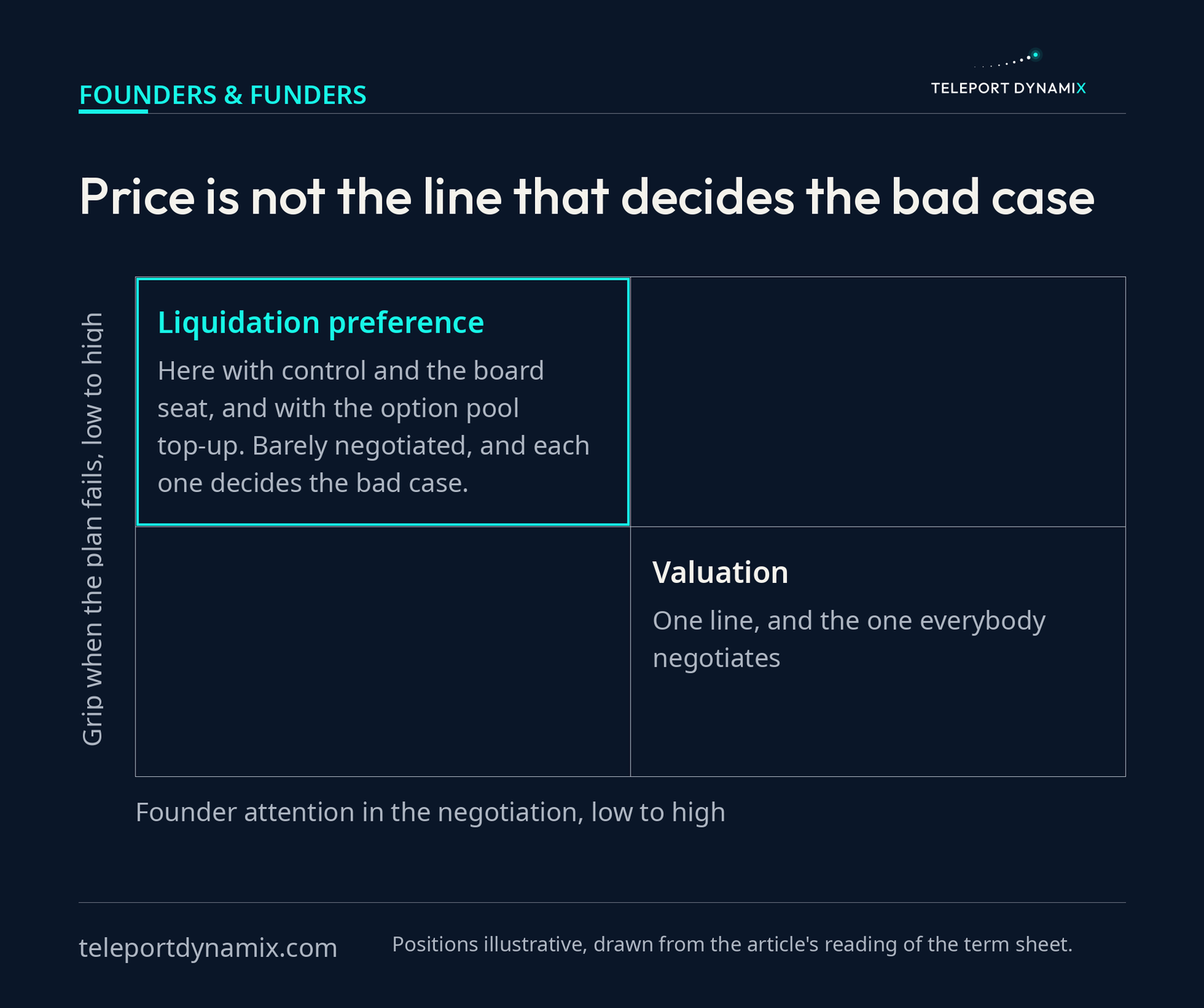
Things go badly more often than they go well. Build for the bad case.
The number on the wire is the least interesting number
Founders announce the amount raised. Investors model the ownership acquired. Those are two sentences about the same event, and only one of them still matters in three years.
Every round writes on top of the last one. The option pool you top up to close this round dilutes the existing holders before the new investor's money touches anything, which is why a tool like Index Ventures' option plan work exists at all: the pool is a real cost, paid by you, presented as housekeeping.
Dilution is felt late and understood too late
Nobody feels a seed round. You still own the large number, the company is small, and the arithmetic is easy to wave away as a rounding error against a big future.
Then the Series A arrives with a new pool, a pro rata allocation, and a preference stack, and the founder who never modeled the compounding discovers they are running a company they control on sufferance. Model the second round before you sign the first. The arithmetic takes an afternoon and it is the only way to see the position you are actually buying.
Sitting on the cap table changes which questions matter
Ownership on a cap table is a position nobody exits by finishing the work. Ours moves with the founder's at every round and in every outcome, which is why the three things we watch during a raise are not the three things that get announced.
The splits we have published, and what they actually cost
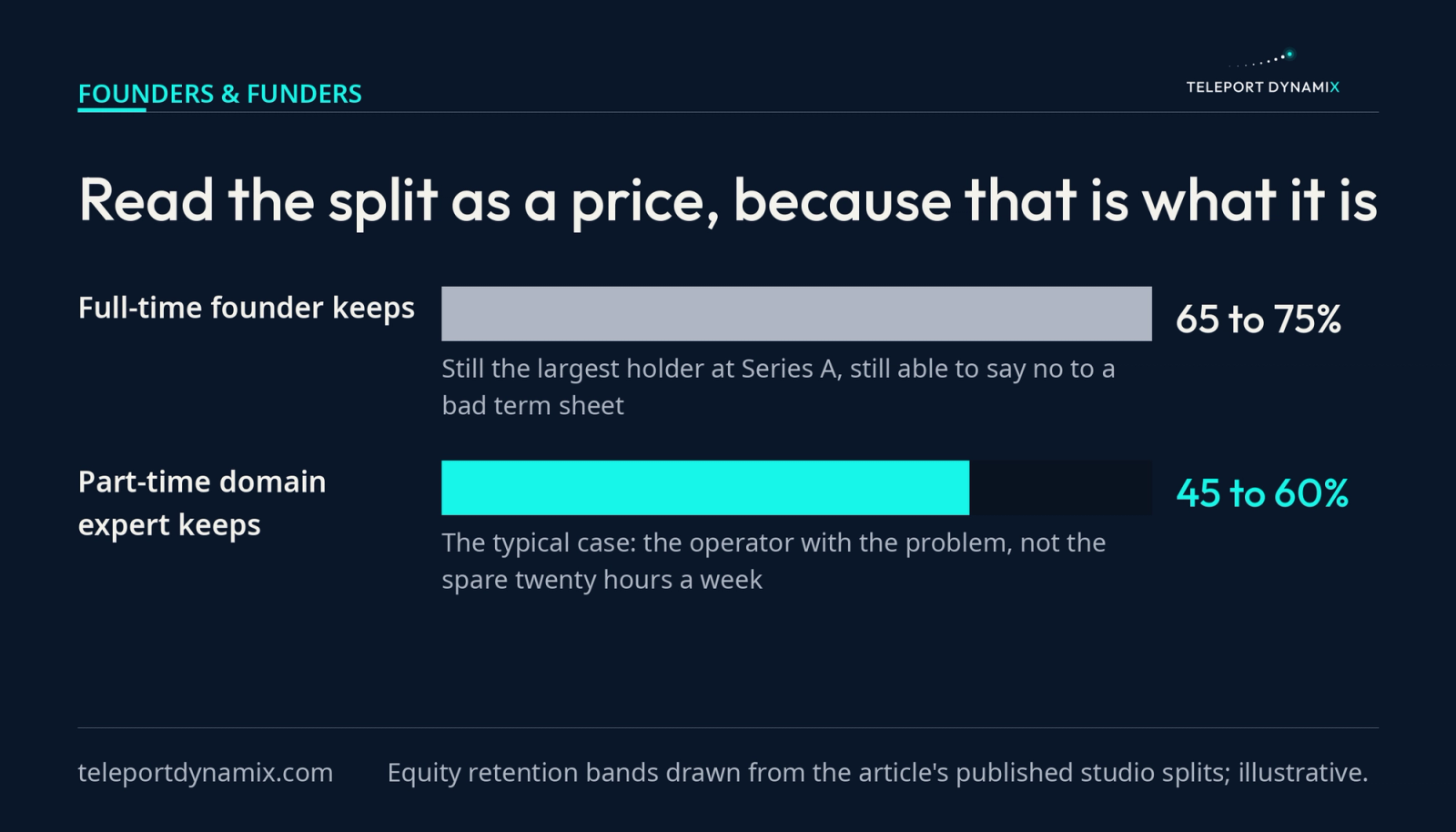
Our equity model is public because it has to be. A full-time founder co-building with us keeps 65 to 75%, so we take 25 to 35%. A part-time domain expert, the operator who has the problem but not the twenty spare hours a week, keeps 45 to 60%, so we take 40 to 55%. That second case is the typical one.
Read those numbers as a price, because that is what they are. Every point we hold is a point that dilutes with you at every future round. We are a shareholder on your cap table, and a shareholder cannot invoice their way out of a bad outcome.
Holding equity is a different incentive from billing hours
An agency is finished when the invoice clears. That is the right tool when you know exactly what to build and you need hands to build it, and it is a genuinely efficient way to buy execution.
But an agency has no exposure to what happens next. We only win if the venture wins, which means a product that does not work is our loss too. It also means we are ruthless in a way a vendor cannot afford to be: we would rather tell you the market is not there at month four than take a fee for nine more months of building the wrong thing. That posture is the whole methodology, and self-interest is what makes it reliable.
Why founders should ask their partners what they own
Whenever anyone offers to help you raise, the useful question is what happens to them if the round succeeds and the company still fails eighteen months later. Ask it out loud and the room sorts itself in about a minute.
Four kinds of help show up around a raise, compared by how each one gets paid and whether the payment survives a failure a year later.
| Who is helping | How they get paid | Exposed if the company fails later? |
|---|---|---|
| Advisor | Fees or a small grant, up front | No |
| Consultant or placement agent | A fee when the round closes | No |
| Investor | Only when the company exits | Yes |
| The studio | Equity, diluted alongside you | Yes |
We do not get paid either way, and neither do the investors we sit beside. The investor view of the studio is simply that we hold equity across every venture on the line, so we are betting on ourselves repeatedly, in public, where it can be checked.
That is also why we are unsentimental about the split itself. A studio that quietly takes 60% of a founder's company has not aligned anything, it has just moved the problem, because a founder without meaningful ownership stops behaving like an owner somewhere around the second hard year. The number has to leave the person doing the daily work with enough of the company to keep doing it. We published our bands so that conversation happens in week one rather than in a term sheet negotiation two years later.
What we watch when a venture we own goes out to raise
The founder watches the term sheet arrive. We watch three things, and the headline price is not one of them.
First, the fully diluted position after the option pool is topped up, because that is the ownership that actually exists once the round closes, and ours moves in the same direction as yours.
Second, the preference stack, because it decides who gets paid in the outcomes nobody puts in the deck, and a modest exit can pay the preference and leave the common holders with a handshake.
Third, the growth rate the number commits the company to. A high valuation sets a rate the company now has to hit, and if that rate turns out to be unreachable, the flat round or the down round that follows lands on our stake exactly as hard as it lands on yours. We are co-signing the price alongside you.
Proof sets the timing of a raise
Founders raise when the runway gets frightening. That is the worst possible trigger, because a frightened seller is a bad seller, and the market can smell it through a screen.
Four months, and what has to be true at the end of them
We run a line from idea to investor-ready in four months, and the shape of it is deliberate. Weeks 3 to 6 are 50 or more real customer interviews, the actual people with the actual problem, before there is anything to demo. A working product with real users by month 3. Investor-ready or an honest pivot by month 4.
That is the process, and every step in it is a condition that has to become true before the next one starts.
Investor-ready is a state, not a feeling
Being investor-ready means you can show an investor something they cannot argue with:
- Users who came back without being asked, which is retention rather than a launch spike.
- A cost to acquire them that you measured rather than estimated, and can defend line by line.
- A retention curve that flattens instead of falling to zero once the novelty wears off.
Andreessen Horowitz publishes the metrics investors actually ask about, and the striking thing about that list is how little of it is about the future. It is nearly all evidence of something that has already happened. A deck is an argument. Evidence is what settles it.
An honest pivot is the cheapest thing on the board
Running out of cash and failing to raise new capital sits at the top of CB Insights' analysis of why startups die, which reads like a funding problem and almost never is. The money runs out because the thing being funded was not working, and everyone involved agreed to find out slowly.
Paul Graham's standing advice on raising money is to treat fundraising as a phase you get through and then leave, precisely because a company that is half-raising is not really doing anything else. Extend that logic one step. A fast no on the idea is worth more than a slow yes on the round.
We would rather kill a venture at month four than fund it into month nine. That is arithmetic, and we are paying for it too.
Decisions in a raise come in an order, and founders run it backwards
Here is the map. Five decisions, in causal order, and each one is a component that gets taken apart properly elsewhere in this series. Founders typically start at decision four, because the deck is the only part of the raise that feels like work you can do on a Tuesday.

First, decide what the money buys
Not how much. What for. A round is a purchase of a specific piece of evidence: the evidence that unlocks the next round, or the evidence that proves you never need one.
Write down the two or three facts that will be true when this money is spent, and then price them. Y Combinator's seed fundraising guide puts the same idea in blunter terms: raise enough to reach a meaningful milestone, and no more, because everything above that number is ownership you sold for comfort.
Second, decide the shape of the round
Pre-seed, seed, Series A, and everything with a hyphen in it get filed as rungs on one ladder. They are separate products, and the vocabulary they share hides how little else they have in common.
Four round shapes, compared by what the cash buys, what the investor is underwriting, and when the round makes sense.
| Round | What the cash buys | What the investor underwrites | When to run it |
|---|---|---|---|
| Pre-seed | Time to find the insight and build a first thing | Founder and problem, before evidence exists | Nothing works yet and the question is still open |
| Seed | Proof that people want it and come back | Insight, team, and the first signs of retention | Users exist and their usage is starting to repeat |
| Series A | Fuel for an engine that already turns | Repeatable acquisition, retention, and unit economics | Growth is predictable enough to forecast |
| Bridge | Months to reach a milestone you missed | Whether the miss was timing or thesis | Proof is close and the runway is not |
Two satellites in this cluster take the middle two apart properly: how to raise a seed round without losing the company on the round bought for insight, and how Series A fundraising buys a different kind of proof on the one bought for a working engine. Running a Series A process on a seed story is the expensive version of getting this wrong, because diligence exposes the gap in week two and a process cannot be restarted.
Third, decide the number
Valuation is the output of a negotiation about ownership, and the ownership gets decided first. Quality never enters that arithmetic. An investor who needs 20% and can write a $2 million check has already priced you at 10 million, whatever the narrative says.
The number is also a liability. Price the round high enough and you commit to a growth rate that must be true at the next round, or you are having a very different conversation about a down round, which is why a startup valuation is a price you have to grow into rather than a trophy you are handed. Banks that sit in the middle of this market, like SVB on raising capital, see both sides of that trade at scale.
Fourth, build the argument
Only now does the deck matter, and it matters as a compression of the three decisions above rather than as a design exercise. Sequoia's own guidance on writing the business plan is a short list of headings starting with the problem, which is a quiet indictment of every forty-slide deck that starts with the market size.
The deck is not the argument. The deck is a container for an argument you should be able to make without it, which is the case the pitch deck is a trailer, not the film investors buy makes in full.
Fifth, run the room
Pitching is a live process with a shape: parallel conversations, a real timeline, and a hard stop. Investors have to keep moving; the ongoing flow of the funding market is public, and any partner you meet is triaging against it, which is exactly why you pitch investors when they are triaging you rather than when you have their undivided attention.
The founders who do this badly run their investor conversations in series, so the fifth meeting learns nothing from the first, and by the time a term sheet arrives there is no competing offer left to price it against.
Of those five decisions, the first is the only one nobody can do for you.
Waste is quiet, and it eats the round from the inside
Nobody wastes a round in one go. It leaks, in ways that look responsible at the time, and the leak is almost always in the place nobody is auditing because it is nobody's job.
Burn you can see, and burn you do not
Salaries you feel. Infrastructure you do not. Our own Cloud Cost Audit puts the recoverable share of a cloud bill at 20 to 40% for companies running on AWS, GCP or Azure, through configuration adjustments, resource right-sizing, storage optimization, and architecture calibrated to current scale rather than the scale on the slide.
That is money you already own, and it does not dilute anyone. Founders about to raise routinely skip it, then sell equity to cover a number that two weeks of work inside the advisory practice would have taken off the burn permanently. Selling ownership to fund an overprovisioned database is a real thing that happens, and it happens quietly.
Hiring ahead of the proof
Headcount is the fastest way to convert a round into an obligation. Every hire made before the thing they were hired to scale is proven is a bet that the demand curve exists, made with money you cannot get back.
Growth-stage operators write about this endlessly on sites like SaaStr, and the pattern is always the same. The team was built for the plan. The plan was wrong. The team is still there.
The company nobody wanted, fully funded
Worst case is having enough money to keep building something the market never asked for, for long enough that walking away becomes unthinkable. Running out is the kinder outcome.
Capital buys time, and time applied to a false premise produces a bigger false premise. Keeping investors genuinely informed while you find that out is what disciplined investor updates are for, and the founders who write honest ones tend to discover the problem earlier, because writing a sentence down makes it harder to believe.
A funded company that is wrong is harder to stop than an unfunded one. The money creates obligations, the obligations create a team, the team creates a plan, and the plan quietly becomes the reason nobody revisits the premise underneath it. Every month of runway is another month of institutional commitment to an answer nobody has retested.
That is the argument for finding out early, while finding out is still cheap.
What this looks like when it works
A good raise is unremarkable from the outside and slightly boring from the inside, which is the tell. Nothing dramatic happens in the room, because the work that would have made it dramatic was done eighteen months earlier.
The evidence arrives before the process starts
Month 4, and the product is in front of real users who came back without being asked. The interviews are done. The cost of getting a user is a measured number rather than a hopeful one, and the founder can defend it without a slide.
The conversations then take weeks rather than quarters, because the founder is not asking anyone to believe a forecast. They are asking them to look at something that already happened. That is the difference between a pitch and a demonstration, and investors can tell instantly.
The founder still owns the company afterward
Full-time founders on our line hold 65 to 75% before any outside round. Dilute that sensibly at seed and the founder is still the largest holder at Series A, still running the company, and still able to say no to a bad term sheet, which is the only leverage that has ever mattered in this business.
Ownership is not vanity. Ownership is the ability to refuse. Whether that fit is right for you is worth deciding before the money is on the table, not after.
A round that buys the right evidence leaves the founder able to keep going without immediately needing another one. Everything else is packaging.
Frequently Asked Questions
How does startup fundraising work?
Startup fundraising works by selling newly issued shares to investors in exchange for cash. Investors negotiate the ownership percentage they need, and the valuation is the output of that negotiation. The cash funds a fixed period of operating time, and the equity is gone permanently, which is the trade at the center of every round.
How can I raise funding for my startup?
Start by defining what the money buys: the specific evidence that unlocks the next round. Then choose the round shape, agree the ownership you are willing to sell, build an argument from what you can already prove, and run investor conversations in parallel with a hard deadline rather than one at a time.
What matters more than valuation on a term sheet?
Liquidation preference, control provisions, and the board seat matter more than valuation, because they decide what happens when the plan stops working. Valuation sets the ownership sold in one round. The other lines govern every fork in the road afterward, and founders routinely sign them without negotiating a word.
Is 1% equity in a startup good?
Depends entirely on the company's trajectory and the stage the equity was granted at. One percent of a company that reaches a meaningful exit is significant. One percent of a company that never raises again is worth nothing. Judge the vesting terms, the preference stack ahead of you, and the realistic outcome.
Can a new LLC get funding?
Yes, though institutional venture investors almost always require a C corporation before they will invest, because their funds cannot easily hold pass-through entities. An LLC can raise from angels, revenue-based lenders, grants or crowdfunding, but a priced venture round usually means converting the structure first.
How far ahead should I prepare for a raise?
Prepare from the moment you start building, because the evidence investors want takes months to generate and cannot be assembled retroactively. Our own line runs from idea to investor-ready in four months, with customer interviews in weeks 3 to 6 and real users by month 3. The raise itself then takes weeks.
Continue Reading:
More In This Series:
- How to Raise a Seed Round Without Losing the Company
- Series A Fundraising Buys a Different Kind of Proof
- Pitch Deck Is a Trailer, Not the Film Investors Buy
- How to Pitch Investors When They Are Triaging You
- Startup Valuation Is a Price You Have to Grow Into
More from Teleport Dynamix:
- Hospitality Software Was Built for Someone Else
- Cloud Cost Optimization Is Engineering, Not Billing
- FinOps Is an Operating Discipline, Not a Cost Tool
- Hospitality Management Platform Built for the Shift
Explore the Insights Categories:


