


FinOps is not a cost-cutting function, a purchase, or a job for finance. It is how engineers come to see the price of the decisions they are already making.
Cloud bills that climb every quarter read as failure. In a company running FinOps properly they can be the sign the discipline is working, because the number that team manages is not the invoice total. It is what one customer costs to serve.
FinOps is an operating discipline in which engineering, finance and product share accountability for variable cloud spend, so that the cost of a technical decision becomes visible to the person making it, at the moment they make it. That last clause is the whole thing. Everything else is implementation.
This fourth chapter in our cloud cost series is about the discipline that makes that unit number knowable, and about the uncomfortable question of whether you need it yet.
Key takeaways
- FinOps puts engineering, finance and product on the same hook for variable cloud spend, so the price of a design choice reaches the person making it while they are still making it.
- Its target is the best unit economics: cost per customer, per transaction, per tenant, per thousand inferences. The cheapest possible bill is a different and worse goal.
- The FinOps Foundation organizes the work as a repeating lifecycle of inform, optimize and operate. Nearly every program that fails, fails at operate.
- Ownership scales with headcount. At 20 people it is one named engineer and one number. At 200 it is a small central function that enables. Give it veto power and it becomes a queue.
- Showback changes behavior. Chargeback changes budgets, and it starts arguments you may not be ready to have.
Inform, optimize, operate, and the phase where programs quietly die
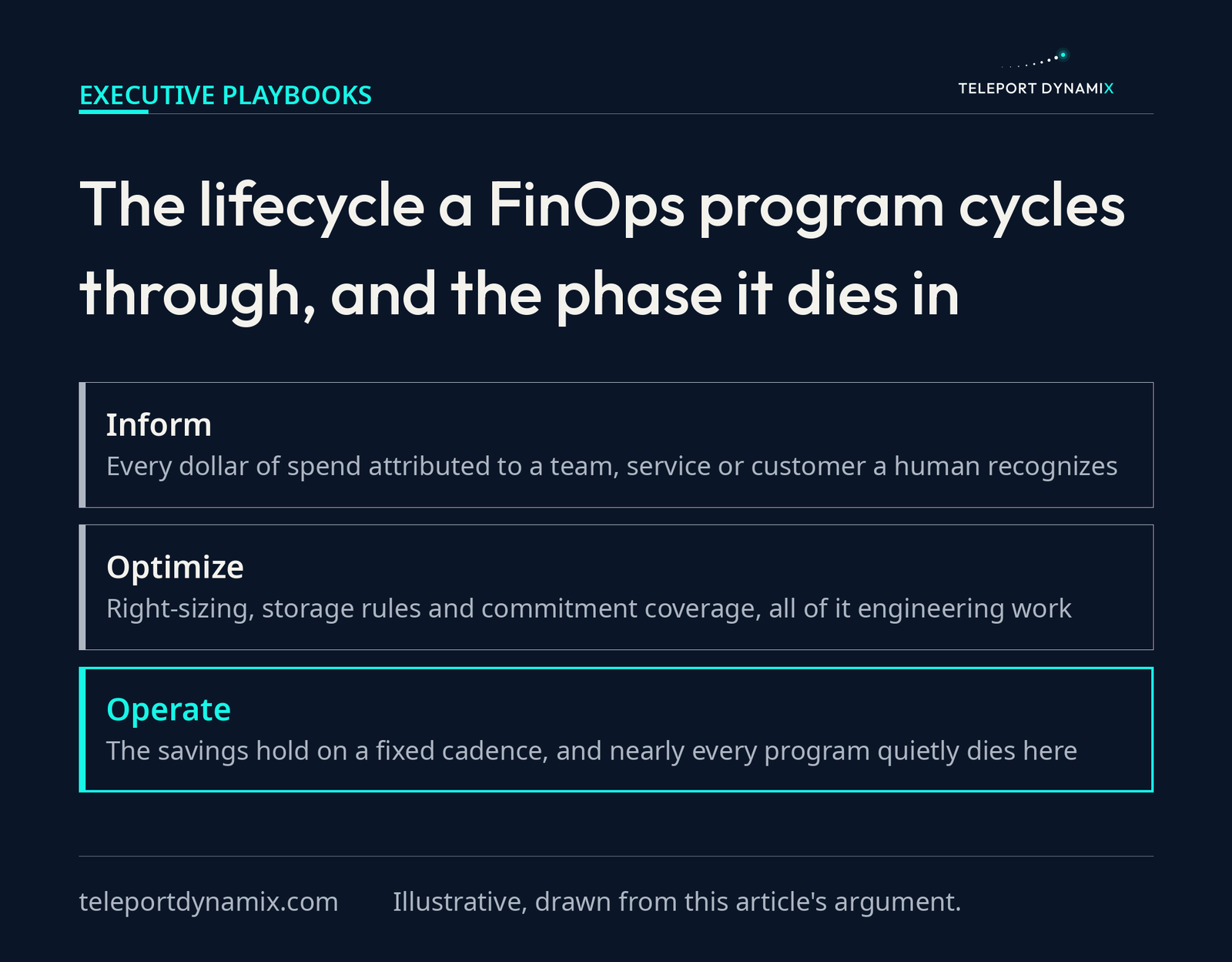
The FinOps Foundation defines the practice as an operational framework and cultural practice that maximizes the business value of cloud, through collaboration between engineering, finance and business teams. It runs as a lifecycle with three phases, and teams cycle through them continuously rather than completing them once.
What are the three phases of FinOps?
Each phase produces a different artifact, sits with a different group, and fails in a different way, which is why a team can be strong at two of them and still lose the savings.
| Phase | What it produces | Who does the work | Where it fails |
|---|---|---|---|
| Inform | Spend attributable to a team, service, product or customer | Platform and infrastructure engineers | Tags added after the fact instead of at provisioning time |
| Optimize | Right-sizing, storage lifecycle rules, schedules, commitment coverage | Engineers, in code or in a console | Finance sets the target but cannot resize the node |
| Operate | Guardrails at provisioning time and a unit cost on a cadence | One named owner with a fixed monthly meeting | Savings hold for a quarter, then quietly reverse |
Naming the phases is easy. Knowing which one you are stuck in is the useful part.
Inform is allocation, and allocation is unglamorous
Every dollar of spend has to land on something a human recognizes. Not "shared infrastructure." Not "platform."
This is the phase people want to skip because it looks like bookkeeping. It is the wiring that makes every later conversation an engineering exercise instead of a negotiation, because you cannot ask a team to reduce a cost it cannot see, and you cannot tell a team its workload is expensive if 30% of the bill sits in a bucket nobody owns.
Enforce tagging at provisioning time in your infrastructure code. The AWS Terraform provider can apply a set of default tags to every resource it creates, so the tag ships with the resource instead of chasing it afterward. A tag policy that depends on people remembering has a half-life of about six weeks.
Optimize is engineering work with a finance label on it
Optimize is where the money actually moves, and every lever in the phase is pulled by an engineer, in code or in a console. Every one of them carries engineering risk, which is why the finance department cannot own this part. The provider-specific version of that list runs long enough to be its own piece, which is what an AWS cost optimization checklist for scaling teams works through line by line.
Which is also why the finance-led version of FinOps stalls so reliably. Finance can set the target and hold the cadence. It cannot resize the node.
Operate is where nearly every program dies
Operate means the savings hold. It means the autoscaling ceiling that got raised during an incident in March comes back down in April, and that somebody notices in April rather than at the next invoice.
This is the part that gets skipped. The cleanup happens, the graph dips, everyone congratulates themselves, and eighteen months later the bill has grown back into the exact shape of the org chart. Cost work has a half-life, because the pressures that created the waste are still running.
The discipline is not the cleanup. The discipline is the part after.
Tooling shows you the number, culture decides whether anyone acts
Every provider ships cost tooling. AWS Cost Explorer and Azure Cost Management are both free, both good, and both already in your account.
Underneath them sits a telemetry stack you are almost certainly running, because collecting cost data is mechanically the same job as collecting any other operational signal. Prometheus scrapes and stores the numbers, Grafana puts them on a wall, and the observability vendors have extended that pipeline to spend, which is why Datadog now treats cloud cost as one more signal next to latency and errors.
So the data is not the constraint. It has not been the constraint for years.
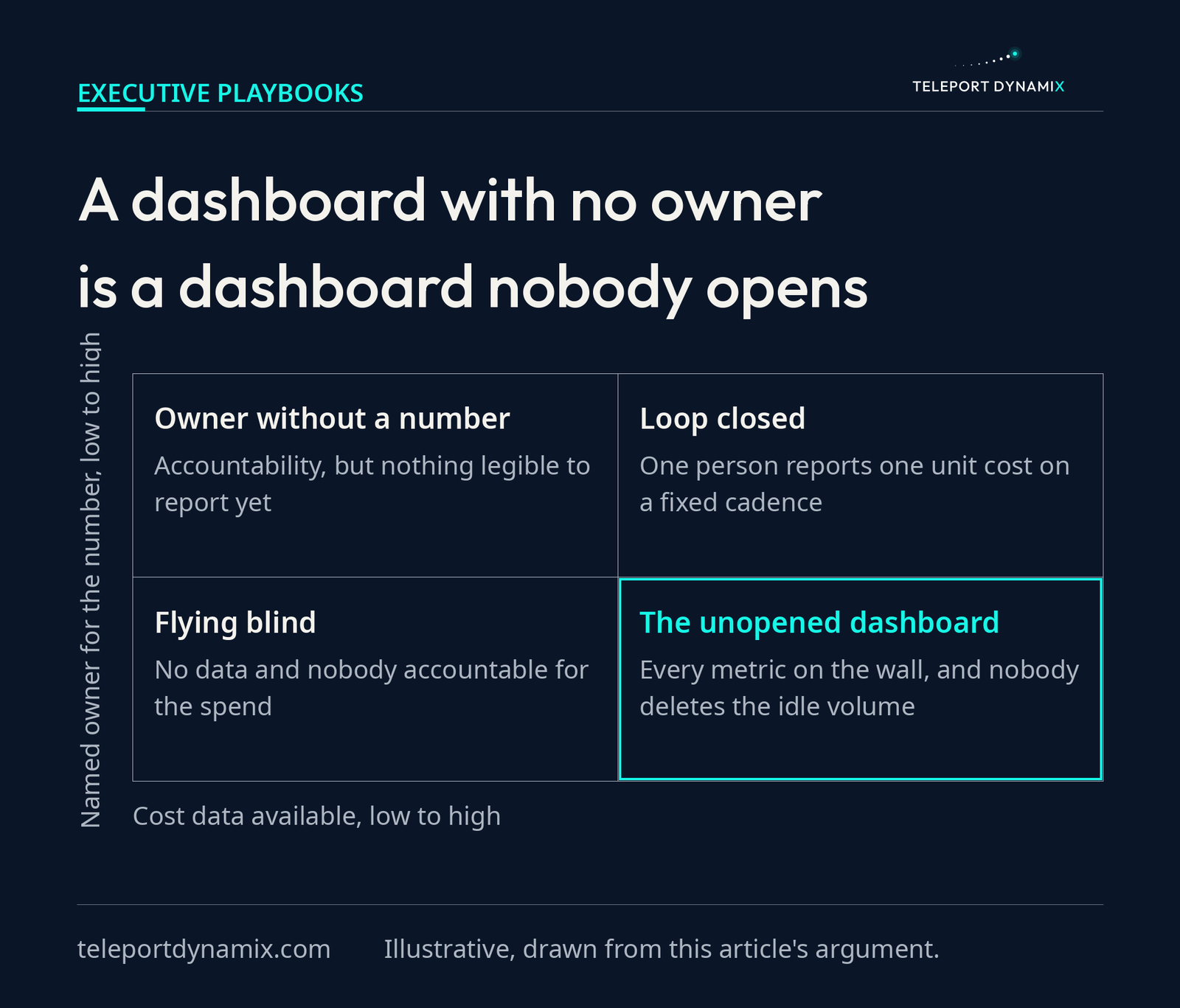
A dashboard with no owner is a dashboard nobody opens
Buy a cost platform before you have assigned ownership and you have bought a very expensive way to feel informed. The tool will find the idle volumes. It will not delete them.
What closes the loop is a person whose name is next to a number, and a review where that number gets said out loud, which is the whole case for treating cloud cost management as something that needs an owner, not a tool. Everything else is telemetry.
The vendor market knows this, which is why the good platforms now sell workflow and allocation rather than charts. The enterprise end of that market has already made the shift in its own language, with suites like Apptio's Cloudability describing themselves around the practice rather than around the dashboard, because a chart with no owner sells once and churns.
It is also why the hardest allocation problem got its own open standard: OpenCost publishes a specification for attributing shared cluster spend, because Kubernetes abstracts away the machine and therefore the price of the machine. Twenty teams can sit in their own namespaces inside one cluster and still arrive on the invoice as a single line.
Conway's law applies to your cloud bill
Systems come to mirror the communication structures of the organizations that build them. Conway made that observation about software design in 1968, and it explains cloud spend better than any pricing page does.
If engineering and finance talk once a quarter through a spreadsheet, you will get an architecture whose costs are legible once a quarter, in aggregate, to nobody in particular. If a team owns a service end to end and can see what its namespace costs, the cost of a bad dependency shows up in a code review, a full billing cycle before the invoice would have found it.
FinOps borrows this move directly from DevOps. The DevOps argument was about accountability rather than tooling: the people who build a thing should answer for how it runs, and the tools followed that accountability rather than creating it.
The same inversion happened in observability, where the instrumentation guidance is addressed to the engineer writing the code rather than to an operations team downstream of it, and where the practice is defined as making a system's internal state legible to the people responsible for it. Cost is the next signal to make that trip.
Same argument. New line item.
Unit economics are the output, not a lower invoice
One reframe separates a FinOps practice from a cost-cutting exercise, and it is the thing worth taking away if you take away nothing else.
Total cloud spend is a number that should go up. If it is falling while the business grows, something is broken, and it may be your growth.
Pick the denominator your business is actually priced on
The number that matters is cost per unit of value delivered, and the right denominator is the one your pricing already runs on:
- Cost per active customer if you sell seats.
- Cost per transaction if you sell throughput.
- Cost per tenant if you sell to businesses and one of them is quietly consuming 40% of your infrastructure.
- Cost per thousand inferences if you have shipped anything with a model in it in the past two years.
Choose the denominator that matches how you charge, because that is the ratio that decides whether you have a business. A gross margin is a unit cost with a price on top.
A rising bill can be the best news in the room
Track a total and every month is an argument. Track a unit cost and the bill becomes readable: spend up 30%, cost per customer down 12%, and the conversation is over in four seconds.
This is also the number a board will eventually ask for, and the question is rarely "what is your cloud bill." It is "what does one customer cost you to serve, and which direction is that going."
A founder optimizing burn before a raise should understand the difference, because fundraising is a purchase, not a milestone and a defensible unit cost is part of what the money is buying. A lower bill buys a quarter of runway. A defensible unit cost changes what the room believes about the company.
Ownership at twenty people looks nothing like ownership at two hundred
The FinOps Foundation maps the practice across several distinct personas: engineering, finance, product, leadership, procurement. Reading that list at a 20-person company is a good way to conclude, wrongly, that this is not for you.
It is for you. It just does not look like the org chart in the diagram. Four things separate a FinOps program at 20 people from the same program at 200.
| Program element | At 20 people | At 200 people |
|---|---|---|
| Who owns it | One engineer, senior enough to be listened to | A small central function |
| The unit reported | One number on one monthly cadence | A published allocation model |
| The verbs | Tag, report, repeat | Builds, sets, publishes, never approves |
| Failure mode | A committee forms before the first owner is bored | A provisioning queue becomes a workaround |
At twenty people, it is one engineer and one number
You do not need a FinOps team. You need a meeting that happens on the same date every month whether or not anyone likes the number, and one person who has to stand behind it.
Adding a second person before the first one is bored is how you get a committee, and a committee will produce a dashboard rather than a decision.
What that person is actually for is the refusal. A design costs what it costs for a reason or it does not, and somebody has to be senior enough to make that call in a design review instead of in a post-mortem. Where nobody in the building can make it yet, our advisory side is built to be borrowed rather than hired.
At two hundred, it becomes a small central team that enables
Past roughly a hundred engineers, the coordination cost of everyone doing their own allocation exceeds the cost of centralizing it. That crossover is the only real reason to build a central function, and it arrives later than the org chart usually assumes.
A central team with veto power over provisioning becomes a queue, and a queue becomes a workaround, and the workaround will be a personal AWS account with a company credit card on it.
The lesson is old, and reliability engineering learned it first. Google's SRE practice names the enemy directly: toil, the manual, repetitive, automatable work that scales linearly with the size of what you run. A central team reviewing provisioning requests one at a time has not built a guardrail. It has invented new toil and put itself on the critical path of every deploy. Platform teams succeed by making the right path the easy path, and fail the moment they make it the only path.
Showback changes behavior, chargeback changes budgets
The two get confused constantly, and the difference is the whole reason one is safe to start with and one is not:
- Showback puts each team's own spend in front of it, and no money moves.
- Chargeback actually debits each team's budget for what it consumed.
- The order is fixed. Showback earns the trust that chargeback then spends.
Showback is where you start, and for many scaling companies it is where you stop. It buys nearly all of the behavior change at a fraction of the political cost, because the mechanism doing the work is visibility plus mild professional embarrassment in front of peers. No money has to move for either of those to bite.
Chargeback is a real accounting construct with real teeth, and it belongs in organizations where teams have genuine P&L ownership and can make genuine tradeoffs. Introduce it before your allocation model is trustworthy and you will spend the next two quarters not on optimization but on adjudicating whose data pipeline is unfairly charged for the shared cluster. The chargeback debate is where FinOps programs go to become a finance function, which is precisely the failure mode.
Start with showback. Earn chargeback.
What actually triggers the need for FinOps?
The honest part, and the one the vendor content leaves out.
If your cloud bill is $4,000 a month, you do not have a FinOps problem. You have a pre-product-market-fit problem, and every hour spent building an allocation model is an hour not spent finding out whether anyone wants the thing. The best financial decision available to you is speed. Spend the money. Ship.
Three moments make the discipline earn its keep, and each one calls for a different first move.
| Trigger | What it usually means | What it needs first |
|---|---|---|
| Cost has to be explained | A board, acquirer or lead investor is asking in diligence | Allocation you can defend line by line |
| Gross margin stops improving with scale | Unit cost stays flat while revenue grows | One named owner and one unit-cost number |
| Bill grows faster than usage | Architecture is scaling badly, so accountability will not help | A scalability review before any allocation work |
Somewhere around 20,000 to 50,000 a month is where the conversation usually starts, though the number matters far less than which of those three arrives first. The first two tend to surface in technical due diligence whether or not you went looking for them, because a diligence team reads unit economics before it reads an invoice. Neither one waits for you to feel ready.
The third is the one FinOps cannot answer, which is the point the cluster pillar makes when it argues that cloud cost optimization is engineering, not billing. A system that scales linearly in spend and sublinearly in value needs a scalability review, and that is a different piece of work with a different answer at the end of it.
How you know the discipline took, a year later
Every cost program looks identical in its first quarter. The graph goes down, the deck gets applauded, and nobody can tell yet whether what happened was a discipline or a spring clean.
The difference shows up around month twelve, in small things nobody schedules.
- The unit-cost number gets reported in a month when nobody asked for it, because the cadence sits on a calendar rather than inside an initiative.
- An autoscaling ceiling raised during an incident comes back down, and somebody catches it before the invoice does.
- A new service arrives already tagged, because the provisioning path makes the tag cheaper to include than to skip.
- Finance asks what a customer costs to serve, and engineering answers in the same units without preparing.
None of that needed a platform purchase. What it needed was the operate phase actually running, which is also how a mature practice keeps cutting cloud costs without losing engineering speed instead of trading one against the other every quarter.
What separates the programs that hold their savings from the ones that quietly give them back was never the tooling, which was always available and mostly free. It is whether one named person reports one number on a fixed cadence, in a meeting that happens whether or not the number is embarrassing.
At Teleport Dynamix, our cloud cost audit runs as a 2 to 3 week sprint and ends in a 90-day savings roadmap with ROI per action, because a finding without an effort estimate is a wish. Its published working band is 20 to 40% of cloud spend recoverable on AWS, GCP or Azure through configuration, right-sizing, storage optimization and architecture calibrated to current scale.
That recovery is the easy half. The discipline that stops it coming back is the half that decides what your gross margin looks like at Series B, and it is a conversation worth starting early.
Engineers who can see the price of a decision make better decisions. The discipline is what keeps them able to see it a year later, after the person who ran the cleanup has moved on.
One owner. One number. Every month.
Frequently Asked Questions
What is the meaning of FinOps?
FinOps is an operating discipline in which engineering, finance and product share accountability for variable cloud spend, so that the cost of a technical decision is visible to the person making it. It is not a cost-cutting team and not a product. Its goal is better unit economics, not the cheapest possible bill.
How is FinOps different from DevOps?
DevOps makes engineers accountable for how their software runs. FinOps makes them accountable for what it costs. Both work by moving a consequence closer to the person who caused it, and both fail when treated as a tool purchase rather than an operating change. FinOps borrows the DevOps argument and applies it to spend.
What are the 6 principles of FinOps?
The FinOps Foundation publishes six: teams collaborate, decisions are driven by the business value of cloud, everyone takes ownership of their cloud usage, FinOps data is accessible and timely, a centralized team drives FinOps, and teams take advantage of the variable cost model of cloud. Ownership and timeliness carry the practical weight.
Which FinOps tools do teams actually use?
Start with what you already own. AWS Cost Explorer and Azure Cost Management are free and sufficient for a first year. Kubernetes users add OpenCost for namespace-level allocation. Commercial platforms add anomaly detection, unit-cost modeling and multi-cloud allocation, and they earn their price only once someone owns the number they produce.
Does FinOps require coding?
For an engineer holding the number, yes, in practice. Tagging is enforced in infrastructure code, guardrails live in the deployment pipeline, and right-sizing happens in a configuration file rather than a spreadsheet. Finance and product participate without writing code, but the savings are made by people who can change a resource definition.
When does a scaling company need FinOps?
When cloud cost becomes a number you have to explain, typically to a board, an acquirer or a lead investor. A monthly bill somewhere around 20,000 is a common trigger. Before that, speed beats efficiency and an allocation model is a distraction. The other trigger is a bill growing faster than usage.
Continue Reading:
More In This Series:
- Cloud Cost Optimization Is Engineering, Not Billing
- AWS Cost Optimization Checklist for Scaling Teams
- Reduce Cloud Costs Without Losing Engineering Speed
- Cloud Cost Management Needs an Owner, Not a Tool
- Azure Cost Optimization Starts With Your Licensing
More from Teleport Dynamix:
- Hospitality Software Was Built for Someone Else
- Startup Fundraising Is a Purchase, Not a Milestone
- Pitch Deck Is a Trailer, Not the Film Investors Buy
- Hospitality Management Platform Built for the Shift
Explore the Insights Categories:


