





Software designed for hospitality from the first line of code would hold three things instead of thirty, and this is what each of them would have to do on an ordinary Tuesday.
Confession first, because the rest of this does not work without it. Naming a category nobody has built means we have a method, a line, and three ventures running on it, and no finished platform to hold up as proof. That is a real cost, and we take it on purpose rather than dress a demo up as a category.
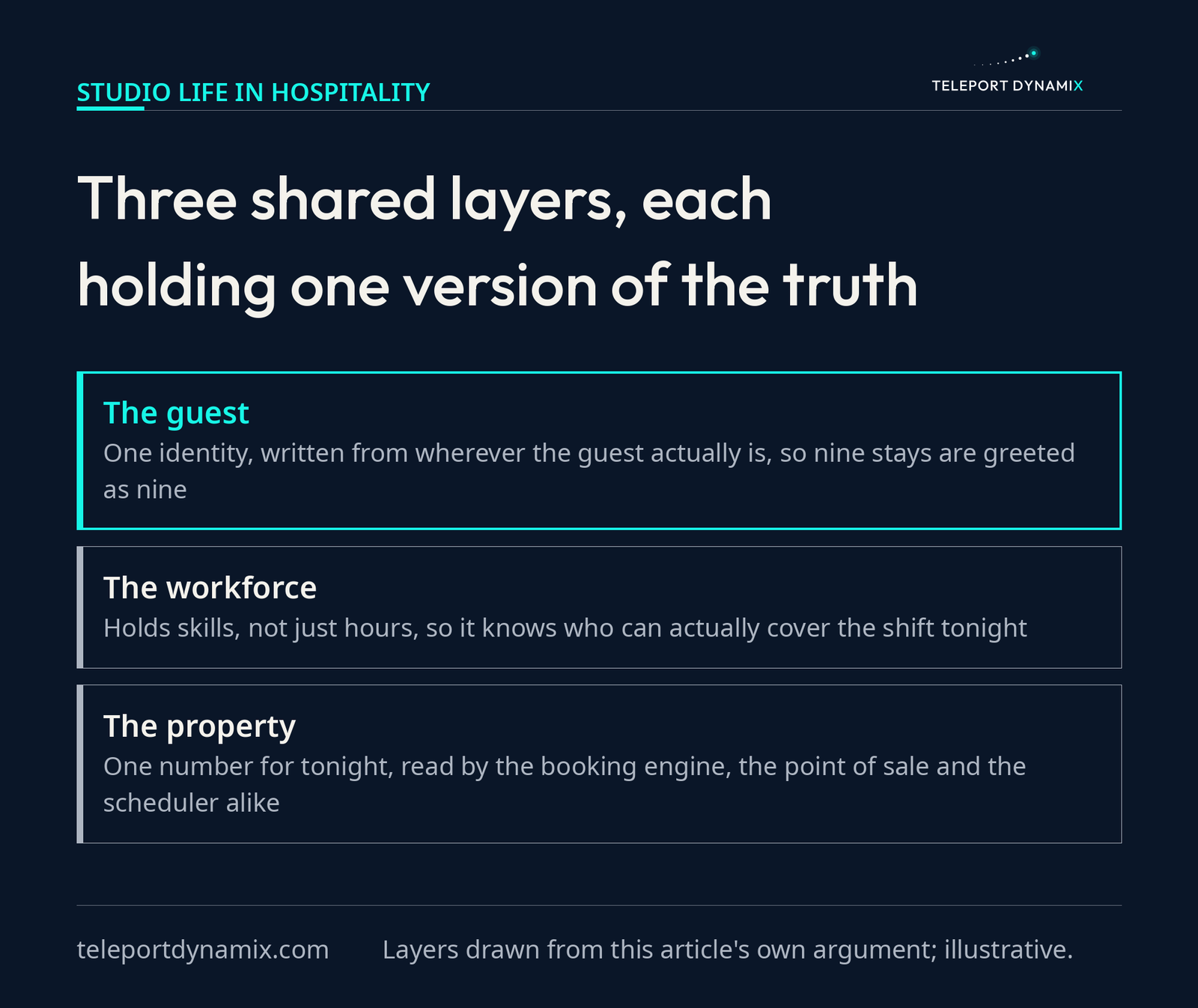
What we can do is be exact about the shape. Software built for the operation from the first line of code would not be a larger suite with more modules bolted to the side. That suite versus specialist trade already has its own chapter in all in one restaurant software versus best of breed, and this piece is about the layer underneath it. It would collapse the stack into three shared layers, the guest, the workforce and the property, each holding one version of the truth that everything else reads from.
Below is what those three layers would have to do on an ordinary Tuesday, and what breaks today because they do not exist. Not a vision. A spec.
Key takeaways
- Every product in a hospitality stack is ultimately touching one of three nouns: a guest, a person on shift, or the property. The stack holds twelve private copies of three things.
- A guest layer means one identity that survives the walk from the room to the table, written from wherever the guest actually is.
- A workforce layer means software that knows a Friday service and a Tuesday lunch are different animals, and that the person who called in sick was the only one trained on the till.
- A property layer means the booking engine, the point of sale and the scheduler read the same number, so nobody reconciles exports at 8am.
- Integrations move the seam. They do not close it. Closing it means building for the operation instead of translating between products built for someone else.
Three layers carry an entire property
Count the products in a hospitality stack and you will get somewhere between eight and twenty. Count the things they are actually about and you will get three. A guest. A person on shift. The property itself.
Every product in the stack is a private copy of one of those three nouns, wrapped in a login screen and a billing relationship. The property management system holds a partial guest. The point of sale holds a different partial guest. The scheduler holds a partial workforce, and the booking engine holds a partial property.
None of them holds the whole thing, because none of them was built to. Each vendor drew a boundary around the slice it could sell, and the operation has been paying the difference ever since.
A hospitality management platform worth the name inverts that. The three nouns are the platform, and the products become views onto them. You do not integrate a guest record across five systems. You keep one, and let the systems read it.
That is a strange sentence to have to write in 2026, and the fact that it still needs writing is the whole point of this series, which opened by showing how hospitality software was built for someone else and then bent to fit. The trade press has been documenting the consequences for years, from coverage of independent and boutique properties to the hotel technology desks, and the diagnosis never changes. Data is trapped in the product that captured it.
Guest identity has to survive the walk from room to table
Start with the guest, because it is the layer operators feel first and forgive least.
One record, written from wherever the guest actually is
Today a guest exists as a stay in the property management system, as a cover in the restaurant point of sale, as an email address in the marketing tool, and as a booking in whatever channel they came through. Four records, one person, no shared key.
A guest layer means the identity is created once and written to from anywhere. Three different hands touch the same record on a single visit:
- The front desk writes the allergy the moment it is mentioned at check in.
- The waiter writes the wine the guest liked, so the next table does not have to ask.
- The spa writes the cancellation, and the record updates before the next slot is offered to anyone.
All three land on the same record, in real time, and none of them needed an export to do it.
This is not a technically hard problem. It is a commercial one. No vendor holding a partial guest record has any incentive to give it up, which is why the industry gets product portfolios and full-stack vendor suites rather than a shared identity. For rooms in particular, that same commercial refusal is why hotel technology integration keeps failing no matter how many new vendors arrive promising to fix it.
What it changes at the door
Here is the operational payoff, and it is small enough to sound trivial until you run a floor.
The guest who has stayed nine times gets greeted as someone who has stayed nine times, by whichever member of staff happens to see them first, in whichever part of the property they happen to be standing. Not by the one person who remembered. Not by the one system that happened to be open.
That is the difference between service that looks personal and service that is personal. One is a trained habit that leaves when the person leaves. The other is in the software.
Workforce software should know who called in sick
The workforce layer is the one everybody underestimates, and it is the one operators name first when you ask what hurts.
Rotas inherited their logic from warehouses
Scheduling tools were built for shift work where an hour is an hour and a body is a body. Hospitality is not that. A Friday service and a Tuesday lunch are different animals, a section can be covered two ways, and the person who called in sick was also the only one trained on the till.
An independent property has no workforce planning function to absorb that gap, because the gap only announces itself on the day it opens. There is a manager, a group chat, and a shift that starts in forty minutes.
The operations coverage in the trade press has been circling this for a decade. Labor is the hardest daily problem in the industry, and the software pointed at it was designed for a different kind of work.
The layer that knows the till training
A workforce layer holds skills, not just hours. It carries what a rota built for warehouse shift work never could:
- Who can run the pass tonight, not merely who is technically free to be rostered.
- Who is certified to pour, so a legal requirement is never discovered at the last minute.
- Who has closed unsupervised before, and who is three shifts away from being trusted to.
So when someone calls in sick at 3pm, the software does not present a list of people who are free. It presents the people who are free and can actually do that job tonight, ranked by what the swap costs you in overtime and in service quality.
That is a small feature. It is also the difference between a manager spending twenty minutes on the phone and spending two. Multiply it by every unplanned absence in a year.
None of the countertop point of sale products sold into hospitality can do this, and it is not their fault. They were never given the workforce layer to read from, because nobody built one.
Property truth means one number, not four exports
Then the property itself. Rooms, tables, covers, rates, stock, spend.
One source of truth, not a nightly reconciliation
Tonight's availability currently lives in at least four places, and none of them defers to the others:
- The booking engine holds a version, updated whenever the last direct reservation landed.
- The channel manager holds a version, updated whenever an OTA last pushed.
- The property management system holds the version the general manager trusts, usually because they checked it by hand.
- The events and private dining tool holds the function room, invisible to the other three.
When those versions disagree, someone oversells a room or leaves one empty, and the reconciliation happens in a spreadsheet before service. Every hour spent on that is an hour of your best person producing nothing a guest will ever see. If you run tables rather than rooms, the same reconciliation runs across the floor, mapped seam by seam in your restaurant tech stack breaks at the same seams.
A property layer means there is one number and everything else is a read of it. Not a synchronized copy. Not a nightly job. One number.
Reporting stops being an act of archaeology
The second effect is quieter and worth more. When the guest, the workforce and the property share one substrate, a question like "what did last Saturday actually cost us" stops being a research project.
Labor, covers, food cost and rate all sit against the same night, keyed the same way. You ask, and the answer is there. Today that question takes three exports and a judgment call about which one is lying.
Bodies like HOTREC publish the sector-level economics, an industry of more than two million businesses in Europe alone, ninety-nine percent of them small or medium-sized. What no operator has is that clarity about their own property, on a Tuesday, without a week of work.
Integrations move the seam, they do not close it
Now the honest objection, because it is the one every operator raises and it deserves a straight answer.
Integrations are the right tool when you have already chosen your products and you need them to exchange data. Connectors, marketplaces and middleware do real work, and for a property running a settled stack they are the correct call. Nobody should rip out a working system for a philosophy.
But an integration is a translation between two products that were each built on a different idea of what a guest is. It carries the fields both sides agreed on, at the interval both sides agreed on, and it breaks when either side ships a change. You did not remove the seam. You hired a translator and put it on a subscription. What that subscription really costs, once you count every breakage and the person who fields it, is the whole of restaurant software integration is not a license fee.
The two approaches diverge on every dimension that matters once the honeymoon ends:
| Dimension | An integration | A shared layer |
|---|---|---|
| What it carries | The fields both products agreed on, at the interval both agreed on | Every field, because the definition lives in one place |
| When it breaks | Whenever either side ships a change | It does not, because nothing sits between the products to break |
| Who owns it | A manager with a shift already to run | The platform, defined once and read by everything |
| The guest | Two products holding two ideas of what a guest is | One definition every product reads from |
That is why the industry press covering hotel operations and the desks covering foodservice technology fill up every year with integration announcements, and why the same complaint about disconnected systems shows up every year underneath them. The connectors keep improving. The seam keeps existing.
Closing the seam is a different act. It means the guest, the workforce and the property are defined once, in the platform, and the products are built on top of that definition rather than negotiating with it.
Pointing the line at one industry costs us nine others
Here is the second confession, and it is the expensive one.
Building this layer means pointing the studio at hospitality and refusing everything else. The refusal is specific, and each item on it is a real business we turn down:
- Fintech offers better uniformity and kinder margins, and we say no to it.
- Logistics offers larger buyers writing bigger checks, and we say no to it.
- Depth in hospitality is the one asset a generalist cannot copy, and it only compounds if we stay.
Saying no to the first two costs us deals we could win with the same team in the same week.
We take that trade because depth in one industry is the only thing a generalist cannot copy. Every build teaches us more about how a guest, a shift and a property actually behave, and how we choose what to build is downstream of that choice, not a preference we decorate it with afterwards.
It also means we are early enough to be wrong. A studio that names a category before it exists is making a claim it has to go and earn, venture by venture, with its own equity sitting in the outcome rather than an invoice sitting in your inbox.
What this looks like when it works
A specification is worth nothing until something ships against it. So here is the honest state of the build, and it is the reason this piece closes the argument the first chapter of the series opened rather than starting a new one.
The line, and what is on it
Three ventures are running. The Gourmet Host sits in food tech. Onbi AI Mentor sits with staff training and operational mentoring, which is the workforce layer approached from the side where operators feel the pain soonest. PropTech KSA is built for how property actually works in the Saudi market.
Agentic reception is next on the roadmap, then a guest experience layer. That ordering is deliberate. You earn the right to hold the guest record by first proving you can hold the operation the guest walks into.
How a build actually runs
Each venture runs the same line. Fifty or more real customer interviews in weeks three to six, with the people running the shift and the floor and the front desk. Real users on a real product inside a real property by month three. Investor-ready or an honest pivot by month four, because a slow no costs more than a fast one.
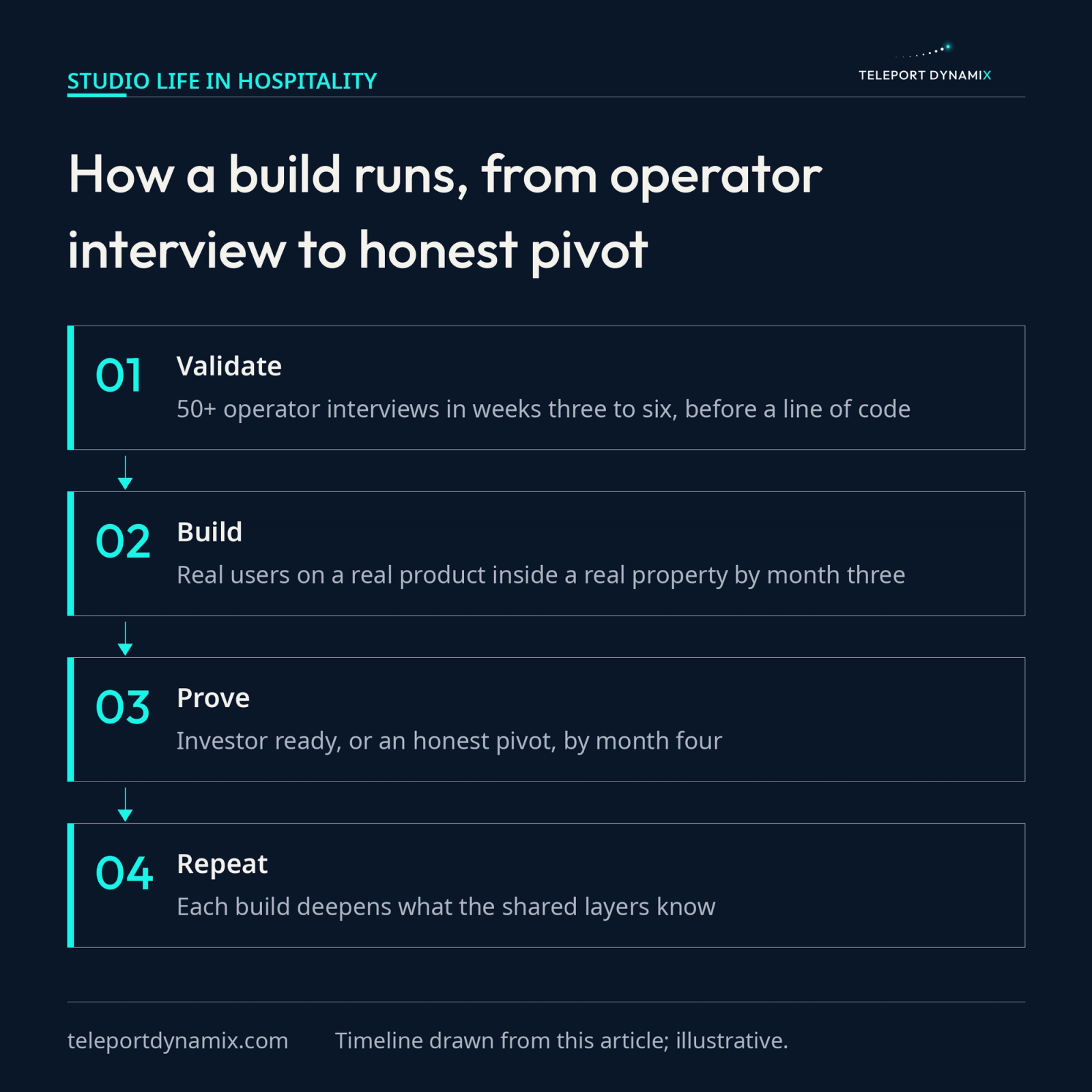
That method is the thing that carries forward, and the way we work is what makes the fourth build cheaper than the first. Each one deepens what the shared layers know about how this industry behaves.
None of that is a finished platform. It is a line pointed at one, built with the operators who live the problem, and it is why who we build with matters more to us than what we build first.
The industry gets a category the same way it got its current stack. One decision at a time. This one is being made on purpose.
Frequently Asked Questions
What is a hospitality management platform?
A hospitality management platform is software that runs the guest, the workforce and the property from one shared source of truth rather than stitching separate products together. In practice, what is sold under that name today is usually a suite of modules with a shared login. The distinction is whether the data is shared or merely co-located.
Which software is mostly used in the hospitality industry?
Hotels run on a property management system, a channel manager and a booking engine. Restaurants run on a point of sale, a reservations tool and a scheduler. Both sides add a guest database and some form of accounting. Almost every one of those categories was invented for another industry and adapted afterwards.
How should you choose a PMS system?
Choose on the seams, not on the feature list. Every serious property management system covers the core well, so the decision that actually costs you is what it refuses to share and how hard it is to get your own data out. Ask what the guest record looks like when the vendor relationship ends.
What are the 5 C's of hospitality?
Commonly taught as commitment, communication, consistency, care and creativity, the five C's are a service-training mnemonic rather than an operational standard, and the exact list varies by who is teaching it. Software cannot supply any of them. It can only stop making them harder by ensuring staff have the guest context they need.
Which PMS is used by Marriott?
Large chains typically run proprietary or heavily customized systems maintained for their own estate, which is exactly the advantage scale buys. Commissioning software that matches your operation has always been available to groups with a technical function and a budget. Independent operators, who make up the bulk of the industry, have never had that option.
Can one platform replace a whole hospitality stack?
Not on day one, and any vendor promising it is selling coverage rather than fit. The realistic path is a shared layer underneath the products you already run, starting with whichever of the three domains costs you the most time. Replacement happens because the layer earns it, not because a contract forces it.
Continue Reading:
More In This Series:
- Hospitality Software Was Built for Someone Else
- Your Restaurant Tech Stack Breaks at the Same Seams
- Hotel Technology Integration and Why It Keeps Failing
- Restaurant Software Integration Is Not a License Fee
- All in One Restaurant Software vs Best of Breed
More from Teleport Dynamix:
- Cloud Cost Optimization Is Engineering, Not Billing
- FinOps Is an Operating Discipline, Not a Cost Tool
- Startup Fundraising Is a Purchase, Not a Milestone
- Pitch Deck Is a Trailer, Not the Film Investors Buy
Explore the Insights Categories:


