





The bill for a stitched-together restaurant stack is paid in labor, errors, connector fees and stale decisions, and this is how to price your own.
License fees are not what restaurant software integration costs you. They are the part with an invoice attached, which is the only reason they are the part everyone counts.
The rest of the bill gets paid in labor, in errors, in connector fees, and in choices made on numbers that stopped being true at some point yesterday afternoon. None of it arrives on a statement. All of it is real money, and it leaves the business every week whether you price it or not.
The reason the bill splits this way is structural rather than careless. Every tool in the stack was built for a different industry and bent to fit, so the seams between them were always going to cost somebody. In an independent operation, that somebody is you.
So price it. What follows is a method for putting a figure on your own second bill, and a way to decide what to do once you can see it.
Key takeaways
- Subscriptions are the visible cost and the smallest one. The real bill is labor, errors, integration fees, and decisions made on numbers that were true yesterday.
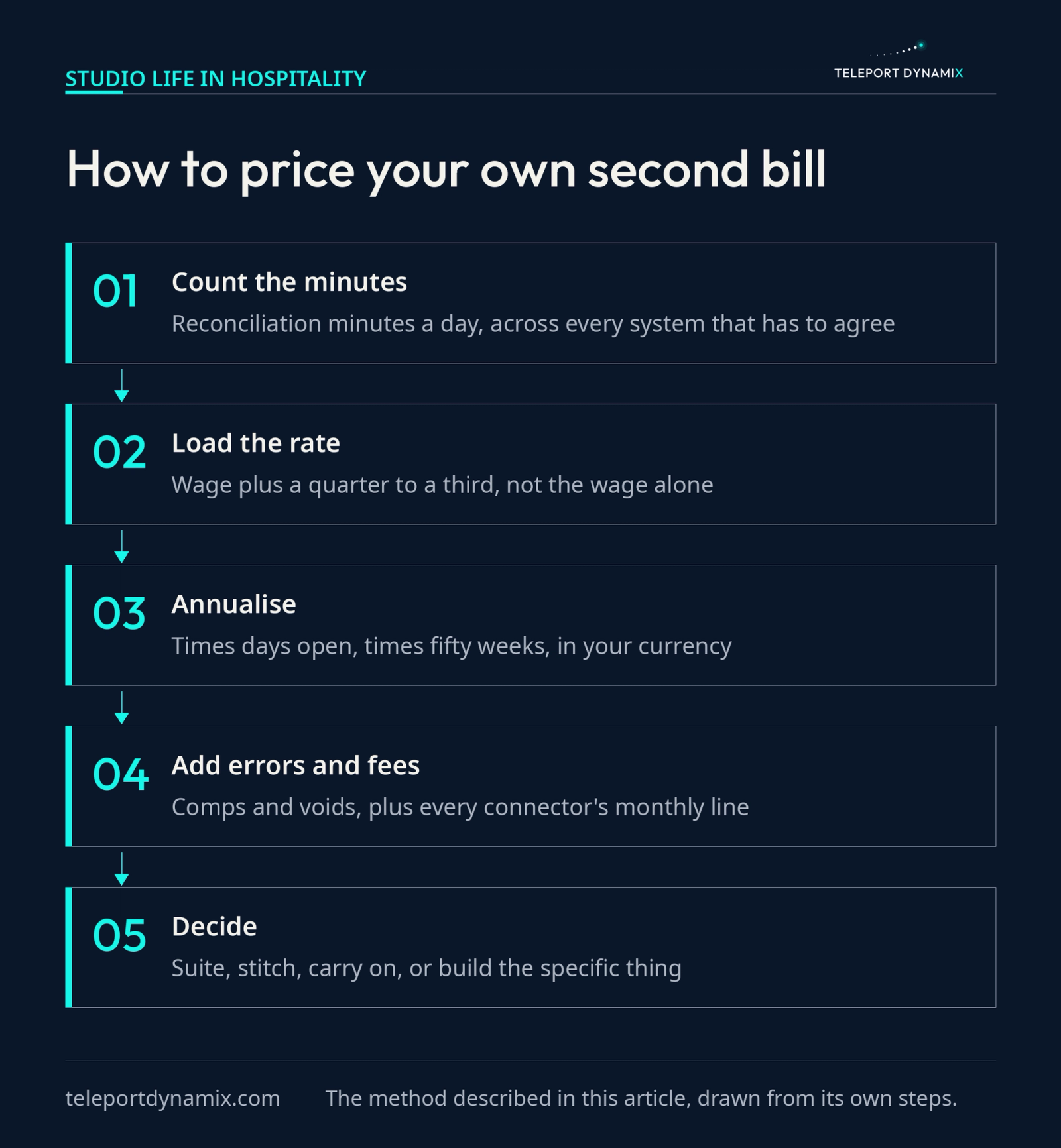
- You can price the reconciliation habit yourself. Minutes per day, times days open, times a loaded hourly rate. No vendor will hand you that figure, and no vendor is required to.
- Errors are not accidents in a disconnected stack. Two systems holding two versions of tonight will produce oversells, comped covers and lost orders at a predictable rate.
- Integration arrives as a fee and stays as a tax. Connectors carry a monthly line and a maintenance obligation that lands on whoever happens to be running the floor.
- The decision is not which product to buy next. It is whether you keep paying to hold someone else's seams together.
Subscriptions are the cheapest line on the bill
Start with what you can already see. A till, a reservations tool, a scheduling app, an inventory system, payroll, a delivery connector, maybe a loyalty product. Each one costs somewhere between a few tens and a few hundreds a month, and every vendor publishes the number.
That transparency is real. You can look up what a modern till costs before you buy it, compare it against the next one, and negotiate the number down. Nothing about that market is hidden.
Which is exactly why it is the wrong number to argue about. The subscription line is knowable, comparable and negotiable, so it absorbs the attention, while the costs that are none of those three things run untouched in the background.
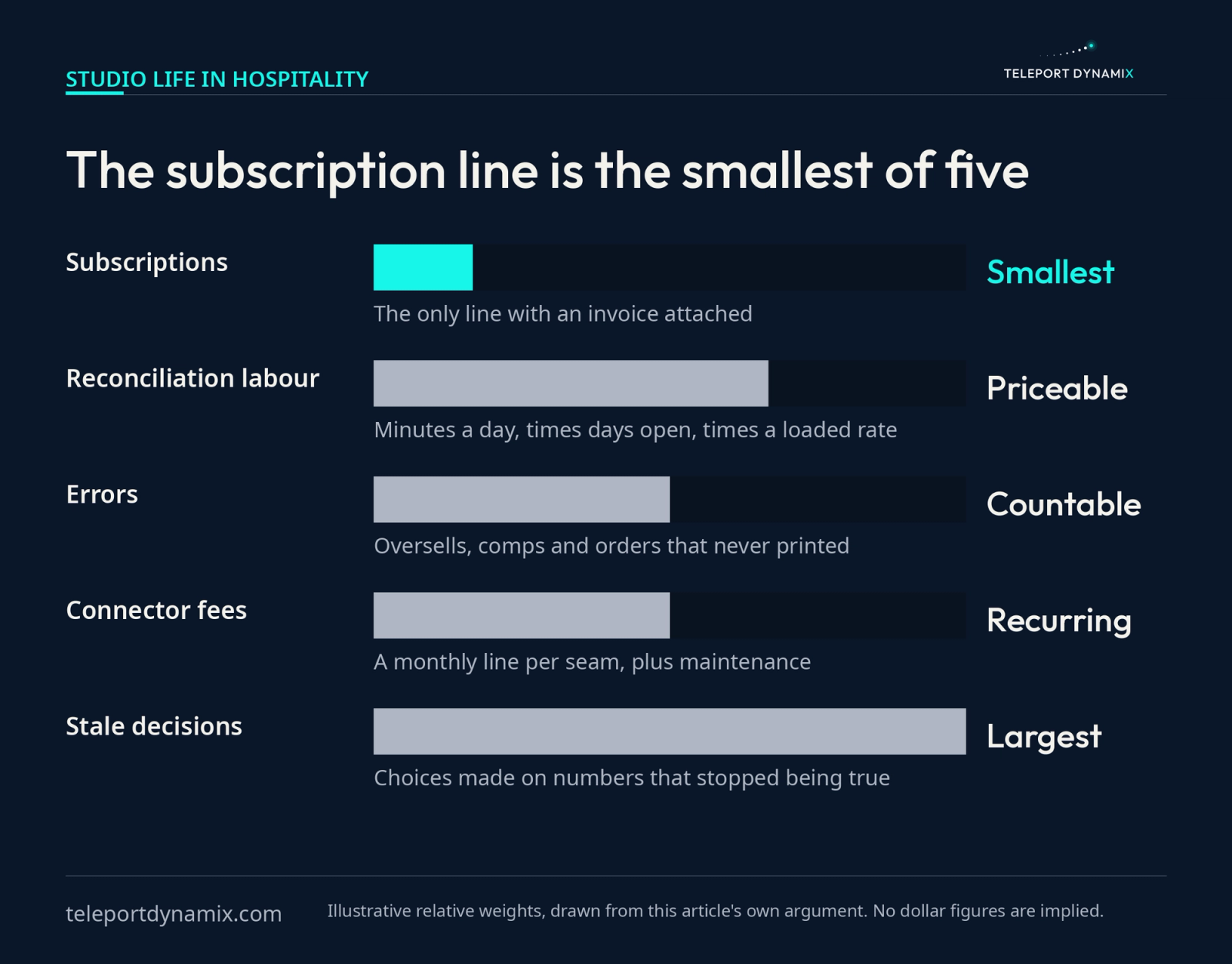
It is also the number the market is built to compete on. Vendors publish it, undercut each other on it, and win deals with it, because it is the one figure a buyer can check in an afternoon. Nobody sells against the cost of the seams, since nobody owns the seams.
So the operator ends up optimizing the line that was easiest to see rather than the line that was largest. That is not a failure of judgment. It is what happens when one cost has a price tag and the other four do not.
Count the minutes, then price them
Here is the first of those costs, and the one you can measure this week without asking anyone's permission.
The reconciliation clock
Somebody in your operation makes two systems agree every day. They export the covers from the POS and match them against the reservations tool. They check what the delivery platforms sent against what the kitchen actually made. They reconcile the roster against who really worked.
That person is rarely a specialist. Nine in ten US restaurants employ fewer than fifty people, on the National Restaurant Association's own research, so the person holding the seams together is usually the same person opening the doors.
The loaded rate, not the wage
Now price their time properly. Not the hourly wage. The loaded rate: wage plus employer taxes plus benefits plus the cost of the shift they are not covering while they do this.
If you do not have a loaded rate to hand, take the wage and add roughly a quarter to a third. It will be closer to the truth than the wage on its own, and being roughly right beats being precisely wrong.
A worked example you can copy
Take the minutes. Forty minutes a day of reconciliation, six days a week, is four hours a week. Fifty weeks a year is two hundred hours.
Multiply by your loaded rate and you have a real number, in your currency, for a job that produces nothing a guest will ever notice. Run it again for the second person who does a version of the same thing at close. The arithmetic is not clever and it does not need to be.
Not a license. A payroll line.
Errors are where the money actually leaves
Reconciliation time is the visible half of the labor cost. The errors are the half nobody logs, because logging them would mean admitting they are systematic.
Two systems, one Friday
When your booking tool and your floor plan hold different versions of tonight, the mismatch resolves itself in one of two ways. You seat a table you have already promised, or you leave one empty. One costs goodwill and a comped round. The other costs the cover.
Neither is a mistake anyone made. Both are the arithmetic of two systems that were never designed to agree, which is the whole reason middleware exists as a category and can support real companies on nothing but translation. The same failure repeats service after service, which is why a restaurant stack tends to break at the same seams rather than at random.
The order that never printed
Delivery is worse, because the failure is silent. An order lands on a tablet, the tablet is not the kitchen screen, and the ticket does not print. You find out when the driver arrives.
Trade coverage of restaurant technology has been documenting this exact failure for years, and the fix on offer is almost always another connector rather than a system that does not need one.
Give this one a number too. Count the comps, refunds and voids for a month, mark the ones that trace back to two systems disagreeing, and annualize it. You will not enjoy the result, but it will be yours rather than a vendor's estimate.
The error cost hides in three places at once:
- The comp you gave to keep the peace. A double-booked table costs goodwill and a round on the house, and neither lands on a vendor invoice.
- The cover you left empty. An overcautious floor plan protects nobody and books nobody, and the table sits dark all night.
- The order that never printed. A delivery ticket that misses the kitchen screen becomes a refund and a one-star review you only see after the driver has gone.
Integration arrives as a fee and stays as a tax
Now the part with an actual invoice, and the part operators consistently underprice.
The connector fee
Every seam has a market. Your till has an app store bolted to the side of it. There is an integrations directory for your scheduling tool, a partner marketplace if you also run rooms, and for the enterprise tier there is a dedicated integration platform whose entire existence is a confession about how the underlying products were built.
Each connector carries a monthly fee. Individually trivial. Added up across seven systems, frequently larger than the cheapest subscription in the stack, and growing every time you add a product.
The upgrade nobody scheduled
The fee is the small half. The tax is that somebody now owns the connection.
When a vendor ships a breaking change, when a token expires, when a field name changes and the sync quietly stops, the work lands on a person who has a service to run in forty minutes. The restaurant technology press is full of operators discovering that an integration they bought once has become an obligation they maintain forever. The hotel side tells the same story with different acronyms, which is the same reason hotel technology integration keeps failing generation after generation, and the trade has been saying so on conference stages, including the big ones, for a decade.
Price the tax the way you priced the labor. It hides in three places:
- The recurring line. Seven connectors billing monthly often beat the cheapest subscription in the stack.
- The maintenance hours. Every breaking change spends a shift, and that someone is rarely a specialist.
- The single point of failure. Whoever understands the sync is one resignation from a break nobody left can fix.
Stale numbers make expensive decisions look safe
Add up the labor, the errors and the fees and you have a number. It will be bigger than your subscriptions. It still is not the largest cost.
The largest cost is that you make decisions on data that is a day old and partial. You order for a Saturday against a covers forecast that does not include the twelve reservations sitting in a system nobody exported. You roster four when the number was five. You keep a dish that looks profitable because the food cost lives in one place and the sell-through lives in another.
Each of those is one decision. You make them all year. This piece, the fourth chapter in the series, is only interested in the arithmetic, and the arithmetic on this one is unforgiving.
You cannot price this the way you priced the minutes, and you should not pretend otherwise. What you can do is bound it. Take one decision you made on incomplete numbers last month, work out what the right number would have changed, and multiply by how often that decision recurs. One over-order a week is a food-cost problem with a calendar attached.
Each of those recurring decisions is a stale-number cost with a different name on it:
- The over-order. A Saturday forecast that misses twelve unexported reservations sends food into the bin instead of onto plates.
- The wrong roster. Four scheduled when the covers said five means a slow section and a table that never turns.
- The dish that only looks profitable. Food cost in one system and sell-through in another keeps a loss-maker on the menu because no single screen ever showed both.
Nobody in the building is being careless. The numbers arrived late and partial, and a careful decision taken on late, partial numbers is still the wrong decision.
Now decide what you are actually buying
You have four options, and it is worth being honest that three of them are sometimes right.
The three answers already on the shelf
Buy a suite, and you trade depth for coverage. That is the correct call when your operation is close to standard and one bill beats seven, and the seams become someone else's roadmap problem instead of yours.
Buy best-of-breed and stitch it, and you trade coverage for seams. That is correct when you have the appetite and the volume to run an integration layer on purpose, and the honesty to admit that owning the layer means owning it on a Friday. That trade between one vendor and five is the whole subject of all in one restaurant software versus best of breed, if you are weighing it right now.
Buy neither and carry on, and you have chosen to keep paying the second bill quietly. That is a real choice, and for a small operation with one till and a paper diary it is occasionally the rational one.
The fourth answer, and why it only just became one
The fourth option is to stop buying things built for someone else and have the thing built for the operation you actually run. Until recently that was unaffordable for anyone below chain scale, which is why the systems inside the big groups look nothing like the ones sold to independents.
That has changed, and not because anyone had a new idea about restaurants. It changed because building a specific product now takes a small team and months rather than a large team and years, and the studio exists because of the change in that arithmetic rather than in spite of it.
What decides between the four is the number you just calculated. If the second bill is small, buy the suite and get on with service. If it is a salary, you are already funding a build. You are simply funding it in the least useful form available.
| Option | Right when | What you pay with | Where the seams end up |
|---|---|---|---|
| Buy a suite | Your operation is close to standard and one bill beats seven | Depth, and your unusual cases | Inside one vendor's roadmap |
| Stitch best-of-breed | You have the volume and appetite to run an integration layer on purpose | Ownership of every connector and API change | On the desk of whoever runs the shift |
| Carry on as is | You have one till, a paper diary, and a genuinely small second bill | The second bill, paid quietly and forever | Exactly where they are today |
| Build the specific thing | The second bill is a salary and generic will not stretch to your operation | Time, access, and a share of the upside | Designed out, because the operation came first |
What this looks like when it works
Software built for the operation does not remove work by being clever. It removes work by not creating it.
The covers a guest booked and the covers the kitchen expects are the same covers, because they were never two records. The roster knows who called in sick because the roster and the shift are the same object. Nobody reconciles anything, because there is nothing to reconcile.
Every line on the second bill disappears for the same structural reason:
- The reconciliation clock stops. There is no export to match against another export, so the forty minutes go back into service.
- The errors lose their cause. Two systems cannot disagree about tonight when tonight is one record.
- The connector tax is gone. Nothing needs a connector when nothing was two products stitched together.
That is not a feature list. It is what happens when a product is designed around a shift rather than borrowed from a warehouse, and it is what the line is built to produce, venture after venture, with our equity sitting next to the operator's outcome rather than on an invoice.
Getting there does not always start with a build. It starts with knowing what is actually broken and what it costs, which is the same discipline behind our alignment audit, where every finding carries a written rationale and a score rather than an opinion.
The same shape shows up elsewhere. Our published cloud cost work puts 20 to 40% of a typical cloud bill in the recoverable column, and it is recoverable for the same reason your second bill is. Nobody had priced it. The full version of that case, that cloud cost is engineering, not billing, is the identical reasoning pointed at a different department.
If you want the judgment before the headcount, a fractional CTO is the cheaper first move, and how we choose what to build starts there more often than it starts with code. Coverage of restaurant operations is full of groups who bought their way toward this and stopped one purchase short.
Count your minutes. Then decide.
Frequently Asked Questions
What software do restaurants use for management?
Restaurants typically run a point of sale, a reservations or table-management tool, scheduling, inventory and food-cost tracking, payroll, and connectors to the delivery platforms. Each was usually bought separately and at a different time. That accumulation, rather than any single product, is what creates the integration cost this article prices.
What is restaurant software integration?
Restaurant software integration is the work of making separate systems share the same data, usually through connectors, marketplace apps or middleware. It is sold as a product feature. In practice it is an ongoing obligation, because every connector carries a fee, a maintenance burden, and a failure mode that lands during service.
Is there a free POS software?
Yes. Several vendors offer a free tier, usually funded by payment processing rather than by a subscription, and for a small operation it is a legitimate starting point. The cost reappears later, when that free product needs to talk to your scheduling, inventory and delivery systems.
What POS does Chick-fil-A use?
Large chains generally run proprietary or heavily customized systems rather than the off-the-shelf products sold to independents, and their exact vendor mix is not something worth repeating second hand. The useful point is structural. Scale buys the option of software built for your operation. Independents have never had that option.
Which is the best restaurant software?
No product is best in the abstract, because the question depends on what your seams cost you. If your reconciliation burden is small, a suite that covers everything adequately wins. If it is large, the strongest individual products plus a deliberate integration layer wins, and neither answer survives without your own numbers.
What is the 30/30/30 rule for restaurants?
The 30/30/30 rule is a rule of thumb that splits revenue into roughly 30% food cost, 30% labor and 30% overhead, leaving about 10% profit. It matters here because the second bill this article describes hides inside the labor and overhead thirds, where nobody goes looking for it.
Continue Reading:
More In This Series:
- Hospitality Software Was Built for Someone Else
- Your Restaurant Tech Stack Breaks at the Same Seams
- Hotel Technology Integration and Why It Keeps Failing
- All in One Restaurant Software vs Best of Breed
- Hospitality Management Platform Built for the Shift
More from Teleport Dynamix:
- Cloud Cost Optimization Is Engineering, Not Billing
- FinOps Is an Operating Discipline, Not a Cost Tool
- Startup Fundraising Is a Purchase, Not a Milestone
- Pitch Deck Is a Trailer, Not the Film Investors Buy
Explore the Insights Categories:


