





Both sides of this argument are right, which is exactly why operators keep getting it wrong, and why the decision needs a framework rather than a feature grid.
Five decisions come back every time an operator rebuilds a stack: which point of sale, which property management system, which scheduler, which payments rail, and whether to buy one system that does all of it or the best product in each category. Four of those are procurement. The last one is architecture, and architecture decides which of the other four you are still allowed to change in three years.
Here is the direct answer, since that is what you came for. All in one restaurant software is the right call when you run one site, your operation is close to standard, and there is nobody on payroll to own an integration. Best of breed is the right call when one part of the operation is genuinely your edge, and someone can own the seams between systems.
Both answers are correct. Both are also answers to a question nobody in hospitality should have had to answer, and the four questions further down will tell you which side of it you are actually on.
Key takeaways
- All in one wins on coverage, speed to stand up, and having nobody to blame but one vendor. For a single site with a standard operation, that is usually the correct call.
- Best of breed wins on depth and on exit. Each tool is better at its job, and one bad vendor becomes a swap rather than a migration.
- Price comparisons mislead because the costs sit in different places. A suite hides its cost in depth. A stack hides its cost in hours.
- Four questions decide it: whether any part of your operation is a real edge, whether anyone owns the seams, how many sites you run, and how soon you expect to switch.
- The binary itself is the problem. It only exists because nobody built a hospitality-native platform, so both answers are compromises with better manners.
Coverage is the product an all in one suite actually sells
An all in one system is not really selling you a point of sale. It is selling you the absence of a project.
One vendor. One bill. One support line that cannot blame the other vendor, because there is no other vendor. What a single codebase quietly removes is a list every small operator recognizes:
- The reconciliation job disappears. Data that ships from one codebase was never separated, so there is nothing to line back up each morning.
- The blame game ends. When something breaks there is one number to call, and no vendor on the far end pointing at another.
- Standing up is procurement, not a project. You buy it, you turn it on, and nobody has to plan a six-system rollout around a live floor.
The integration tax you never pay
Every connected stack carries a running cost that never appears on an invoice. Somebody has to notice when an API version changes, re-map a field that moved, and work out which of two systems is now wrong about last night's covers.
Suites remove that job by construction. When the point of sale, the inventory module and the reporting all ship from one codebase, the data never has to be reconciled, because it was never separated in the first place. When a vendor publishes an integrations directory, read it as a map of what the product contains versus what it merely connects to.
Standing one up is a decision, not a program
Buying a suite is a procurement decision. Buying the best product in six categories is a project, with a plan, a timeline, and somebody accountable when two systems disagree about a table.
That difference is the whole game for a small operator. Nine in ten US restaurants have fewer than fifty employees, on the National Restaurant Association's research, so the person who would run that integration project is the same person running the floor at eight on a Friday.
Platforms like Square and Epos Now are built on exactly that promise, and the trade press that covers this market has spent years documenting operators who consolidated onto fewer systems and were straightforwardly better off. Coverage beat depth. It usually does, until it doesn't.
Depth is what best of breed buys, and depth is not a small thing
The counter-case is just as real, and it is not the case a vendor will make for you. Depth buys three things a suite structurally cannot:
- A stronger tool in every slot. A company that does one job for a living outbuilds a bundled module that does it as a side effect.
- An exit priced as a swap. A weak vendor becomes one replacement, not a full migration off an entangled platform.
- A vote on your own roadmap. You are no longer betting that one company's product decisions keep matching your operation for years.
Each specialist tool is genuinely better at its job
A dedicated scheduler built by a company whose entire existence depends on scheduling will beat a suite's scheduling module. That is not an insult to the suite. It is arithmetic. The specialist pointed ten times the engineering at one problem.
The same holds down the stack. A dedicated channel manager handles rate parity and the ugly edge cases of OTA distribution in ways a bundled booking module does not, which is why booking and distribution specialists keep winning business inside properties that already own a full suite. The operator did the maths and decided that one part of the operation was worth the seam.
One bad vendor becomes a swap instead of a migration
Lock-in is the quiet cost of a suite, and it is not really a pricing cost. It is a roadmap cost.
You are betting that one company's product decisions will keep matching your operation for as long as you own the system. If it pivots upmarket, sunsets the module you depend on, or spends the next two years on a market that is not yours, you do not get a vote. You get a migration.
Best of breed keeps that door open. Replace the scheduler, keep everything else. The stronger vendors already know this is what buyers want, which is why they publish open integration layers rather than pretending the rest of your stack does not exist. Coverage of hotel technology and property operations is full of groups who bought depth on purpose and would do it again.
The cost is that you now own the seams. Every one of them. Owning them is only manageable if you know where they sit, which is the failure map drawn in your restaurant tech stack breaks at the same seams, the sibling piece that walks the four tear points against a real service.
Price comparisons mislead because the two costs sit in different places
Ask which is cheaper and you will get an answer that is precise and useless, because the money leaves by different doors.
Cheapest is a per-month number, and the per-month number is not the cost
Search for the cheapest point of sale system for a restaurant and you will find real options, some of them very good. Free tiers exist. Free downloads exist. Neither is a lie.
What the sticker does not carry is the hardware you are now committed to, the payment processing margin that pays for the "free" software, the cover count at which the free tier stops being free, and the cost of getting your data out later. Cheap software is rarely cheap. It is unpriced.
The line items nobody quotes you
The real bill is a set of line items nobody puts on a quote:
- Migration hours, paid by the people who should be running service.
- Staff retraining, during trading, on a system nobody trusts yet.
- The parallel month, where both systems run and neither is believed.
- The report tax, where a four-click number now takes a spreadsheet.
Run those against both options honestly and the gap usually narrows to something much smaller than the marketing suggests. Where the rest of that integration cost actually lands, well past the license line, is the whole subject of restaurant software integration is not a license fee. Buyer's guides such as Revfine's technology overviews are useful for mapping what exists, and useless for telling you what your own switching cost will be, because only you know how weird your operation is.
Four questions settle this faster than any feature grid
Stop comparing modules. Answer these four, honestly, about the operation you actually run rather than the one you plan to run.
| Question | Points to all in one | Points to best of breed |
|---|---|---|
| Is any part of your operation a genuine edge? | No. You run a good, standard operation. | Yes. Your labor model, your covers, or your distribution is how you win. |
| Does anyone own the seams? | Nobody. The manager is the integration team. | Someone does, or a partner does it for you. |
| How many sites, and how similar are they? | One site, or several near-identical ones. | Several sites that genuinely differ. |
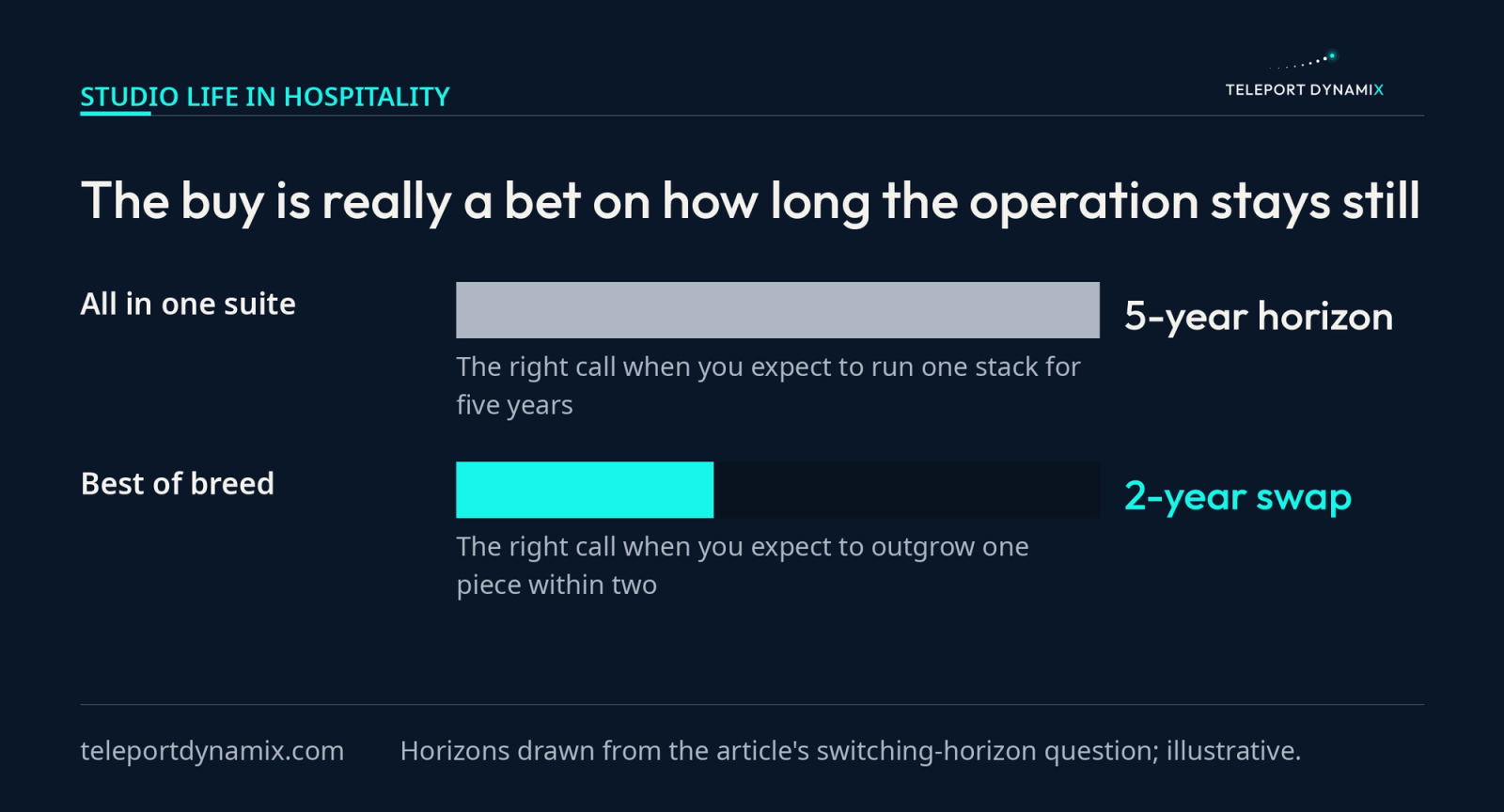
| What is your switching horizon? | Long. You expect to run this for five years. | Short. You expect to outgrow at least one piece within two. |
Three or four answers on one side and the decision is made. Stop reading comparison pages and go buy the thing. The last question does the heaviest lifting, because the buy is finally a bet on how long the operation will sit still.
Split answers mean the operation is telling you something
Two and two is the interesting case, and it is more common than the tidy version. It usually means one part of the operation has outgrown a suite while the rest has not.
That is a real finding, and it has a real answer: keep the suite as the spine, and take one system out of it. This is the pattern behind the argument this whole series is making, which is why it arrives here, in the fifth chapter, rather than at the start. Get the sequencing wrong and you will end up running a scalability review on a stack you chose by feature grid.
Both answers are downstream of a category nobody built
Now the part the vendors will not say out loud.
You are choosing between coverage and depth because those are the only two shapes on the shelf. Suites were assembled by buying adjacent products and merging them. Best of breed exists because specialists went deep on one slice and left the rest of the operation to you. Neither shape was designed around how a property actually runs a night. Both are the residue of how the software industry allocated its attention, and hospitality was never where that attention went, which is the fuller argument in hospitality software was built for someone else.
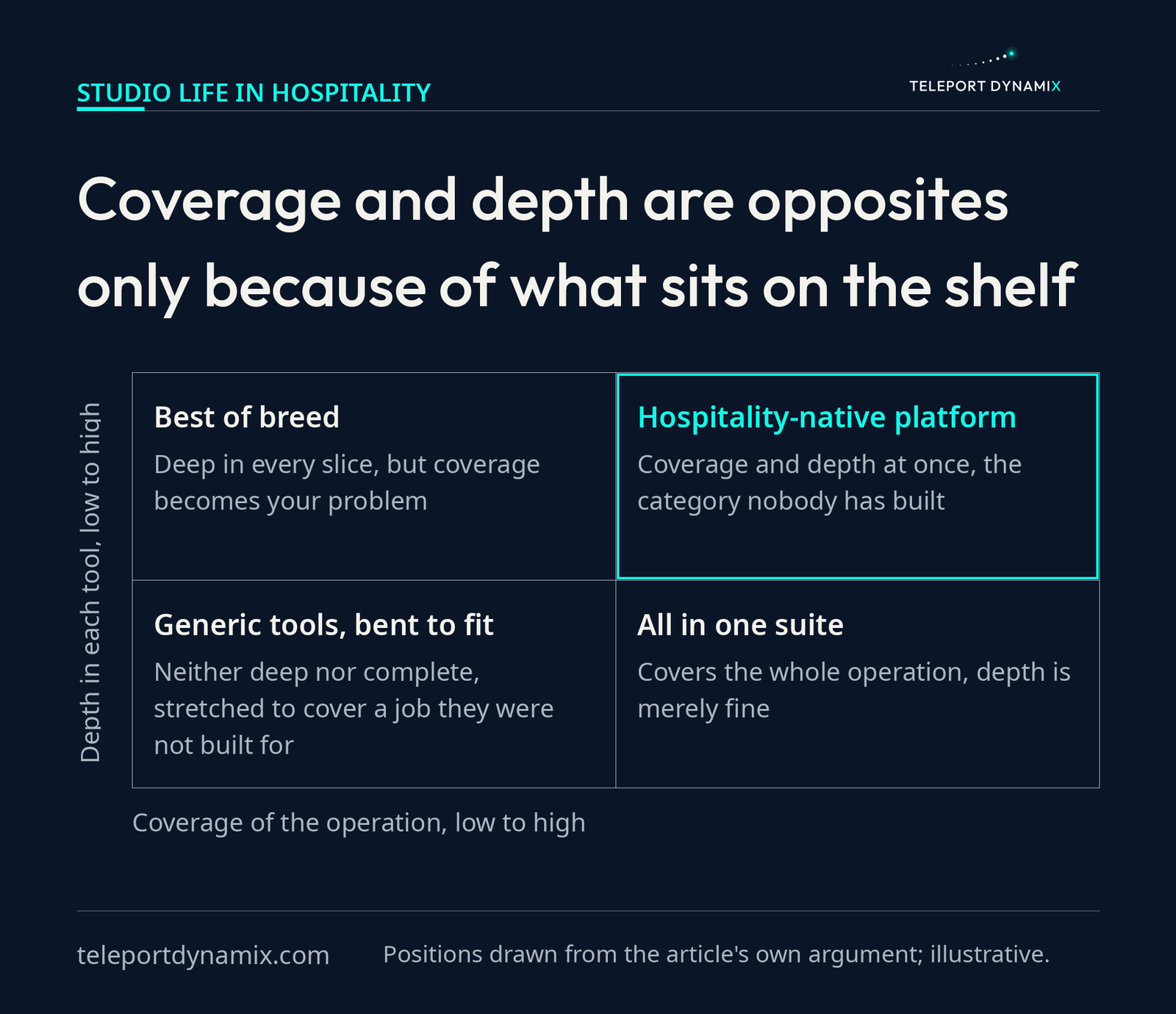
That is the real reason this decision feels like picking a lesser evil. Because it is.
Software built for hospitality from the first line of code does not force the tradeoff, because coverage and depth stop being opposites once one team owns the whole operation as a single problem. What that top-right quadrant actually is, the category nobody has built, gets its name and shape in hospitality management platform built for the shift. That is the bet our studio is built on, and how we choose what to build starts with an operator's shift rather than a category on a shelf. It is also why we take equity instead of billing for a build: a product that does not fit the operation is our problem too.
What this looks like when it works
Two operators, same week, opposite answers. Both right. The pattern underneath them is worth naming before the details:
- The operation decided, not the software. Neither buy came from a feature grid, and neither would flip if the vendors renamed their tiers.
- The edge is the deciding variable. Where a real edge exists, depth wins the slot that carries it; where it does not, coverage wins the whole stack.
- The same four questions produced opposite buys. That is the framework working, not failing.
The 60-cover independent
One site. Good food, standard service, no unusual labor model, no distribution edge. Nobody in the building wants to own an API.
Four questions, four answers pointing the same way. Buy the suite, take the coverage, accept that the scheduling module is merely fine, and put the saved hours into the floor. Anyone selling this operator a six-vendor stack is selling them a second job.
The 40-key boutique with a serious restaurant
Two operations under one roof, and the restaurant is the reason people book the rooms. The food and beverage side is the edge, distribution is complex, and the group already pays for senior technical judgment, which is what a fractional CTO is for.
Here the seams are worth owning. Keep a strong property management spine, run the best restaurant system money can buy alongside it, and accept the integration work as the price of the thing that makes the business special. For a rooms operation carrying that same burden, hotel technology integration and why it keeps failing explains why the property management spine is the hardest seam to hold across every new vendor.
The lesson generalizes, and the trade press covering restaurant operations and full-service technology says it constantly. The right answer is a function of the operation, not the software. Which is also the argument for why the operation, not the category, should be what somebody finally builds for. That is what the ventures on our line exist to prove, and it is the conversation happening at every serious industry gathering now that the cost of building the specific thing has collapsed.
Frequently Asked Questions
What software do most restaurants use?
Restaurants typically run a point of sale as the backbone, plus scheduling, inventory, accounting, and some form of online ordering. Smaller sites usually buy that as one suite. Larger groups tend to run a stronger point of sale alongside specialist tools for labor and inventory, and connect them.
Which is the best restaurant software?
There is no single best, and any answer that ignores your operation is a sales pitch. A suite is best when you run one standard site with nobody to manage integrations. Best of breed is best when one part of the operation is your competitive edge and someone can own the connections between systems.
Is free restaurant POS software actually free?
Free point of sale software is usually paid for somewhere else, typically through payment processing margin, hardware commitments, or a cover volume ceiling that triggers a paid tier. That can still be an excellent deal for a small site. Read the processing rate and the data export terms before you commit.
How much does an all in one restaurant system cost?
Expect a monthly software fee per terminal or per site, plus hardware, plus payment processing. The honest number is the total of those three over three years, not the headline monthly price. Add migration hours and staff retraining, because both are real costs that no vendor quotes you.
When does best of breed beat an all in one suite?
Best of breed wins when a specific part of your operation is how you compete, when you run several genuinely different sites, or when you expect to outgrow at least one system within two years. It also wins when somebody in the business can own the integration work without abandoning the floor.
Can you switch from an all in one suite later?
Yes, but the exit cost is the thing to check before you sign, not after. Ask how guest and sales data leaves the system, in what format, and at what price. A suite with clean data export is a reversible decision. A suite without one is a five-year commitment wearing a monthly invoice.
Continue Reading:
More In This Series:
- Hospitality Software Was Built for Someone Else
- Your Restaurant Tech Stack Breaks at the Same Seams
- Hotel Technology Integration and Why It Keeps Failing
- Restaurant Software Integration Is Not a License Fee
- Hospitality Management Platform Built for the Shift
More from Teleport Dynamix:
- Cloud Cost Optimization Is Engineering, Not Billing
- FinOps Is an Operating Discipline, Not a Cost Tool
- Startup Fundraising Is a Purchase, Not a Milestone
- Pitch Deck Is a Trailer, Not the Film Investors Buy
Explore the Insights Categories:


