





Restaurants are not short of software, and the four places their stack tears are predictable enough to name in advance.
Ninety-nine percent of restaurant operators now run a point of sale, and ninety percent of full-service operators run a reservation system on top of it, on the survey numbers reported by FSR. Seventy-four percent plan to spend more on technology in the next six months. Nobody is short of software.
What is short is agreement between the pieces. A restaurant tech stack is six or seven products, bought at different times, from different vendors, for reasons that made sense one at a time. The operation runs in the gaps between them, and the gaps are where your shift leader spends the first hour of the day.
Those gaps are not random. They sit in four specific places, and every one of them is a spot where two companies each built as if the other did not exist.
Key takeaways
- Adoption is finished. Ninety-nine percent of operators already run a point of sale, so the remaining problem is not buying, it is connecting.
- A restaurant tech stack is six or seven products bought at different times, from different vendors, for different reasons. The operation lives in the gaps between them.
- Four seams do almost all the damage: the menu, the order route into the kitchen, the cost and sales reconciliation, and the guest record.
- Consolidation is the industry's current answer and it half works. It moves the seams inside one vendor rather than removing them.
- A stack built for the shift starts from the operation and treats the systems as one, which is a build decision, not a purchasing decision.
Six layers, bought one at a time, running as if alone
Strip the marketing away and the stack is short enough to list. There is a point of sale, which is the till and increasingly the system of record for sales. There is a kitchen display that turns tickets into work, of the kind Lightspeed sells as a KDS. There is a reservation or table management tool. There is online ordering and the delivery aggregators. There is inventory and purchasing. There is scheduling and payroll.
Six layers, plus payments underneath all of them. Add a loyalty program and a marketing tool and you are at eight.
- The point of sale anchors the stack and increasingly acts as the system of record for sales.
- The kitchen display turns tickets into work on the line.
- Reservations and table management own the book and the floor plan.
- Online ordering and the delivery aggregators bring demand in from outside the room.
- Inventory and purchasing track what you bought against what you sold.
- Scheduling and payroll decide who is on, sitting on the payments layer that carries all of it.
That is the answer in one paragraph. The rest is the mechanism.
Each layer solved its own problem, correctly
None of these products is bad at its job. A modern restaurant point of sale takes payment, prints the ticket and closes the till accurately. A delivery integration platform does exactly what it promises, which is to stop three tablets from three aggregators sitting on the pass.
The failure is not inside any of the boxes. It is that each box was designed and priced as a standalone purchase, and your restaurant is not a standalone purchase. It is one operation that happens to be running eight of them at once.
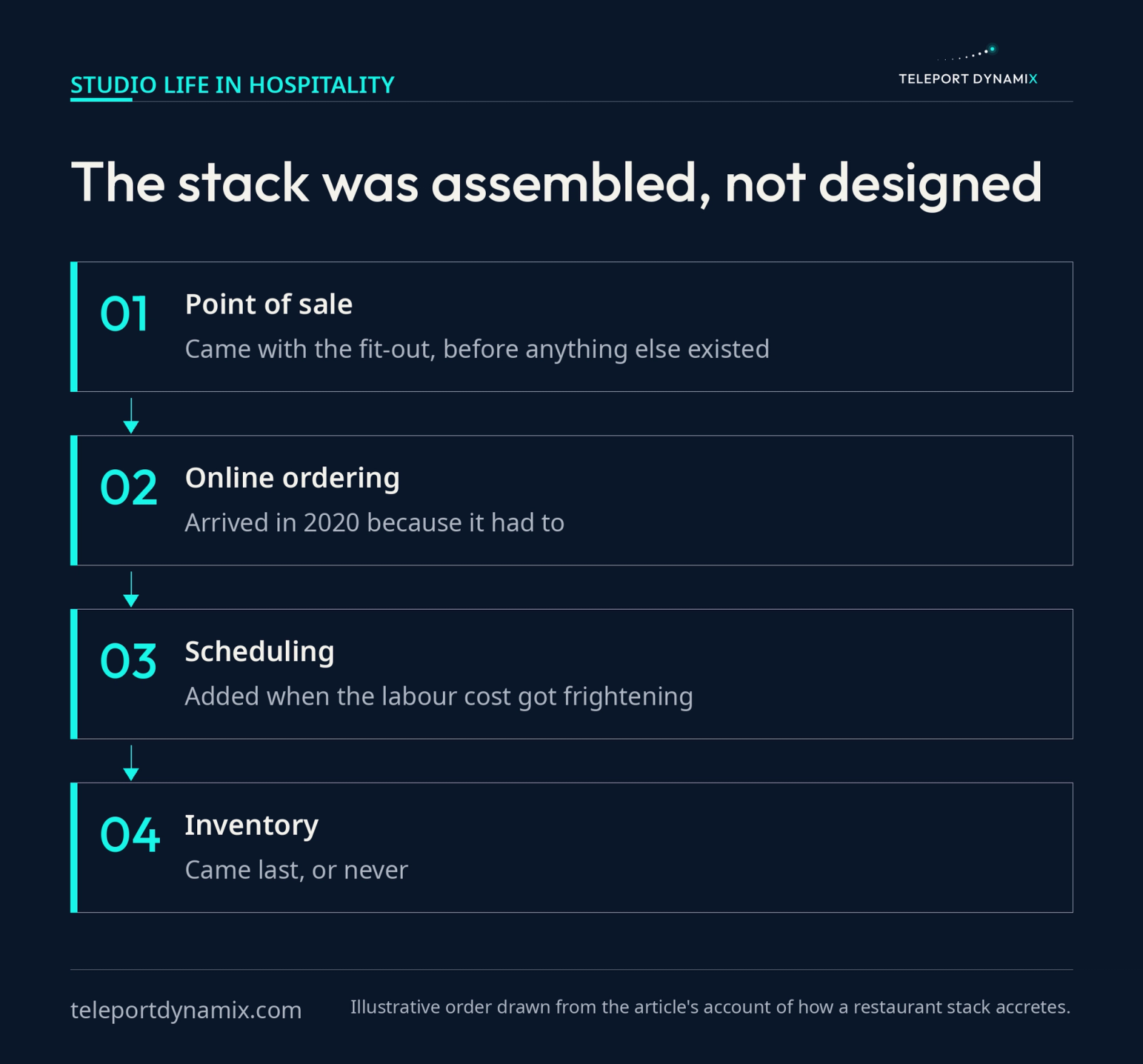
The stack was assembled, not designed
Ask an operator when they chose their stack and you get a timeline instead of a decision. The POS came with the fit-out. Online ordering arrived in 2020 because it had to. Scheduling was added when the labor cost got frightening. Inventory came last, or never.
Bought separately. Run together.
Fragmentation is a supply-side outcome, not a discipline problem
Operators get told, gently, that better process would fix this. It would not. The fragmentation was decided upstream of you, by how the products were built and sold, and no amount of internal tidiness closes a gap that exists between two companies' roadmaps.
Software vendors build for a market they can price and repeat. A POS company sells a POS to fifty thousand restaurants and gets paid per terminal. Nothing in that business model pays them to make the schedule agree with the ticket, and nothing in the scheduling vendor's model pays them either. The integration between the two is nobody's revenue line, so it becomes nobody's product.
- The POS vendor is paid per terminal, so it optimizes the till and stops at its own edge.
- The scheduling vendor is paid the same way, so making the roster agree with the ticket is nobody's line item.
- The seam between them belongs to no one, which is why it survives every new generation of vendor.
That is why the trade press has been running the same integration story for a decade, filed most recently as the great tech integration race, and why sector overviews still describe the landscape as a set of categories rather than a system. The categories are the vendors' shape, not yours.
Hotels have exactly the same disease
None of this is a restaurant peculiarity. Hoteliers describe the same problem in different vocabulary, which is why the hotel trade asks openly whether the tech stack is weighing operators down, and why hotel technology coverage now frames the interesting news as tools moving from standalone into connected operations.
This piece is the restaurant chapter of a series that starts from a simple claim, that hospitality software was built for another industry and bent to fit, and the restaurant floor is where the bending shows first. If you run rooms rather than tables, the same failure wears a hotel-shaped costume, which is the subject of why hotel technology integration keeps failing.
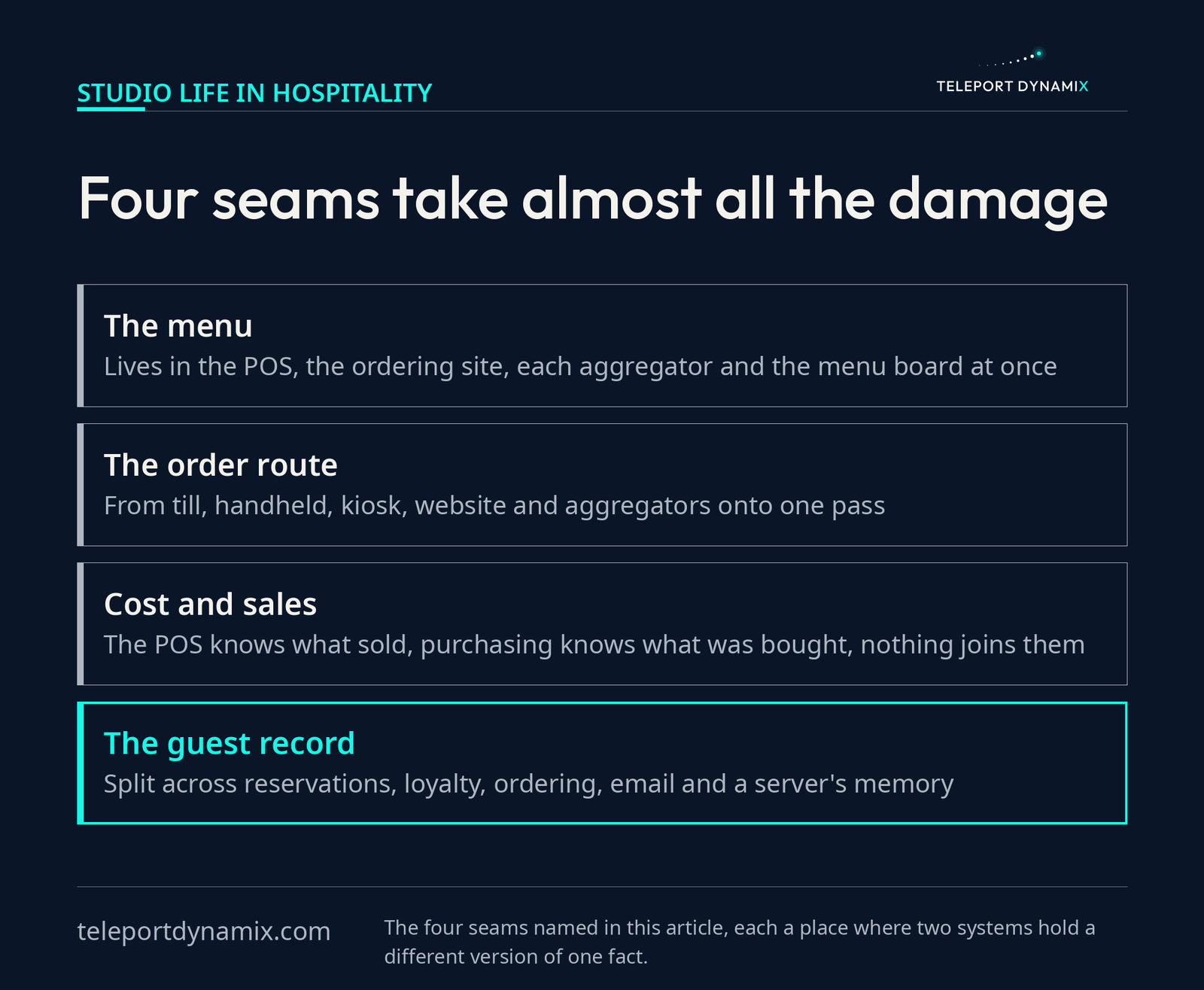
Four seams take almost all the damage
Abstraction is comfortable here, so let us be exact. When a restaurant tech stack fails, it fails in four places, and each one is a place where two systems hold a different version of the same fact.
The menu is the first thing to disagree
Your menu exists in the POS, in the online ordering site, in each delivery aggregator, and on the digital menu board. Change a price or 86 an item and you are updating it four times, by hand, during service.
Operators say so out loud. Ask them what goes wrong with digital ordering and menus failing to sync across technologies comes back unprompted, which is a strange complaint when you read it slowly. A restaurant's menu is the product. The stack cannot agree on the product.
The fix is not a tidier spreadsheet. It is treating the menu as one object with one owner, which is what menu management systems are for, and what a back-of-house platform is doing when it holds recipes, allergens and menu costing in one place and pushes them outward. That approach works exactly as far as the systems downstream agree to read from it. Nothing in an assembled stack agreed to anything.
The order route into the kitchen
Orders arrive from the till, the handheld, the kiosk, the website and three aggregators, and every one of them has to end up as work on a line that has one screen and one pass. When that route holds, it is invisible. When it breaks, it breaks at the worst possible moment, because the moment it breaks is the moment volume is highest.
The same body of research found that among operators using handhelds, 79 percent report their handhelds are integrated with the kitchen display, per Restaurant Technology News. Which tells you that one in five have a handheld taking orders that the kitchen screen does not know about.
Cost, sales and the reconciliation nobody enjoys
The POS knows what you sold. Purchasing knows what you bought. Neither of them knows your plate cost without someone building the bridge in a spreadsheet, which is why 48 percent of operators say they are only somewhat confident in their own forecasting, on the same research.
Confidence is not a personality trait here. It is a function of whether the numbers arrive joined up or in five exports.
The guest, split five ways
Guest history sits in the reservation system, the loyalty program, the online ordering account, the email tool and the server's memory. None of them is wrong. None of them is complete. So a guest on their tenth visit gets greeted like a stranger by whichever screen happened to be open.
Closing that gap is the entire premise of a restaurant CRM, which pulls the scattered records into one profile the floor can actually see. It closes the gap for the systems that agreed to feed it, and leaves the rest of the guest wherever it already was.
Four seams, one shape. The operation is continuous and the software boundaries are arbitrary, and the person absorbing the difference is the person running the floor.
Consolidation is the industry's answer, and it half works
Operators worked this out long before the vendors did. Ask an operator which efficiency strategy they are actually pursuing and consolidating the technology stack arrives ahead of every shiny option on the list. The market has caught up with them and is now sorting itself into two camps, the single suite on one side and best-of-breed systems joined by integrations on the other.
Consolidation is the right tool when your operation is close to standard and you value one bill and one support number over depth in any single layer. It genuinely reduces the number of places a fact can go missing. Nobody sensible should sneer at it.
The two camps split cleanly, and they split on where the seam goes rather than on whether it survives:
- The single suite trades depth for coverage and hands you one throat to choke.
- Best-of-breed joined by middleware trades coverage for the strongest product in each layer, and hands you the integration layer to run.
- Neither camp removes the seam, which is the honest version of the trade taken apart in all in one restaurant software versus best of breed.
But it does not delete the seams. It moves them inside one vendor's roadmap, where you can no longer see them and can no longer route around them. The suite's scheduling module is rarely as good as the best scheduling product, and when your operation does something unusual, you are back to an export.
| Approach | What it is | Where the seams end up |
|---|---|---|
| All-in-one suite | One vendor, one bill, one support number | Inside one vendor's roadmap, out of your sight |
| Best-of-breed plus middleware | The strongest product per layer, joined by an integration layer | On your desk, owned the day an API changes on a Friday |
| Built for the shift | One team owns the whole path, designed for the operation | Designed out, because the operation came before the categories |
Middleware is the same trade in a different coat
The other answer is an integration layer that translates between systems you keep. It works. It also means you now own the seams, and someone has to care when an API version changes on a Friday. What that ongoing care actually costs, well past the license line on the quote, is the whole point of why software integration is not a one-off license fee.
Operators will tell any survey that technology gives them a competitive edge, and they are not wrong to say it. Notice what that answer does not say. It does not say the technology fits.
What a stack designed for the shift does differently
Start from the operation instead of the product categories and the picture inverts:
- The menu becomes one object that every channel reads, rather than four copies that drift.
- The order becomes one record, from wherever it entered to whatever came off the pass.
- The guest becomes one person, not five partial rows in five systems.
- Cost and sales meet nightly, with no human courier carrying exports between them.
None of that is exotic engineering. It is what you get when the same team owns the whole path and designs it for a Friday service rather than for a category on a pricing page. That is what our studio is for, and it is why we build alongside operators instead of handing over a specification. The shape of the category that does this on purpose, venture after venture, is drawn in a hospitality management platform built for the shift.
It is a build decision, not a purchasing decision
The reason this rarely happens is that the operator making it is not a software company, and running one inside a restaurant group is a permanent tax. Groups that survive that usually buy senior engineering judgment before they buy engineers, which is the entire argument for a fractional CTO over a first technical hire, and the same instinct behind an honest technology audit before anyone writes code.
We take the other side of that trade. We co-build, we sit on the cap table rather than send an invoice, and our equity model means a product that does not work is our problem too. Hospitality is the only industry we point the line at, which is a cost we accept, because the depth is the thing a generalist cannot copy.
What the operator actually gets back
An hour a morning, for a start. The manager stops being the integration layer, and the exports stop being a job. The industry has been promising that hour back from a conference stage for a decade, and the honest summary is that the conversation is older than the technology.
Adoption is done. The build is what is left.
Frequently Asked Questions
What technology is used in restaurants?
Restaurants run a point of sale, a kitchen display, a reservation or table management tool, online ordering with delivery aggregators, inventory and purchasing, and scheduling with payroll, all sitting on a payments layer. Larger operations add loyalty and marketing tools. Almost every one of those categories was invented elsewhere and adapted for restaurants afterwards.
What does a typical restaurant tech stack include?
Six to eight separate products, bought at different times from different vendors. The point of sale is usually the anchor, since survey data puts adoption at 99 percent of operators, with reservations, online ordering, kitchen display, inventory and scheduling layered around it. Typical also means unintegrated, because the pieces were purchased one at a time.
How much should a restaurant tech stack cost?
Budget by seam, not by product. Software subscriptions and payment processing are the visible costs, but the real cost is the labor spent reconciling systems that do not agree, which lands on a salaried manager and never appears on an invoice. Price the manual hours before you price the licenses.
Which part of the restaurant tech stack breaks first?
Menu synchronization, usually. Prices and availability live in the POS, the website, each aggregator and the menu board, and operators routinely name menus failing to sync as one of the direct problems with digital ordering. Order routing to the kitchen breaks next, and it breaks hardest at peak volume.
What is the 30/30/30 rule for restaurants?
A cost-structure heuristic that splits revenue roughly into 30 percent food cost, 30 percent labor and 30 percent overhead, leaving around 10 percent profit. It is a rough guide rather than a law. It matters for technology because a stack that costs a manager an hour a day is quietly billing the labor line.
Does the 60/40 restaurant rule apply to technology?
Not directly. The 60/40 rule of thumb concerns prime cost, the share of revenue absorbed by food and labor combined, and it says nothing about software spend. Technology touches it indirectly, because reconciliation work sits inside labor, and better connected systems return hours to the shift.
Continue Reading:
More In This Series:
- Hospitality Software Was Built for Someone Else
- Hotel Technology Integration and Why It Keeps Failing
- Restaurant Software Integration Is Not a License Fee
- All in One Restaurant Software vs Best of Breed
- Hospitality Management Platform Built for the Shift
More from Teleport Dynamix:
- Cloud Cost Optimization Is Engineering, Not Billing
- FinOps Is an Operating Discipline, Not a Cost Tool
- Startup Fundraising Is a Purchase, Not a Milestone
- Pitch Deck Is a Trailer, Not the Film Investors Buy
Explore the Insights Categories:


