


A Series A is not a bigger seed round, it is a different purchase, and the thing being bought is evidence that the machine repeats.
Why does a Series A lead test whether a customer pays back their acquisition cost inside twelve months? Because that one number separates a company that funds its own growth from one that needs the next round to survive. The benchmark has been sitting in the open for over a decade, next to its partner: a customer should be worth more than three times what they cost to acquire.
Nobody at seed asked you for that. At seed the investor's check was written against you, your rate of learning, and a market thesis that could still be wrong in a forgivable way.
At Series A the check is written against a machine. This is the third piece in a six-part series on the raise. The series opens by arguing that startup fundraising is a purchase, not a milestone, and this is the piece where the thing being purchased changes completely.
Key takeaways
- Seed money buys the team and the rate of learning. Series A money buys proof that a customer costs less than they are worth, predictably.
- The benchmark is public and old: a customer worth more than three times what they cost to acquire, with that cost recovered inside twelve months.
- Technical due diligence becomes real at Series A. The scalability ceiling and the technical debt get scored, and the founder is usually the last to see the report.
- Graduation from seed to Series A is far rarer than the ladder metaphor suggests, and that gap is structural, not personal.
- Raising a Series A on seed-stage evidence is how a good company gets a bad term sheet. Not raising yet is a position you can hold on purpose.
Seed buys the team. Series A buys the engine.
Both rounds look like fundraising. They are different products sold to different buyers with different definitions of a good answer.
A seed investor is buying an option on a group of people. The portfolio math assumes many of those options expire worthless, so the diligence is proportionate: a few reference calls, a look at the market, a judgment about whether these particular humans will figure it out faster than the money runs out.
A Series A investor is buying a machine that has already been switched on. The check is large enough that the fund cannot treat it as an option, so the questions move from the people to what the people built: the cohort file, the channel history, the codebase, and a scalability answer with a number attached.
The seed round, the Series A and the Series B each underwrite a different claim, demand a different kind of evidence, and are checked by a different kind of reader.
| Round | What the check underwrites | What evidence it demands | Who runs the diligence |
|---|---|---|---|
| Seed round | The team and its rate of learning | A market thesis and something working in front of users | The partner, over a handful of reference calls |
| Series A | Proof the acquisition and retention engine repeats | Cohort retention and payback measured across several quarters | An outside reviewer hired to audit the economics and the code |
| Series B | Proof the engine holds when capital is poured into it | The same metrics at multiples of current volume | A deal team with financial and technical specialists |
The evidence moves from forward-looking to backward-looking
Seed decks are arguments about the future. Series A decks are arguments about the past, dressed as arguments about the future.
The lead wants to look at something that already happened. Cohorts that retained. A channel that produced customers at a stable cost across three quarters instead of one lucky month. Revenue that grew because the machine ran, not because the founder personally closed every deal.
That shift is the one founders miss. A lead is comparing you against a distribution built from companies that already did the thing, and a forecast does not compete inside that comparison.
The failure mode is a Series A process running a seed story
Founders bring the seed pitch to the Series A meeting. Vision, team, market size, momentum. It lands well in the first meeting and dies quietly in the third, and nobody tells you why, because partners do not enjoy explaining that the deck was fine and the data was thin. A pitch deck is a trailer, not the film investors buy, and at Series A the film is the evidence sitting behind the slides. A process running on seed evidence is the round you should not have run.
What a lead is really testing behind the polite questions
Every question in a Series A meeting is a proxy for one underlying question: if we put $10 million into this, does more come out, reliably, and can we tell in advance how much?
Payback period, the retention curve and the lead's ownership target are the three tests that carry the weight.
| Test | What it proves | Why it cannot be faked | What a weak answer does |
|---|---|---|---|
| Payback period | The business funds its own growth out of customer cash | Spending harder shortens nothing, it only enlarges the loan | Every new customer becomes a claim on the next round |
| Retention curve | The product is load bearing in someone's working week | Budget buys signups, never a curve that flattens | The lead reads the traction as rented attention |
| Ownership target | The fund can return itself on a single winner | Fund arithmetic fixes it before your valuation is discussed | The valuation falls to whatever the target allows |
Unit economics, and whether they survive being scaled
Payback period is the number people underweight, because it never appears on a growth chart. The underlying math is published in full, down to the months-to-recover-CAC calculation and the gross-margin adjustment it needs. Growth rate impresses. Payback period decides.
Retention, because it is the only metric that cannot be bought
That is why the lead asks for the cohort file rather than the summary chart. A summary chart is a claim. A cohort file is a record nobody can edit after the quarter closes.
Funds screen for whether the revenue repeats when the founder is not in the room, and whether the curve holds through a quarter where nothing goes right.
Ownership, which decides the valuation before you discuss it
A lead works backwards from the ownership its fund model requires at entry, and that target is fixed long before your valuation is discussed. Teleport Dynamix plans against roughly a fifth of the company at the A, which is our working number rather than a market rule.
Whatever narrative you bring, the check size and the ownership target multiply out to a price. The legal machinery then expresses that arithmetic in clauses rather than numbers: liquidation preference, protective provisions, the option pool and who it comes out of.
Read a term sheet clause by clause long before one is in front of you, because the valuation you argue about in the room is only the part of the deal that has a number on it. That number is a price you have to grow into. The quality of the pitch does not set it.
Diligence stops being a conversation and becomes an audit
Teleport Dynamix works this from the other seat. At seed, technical diligence is a friendly call where a partner asks what you built it in. At Series A, an investor hires someone to open the hood, and that someone is not there to be encouraging.
The firm publishes a Technical Due Diligence service for exactly that moment, because investment committees want a read that does not come out of the founder's own deck: risk, technical debt and the scalability ceiling, scored and prioritized for the committee.
What a technical due diligence review scores
Elegance is not on the list. Three questions carry the review, in this order.
- Can the architecture carry ten times the current load. If not, the rewrite has a price in months and money, and the investor wants both figures.
- How much of the codebase is a liability. An engineering hire who spends two quarters paying down debt is not building the plan you sold.
- Would the security and data posture survive procurement. The first enterprise customer in your plan runs a review before they sign anything.
Our own Business-IT Alignment Audit publishes its weighting, and the seven dimensions below combine into the 0 to 100 composite an investment committee reads. Each is scored on a calibrated 0 to 5 rubric before it is weighted, audited against ISO/IEC 25010, ISO/IEC 27001, OWASP, SOC 2 and GDPR.
| Dimension | Weight in the 0 to 100 score | What a low score signals to a Series A lead |
|---|---|---|
| Architecture | 20 | The scale story in the plan needs a rewrite first |
| Infrastructure and Cloud | 20 | Growth multiplies the cloud bill faster than it grows revenue |
| Security | 15 | Enterprise procurement stalls the pipeline sitting in the deck |
| Code Quality | 15 | New engineers pay down debt instead of shipping the roadmap |
| Performance | 10 | The product degrades exactly when usage proves the thesis |
| Process and Delivery | 10 | Roadmap dates slip and shipped scope keeps missing the plan |
| Business-IT Alignment | 10 | Engineering effort drifts away from the commercial priorities |
Read the sample on that page as a founder, not as a customer. It is redacted from a real engagement and scores 62, grade C, with 2 critical, 4 high, 7 medium and 5 low findings. A 62 is a perfectly normal company. It is also a document that lands in an investment committee before you get to explain it.
The report exists whether or not you commission it
You do not get to opt out of technical diligence. You only get to choose whether you read it first.
A founder who has already run a scalability review walks into the process with the ceiling identified, a costed plan to raise it, and a written rationale per finding. A founder who has not is discovering their own critical findings in a room full of people deciding whether to wire money.
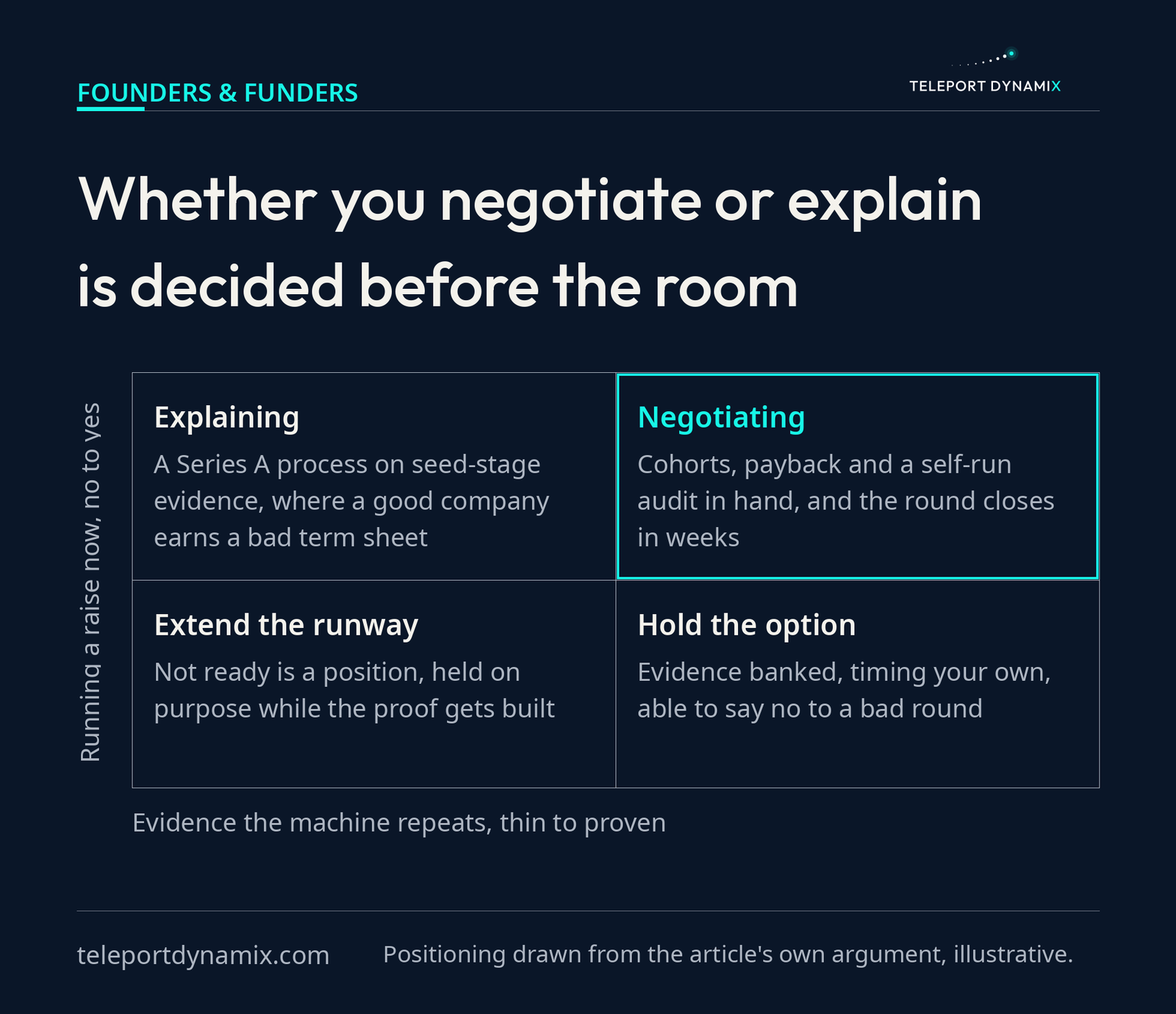
One of those founders is negotiating. The other is explaining.
Governance arrives with the money and does not leave
The seed round gave you an information right and a friendly investor who answered emails. The Series A gives you a board.
Two founders, one lead investor, one independent, in some arrangement. From that day, hiring a VP, changing the plan, or selling the company becomes a conversation with people whose fund math is not identical to your life.
- A board seat replaces the update email. Hiring, pivots and a sale now pass through a room that includes people who do not share your timeline.
- Consent rights decide your daily freedom. The price is one line. The protective provisions are the lines that say what you can do without asking permission.
- The board does not leave when the market turns. It is a standing feature of the company from the day the money lands.
A good board is genuinely useful, the mechanics of running the meeting are published in detail, and the operators who write candidly about this, such as Fred Wilson's two decades of daily posts, tend to describe the board as the single biggest input on whether the next two years go well or badly.
Read the consent rights as if the plan fails, because that is the scenario they were written for. They are the clauses founders skim, because they are boring and the price is exciting.
A clause by clause walkthrough of a venture term sheet takes each one in turn, from the liquidation preference to the protective provisions and the drag along, and operating guides written by the people who close these rounds cover the same clauses from the fund's side. The hour it takes to read both is the cheapest hour in the entire raise.
Graduation from seed is rarer than the ladder metaphor suggests
Seed, Series A, Series B. It reads like a staircase. It is not a staircase, it is a filter, and the filter is tight.
Of the companies that raised a seed round in the first quarter of 2022, 15.4% had raised a Series A within two years, against 30.6% of the cohort that seeded in the first quarter of 2018. The direction of that number explains more about how a Series A process feels than any advice about the deck does.
The squeeze is structural. Seed checks got cheap to write, the number of firms writing eight-figure Series A checks did not grow with them, and the running coverage of the funding market has documented the same pattern on both sides of the Atlantic.
The arithmetic behind that is not mysterious. A seed check is small enough that a new manager can write dozens of them out of a first fund, while an eight-figure Series A check needs a fund large enough to hold one position for a decade and reserve capital behind it for the rounds after. The supply of the first grew with the number of managers. The supply of the second grew with the amount of capital willing to wait that long, and those two lines were never going to stay parallel.
So the base rate is against you, and it is against you for reasons that have nothing to do with your company. Plan accordingly, and stop reading a failed process as a verdict on the idea.
Why a seed extension beats a Series A you cannot win
Founders treat a bridge as a scarlet letter. The investors who do this for a living talk about the raise in far less dramatic terms, and a seed fund would rather extend runway than watch a company run a Series A process it cannot win. A bridge is easier to hold when the seed round left room for one, which is part of why how to raise a seed round without losing the company matters more than it looks at the time.
A failed Series A process is expensive in a way founders underestimate. It burns three to five months of founder attention, it puts your data in front of every relevant fund in your category, and it makes the next attempt harder, because a partner who passed once has a written reason on file.
Venture debt and runway extension sit in the same conversation, and the banks that lend into this market publish plainly about when borrowing beats diluting. Borrowed money is repaid. Sold ownership is not.
Not ready is a position, and you can hold it on purpose
Sometimes the evidence does not exist yet, and no amount of deck work will conjure it. The useful question then is what a month of runway is worth against a point of ownership.
Extend the runway before you sell the ownership
Every month of runway you find without raising is a month of ownership you keep. That is not a mindset. That is arithmetic, and it is arithmetic we run on our own cap table, because Teleport Dynamix takes equity in the ventures it co-builds and gets diluted alongside the founder at every round.
Cloud spend is the usual place the money is hiding. Our Cloud Cost Audit puts 20 to 40% of cloud spend within reach of recovery for companies running on AWS, GCP or Azure, through right-sizing, storage optimization, configuration and architecture calibrated to the scale they actually run at.
Read cloud cost optimization is engineering, not billing before you accept the bill as fixed, because that recoverable share is found by engineers reading architecture rather than by finance reading invoices. Selling equity to fund an oversized database happens quietly, in the weeks before a raise.
Build for the evidence instead of for the process
The studio line produces this evidence in the order a Series A lead asks for it: 50 or more real customer interviews in weeks 3 to 6, a working product in front of real users by month 3, and a verdict on investor-readiness by month 4. That is the process, and this exact moment is the reason it is built that way.
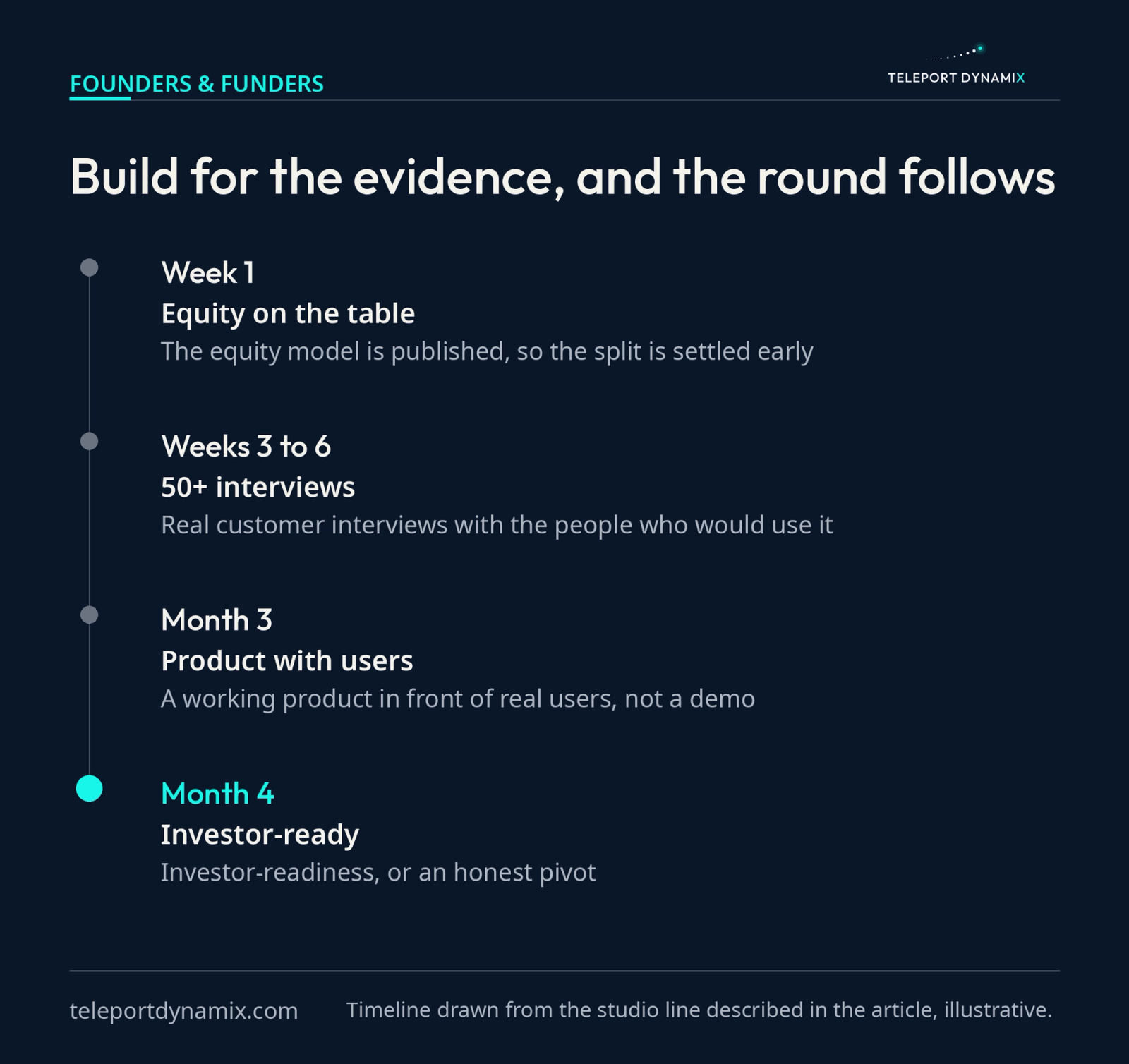
A full-time founder co-building with us keeps 65 to 75% of the venture, and the equity model is published so the conversation happens in week one rather than in a term sheet two years later. The share of the company you still hold is the only thing that lets you walk away from a Series A you do not like.
The founder advice that survives contact with the growth stage keeps circling the same failure: a company that raised on a story, hired against the story, and then had to tell the board the story was not true. Raising too early trades ownership for obligations that outlast the plan they funded.
How this looks when it works
From the outside it looks unremarkable, and that is the tell.
- The diligence confirms, it does not surprise. The reviewer finds exactly what the founder said would be there.
- The round closes in weeks. The questions were answered before anyone in the room got to ask them.
- The valuation follows the evidence. The price is a consequence of what is proven, and the founder keeps enough to run the company.
The founder walks in with twelve months of cohort data, a payback period they measured rather than modeled, a technical audit they commissioned themselves, and a costed answer to the scalability question before it is asked. That is what the investor view of a studio is built around, and it is worth deciding whether that fit is right for you long before the term sheet exists.
Evidence first. The round follows.
Frequently Asked Questions
What's a good Series A raise?
A good Series A raise is sized to the specific piece of evidence you need to produce next, rather than to a headline. Teleport Dynamix plans against 8 million to 15 million dollars for a US round, though the number matters far less than the ownership you sell and what the money is actually buying.
How much money does Series A funding give?
Series A check sizes vary widely by sector and geography, and Teleport Dynamix works to a planning range of 8 million to 15 million dollars in the United States. The check is derived from the lead's ownership target, which we plan at roughly a fifth of the company, multiplied against a valuation the evidence can support.
How hard is it to raise Series A?
Hard, and harder than the seed round by a wide margin. Of the companies that raised a seed round in the first quarter of 2022, 15.4% had raised a Series A within two years, against 30.6% of the first-quarter 2018 cohort. That base rate reflects the funding market rather than your specific company.
What is the difference between Series A and B fundraising?
Series A underwrites whether a repeatable acquisition and retention engine exists. Series B underwrites whether that engine scales when capital is poured into it, so the diligence shifts from proving unit economics to proving they hold at multiples of current volume. Series B investors buy expansion. Series A investors buy repeatability.
What are common Series A terms?
Preferred shares with a 1x non-participating liquidation preference, pro rata rights, an option pool top-up, a board seat for the lead, and protective provisions requiring investor consent for major decisions. The price is the line founders negotiate. The consent rights and the preference stack govern what happens when the plan stops working.
What is a Series C fundraise?
A Series C is a later growth round, raised once the business model is proven and the capital is buying scale, geographic expansion, or acquisitions rather than product-market fit. Investors at that stage include growth funds and crossover investors, and diligence looks closer to a financial audit than a founder assessment.
Continue Reading:
More In This Series:
- Startup Fundraising Is a Purchase, Not a Milestone
- How to Raise a Seed Round Without Losing the Company
- Pitch Deck Is a Trailer, Not the Film Investors Buy
- How to Pitch Investors When They Are Triaging You
- Startup Valuation Is a Price You Have to Grow Into
More from Teleport Dynamix:
- Cloud Cost Optimization Is Engineering, Not Billing
- FinOps Is an Operating Discipline, Not a Cost Tool
- Hospitality Software Was Built for Someone Else
- Hospitality Management Platform Built for the Shift
Explore the Insights Categories:


