


Investors are not evaluating your company in the first meeting, they are triaging it, and the difference decides everything you should do in the room.
Five things come back from a first investor meeting: silence, a polite pass, a request for materials, a second meeting with a partner who was not in the room, and, occasionally, a term sheet. One of those five decides the outcome, and it is the fourth. Everything you do in the room is a bid for it.
That reframe changes what a pitch is for. A partner is not deciding whether your company is good. They are deciding whether it is worth spending more of the firm's scarcest asset, which is partner time, and they make that call early.
Teleport Dynamix sits on the cap table of the ventures it co-founds, so we are diluted alongside the founder rather than watching from the other chair. We also run technical due diligence for investors, a service built to produce a read of a company's technology that stands on its own evidence. This piece, the fifth in the fundraising series, is written from both of those seats.
Key takeaways
- Five things come back from a first meeting. Only one of them, the second meeting with a partner who was not in the room, is worth optimizing for.
- The first 90 seconds are a triage decision, not an evaluation. The partner is deciding whether you are worth more of the firm's time, not whether the company is good.
- Answer the question actually asked. Founders answer the question they rehearsed, and the mismatch is audible.
- "I do not know, here is how I would find out" outscores a confident bluff every time, because they are underwriting your judgment, not your recall.
- Run a process, not a sequence. Parallel conversations with a hard stop are the only thing that turns a good meeting into a priced round.
Investors triage in the first 90 seconds, they do not evaluate
Evaluation costs hours. A partner does not have hours for every company that reaches them, so triage runs first and the deep work only starts on whatever survives it.
The opening therefore works as a sorting question. Four checks run in the first half minute, before you have reached the part of the pitch you spent the weekend on:
- Thesis. Is this the kind of company the firm has already decided it wants to back?
- Stage. Is it early or late enough to fit the fund they are deploying right now?
- Size. Could it get big enough to return that whole fund on its own?
- The founder. Can this person be trusted with other people's money for a decade?
Which means the first 90 seconds cannot be throat-clearing. They have to answer what the company is, who it is for, and what has already happened, in that order, in plain sentences.
Founders lose the room here more often than anywhere else, and not because the company is weak. They lose it because they built an arc, and an arc requires the listener to wait. Nobody in that chair is waiting.
Say what already happened before you say what will
Forecasts are free, so they carry no information. Evidence is expensive, so it carries all of it.
Open on the thing that has already occurred: users who came back, a cost of acquisition you measured rather than modeled, a retention curve that flattened. The decade of writing on how venture partners actually read early companies keeps landing in the same place. Investors want something that has already happened and is compounding, and internal consistency in a plan is cheap to manufacture.
At the seed stage this is the whole game, which is why raising a seed round without losing the company starts with evidence you can point at rather than a forecast you can defend.
Be legible before you are impressive
The founder who cannot be placed in a category gets sorted into the pile marked "later," and later never arrives.
Give them the shelf to put you on in the first sentence, then spend the rest of the meeting explaining why the shelf is wrong. Reversing that order costs you the room while you are still being interesting.
Answer the question they asked, not the one you rehearsed
Founders rarely lack answers. They fail by delivering a prepared one to a question nobody asked, and the mismatch is audible to everyone in the room.
A partner asks "how do you get your first thousand customers" and hears a five-minute market-size answer. The question was about your distribution and your honesty. What came back was a rehearsal, and the score just moved down.
What every investor question is really asking
Five questions sit underneath almost everything a partner asks in a first meeting, and each one tests something different.
| Question in the room | What it is really testing | What a strong answer carries |
|---|---|---|
| "How big can this be?" | Whether the outcome could return the whole fund | A wedge, the market it opens, the assumption |
| "Why you?" | Whether this team closes the gap it named | An insight the team earned somewhere real |
| "Why now?" | Whether the window opened recently | The specific change that made it possible |
| "Why has nobody done it?" | Whether you understand your own moat | Why earlier attempts failed on their merits |
| "What breaks first?" | Whether you found the flaw before they did | The failure point and the test that watches it |
When you hear a question, name the underlying one before you answer it. Saying "I think you are asking whether this is a feature or a company" tells the room you know what is being scored, and it turns a test into a conversation between two people looking at the same problem.
Cut the answer at the point it is complete
Length reads as anxiety. A founder who answers in four sentences and stops has told the room they are comfortable, and comfort is what a partner is looking for when they imagine you in front of their investment committee.
Then stop talking. The silence after a short answer belongs to them.
Saying you do not know is the highest-scoring move in the room
The most tested moment of any pitch is the question a partner asks that you cannot answer.
Every partner asks one, and the good ones ask it on purpose, because the answer to a question you have not prepared for is the only unrehearsed data they will get from you all meeting.
They are underwriting your judgment
Funding follows what a founder will do in eighteen months, when the plan stops working and there is nobody left to ask. Recall of a number today is a weak predictor of that.
Sam Altman's note on what actually separates the companies worth backing puts the weight on that quality rather than on polish. A bluff answers the question. It also tells the partner exactly how you will behave the first time a board meeting goes badly, which is a far more expensive piece of information than the one they asked for.
The honest answer has a shape
"I do not know" on its own is a shrug. The version that scores has three parts:
- I do not know. Said plainly, without flinching or filling the silence with noise.
- Here is what I would need to know it. The specific data or test that would settle the question.
- Here is when I would have it. A date, so the gap becomes a plan with a deadline attached.
That answer demonstrates the exact thing they are buying. It shows a founder who can hold an open question without panicking, and who converts uncertainty into a plan rather than into a story. Our technical due diligence service is designed to grade the same way, scoring findings against evidence and writing a rationale for each one instead of resting on how confidently a claim was made. No opinion without proof, on either side of the table.
Running a process beats running a series of meetings
Founders take meetings as they come, which produces a sequence rather than a raise, and a sequence has no price discovery in it. Running the raise as a process instead is the through-line of this whole series, because startup fundraising is a purchase, not a milestone: a thing you go out and buy on the best terms you can engineer.
A process differs from a sequence in three concrete ways:
- A start date. You open every conversation inside the same short window, on purpose.
- Parallel conversations. Several firms move at roughly the same speed, so none of them sets the clock alone.
- A hard stop. You name the date the process closes, and you hold to it.
Investors are professionals at reading timelines, and a partner can tell within a question or two whether you are running a raise or drifting through one. Drift reads as weak demand, and weak demand is the one thing a partner can act on immediately by waiting.
From the cap table the arithmetic is blunt. Whatever number the process settles on, every existing holder is diluted at it, so a studio sitting on the register wants the conversations opened together for exactly the reason the founder does.
Three interested investors make a market
One interested investor is a negotiation you lose. Three interested investors on the same timeline is a market, and a market sets a price. That price is a burden you accept rather than a trophy you win, which is the argument in startup valuation is a price you have to grow into, and it is worth reading before you let a competitive round hand you a number you then have to earn.
The founder resources published by early-stage programs such as Antler and Hustle Fund say versions of this repeatedly, and the reason it needs repeating is that running things in parallel feels rude. It is ordinary practice, and it is the difference between being priced and being told the price.
Know the market you are pitching into
Terms, timelines and appetite move. What cleared last year does not clear now, and a founder who has not read the room they are walking into is negotiating against a memory.
The evidence is free and public. Who is raising, at what stage, and on what terms is tracked the week it happens, and almost nobody preparing to pitch reads it until after the meeting that went badly. Read it the week before instead, and you walk in knowing which of your asks is normal and which one you will have to defend.
Signals in the room tell you where you actually stand
The meeting is telling you the outcome in real time. Founders leave without having read any of it, then spend three weeks waiting for an email that was already written.
Five signals show up in a first investor meeting, and each one calls for a different move.
| Signal in the room | What it means | Your move |
|---|---|---|
| An associate alone | A screen, not a decision | Give a crisp version and expect a gatekeeper pass |
| A partner alone | A real look | Answer for the committee they will report to |
| A second partner pulled in | You are worth someone else's afternoon | Shift from explaining to negotiating |
| "Send me the deck" | A polite ending | Read it as a soft no and keep the update running |
| A specific diligence ask | A firm building an internal case | Send the exact numbers within a day |
Who else is in the room, and who is not
Seniority is the cheapest read available to you, because a firm spends its scarcest asset by putting more of it in front of you. Nobody adds a second partner to a meeting they intend to pass on.
Watch what happens at minute twenty. If they stop asking about the company and start asking how much you are raising and who else is looking, the meeting has moved from triage to interest and your job has changed.
The follow-up ask is the real verdict
Specificity is the score. A vague ask costs a partner nothing, while a request for cohort retention by month and three months of gross margin costs someone on their team a week, and firms do not spend that week on a company they plan to pass on.
The deck itself barely moves that needle, which is the whole point of pitch deck is a trailer, not the film investors buy: it can earn the meeting but it cannot survive the questions that follow. The finance and diligence checklists that firms like Kruze Consulting publish for founders are worth reading before the meeting rather than after the ask lands, because the list of documents barely changes from firm to firm.
Diligence audits the claim you made in the room
Every claim that earns a second meeting eventually gets checked by someone who was not in the first one. A firm that hires an outside team to look at a target's technology is buying an assessment that rests on the evidence rather than on the founder's account of it, and that is what a technical due diligence engagement is built to produce.
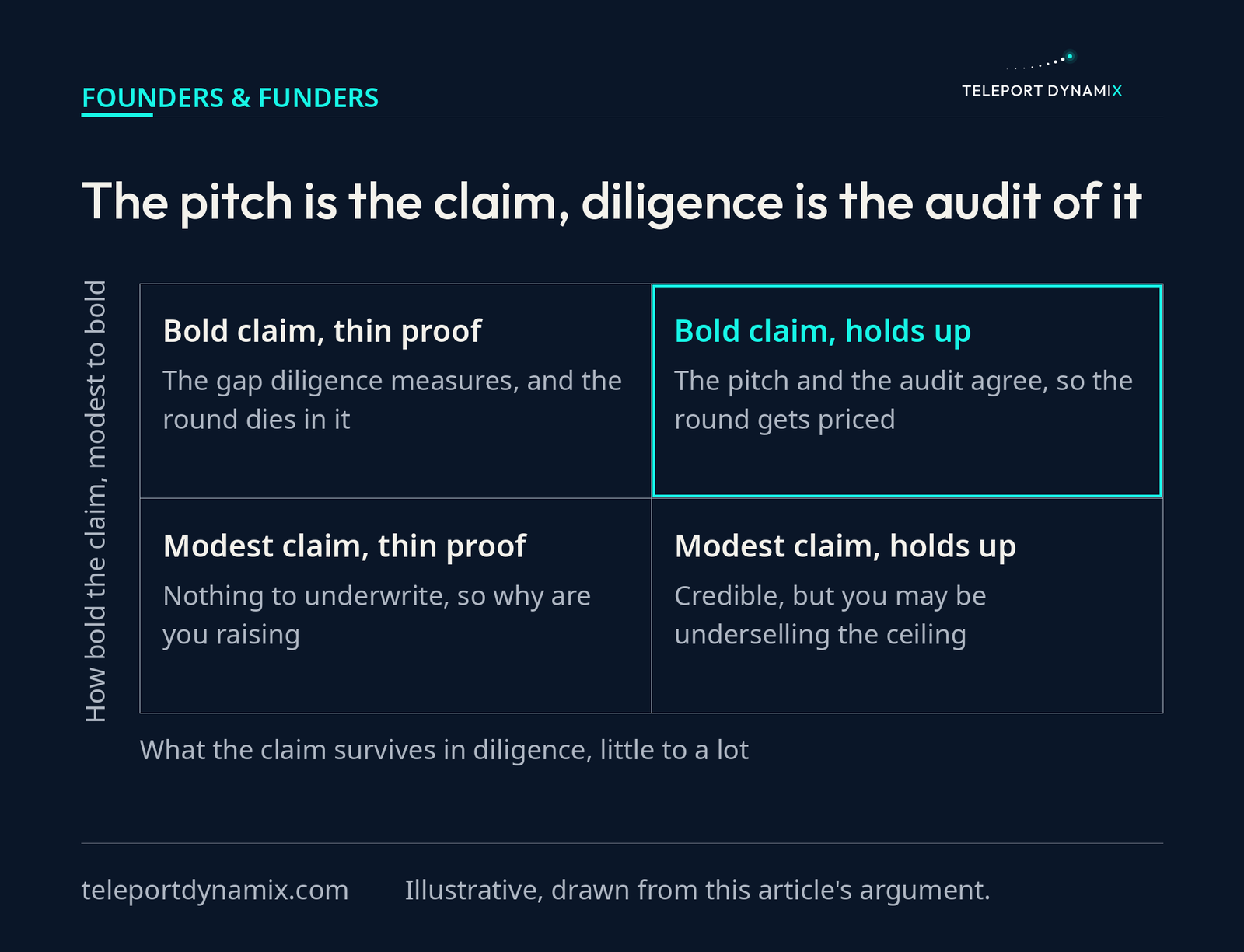
What gets measured is the gap. The distance between what a founder said in the room and what the code, the cloud bill and the retention data actually show.
Founder claims fall into a small number of shapes, and each shape has a proof an investor will accept and a place diligence goes looking for it.
| Founder claim | What an investor accepts as proof | Where diligence looks |
|---|---|---|
| "The product is built" | Real users completing the core action every week | Product analytics and deployment history |
| "It scales" | Current load handled at a known cost per user | Architecture, cloud bill, error rates at peak |
| "Retention is strong" | Cohorts that flatten after month three | Raw cohort tables by signup month |
| "The team can ship" | Features delivered on the dates promised | Commit history, release cadence, key-person risk |
| "Margins improve with scale" | Unit cost falling as volume rose | Infrastructure spend per account over time |
Claim only what would survive that comparison. The pitch is the claim, diligence is the audit of the claim, and the two get compared line by line.
Ceiling questions are asking for a mechanism you can defend
"How big can this be" is the question founders answer worst, because they hear a request for a number when the partner is asking for a mechanism.
A partner asking about the ceiling is asking whether you have thought seriously about the shape of the outcome, whether you understand what has to be true for it to be large, and whether you will tell them the truth about it. The benchmark material that firms publish, from the insights libraries kept by the funds themselves to the data-led analysis that has been public for years, exists precisely so that the answer can be argued with evidence rather than asserted with a number.
The wrong answer is a total addressable market slide. The right answer is a mechanism, laid out in four parts:
- The wedge. The narrow thing you win first, described concretely rather than in categories.
- What it opens. The larger market that first win earns you the right to enter.
- The assumption. The single thing that has to hold for the second step to work at all.
- The proof point. How you would know within two quarters whether that assumption is true.
By the time you raise a Series A, that mechanism has to survive contact with real numbers, which is the whole subject of series A fundraising buys a different kind of proof, where the ceiling stops being a story and becomes a curve you have to defend.
Say the assumption out loud. Naming the thing that could kill the outcome is the cheapest credibility available in a pitch, and the essays that founders and operators keep publishing about early-stage positioning all converge on it.
Follow-up discipline converts a meeting into a term sheet
Good meetings die in the week after them, quietly, because the founder went back to building and the partner went to a hundred other things.
Two habits keep the meeting alive after everyone has left the room:
- The twenty-four-hour email. Answer the question you could not answer in the room, exactly, with the number and the method attached. It proves the claim under no supervision at all.
- The monthly update to every no. One page, the number you said you would hit beside the number you actually hit. It is the only evidence a partner gets that you do what you say when nobody is watching.
A no from six months ago turns into a lead when the curve in that email keeps going the way you promised.
From the cap table, the month after a meeting has a cost attached. Runway is finite and visible to everyone on the register, so three quiet weeks following a good meeting is three weeks of the raise spent on nothing.
Anyone holding equity alongside you is watching the same two numbers a partner is: how fast the evidence is accumulating, and how much time is left to accumulate it in. A founder who goes quiet is moving one of those numbers and leaving the other alone.
HSBC Innovation Banking publishes commentary on how the venture market is moving, and law firms such as Cooley publish the rounds as they are announced. Neither record shows the months of contact behind the announcement, which is where the round was actually won.
What this looks like when it works
Nothing dramatic happens. That is the tell.
The founder walks in with something that already occurred, says it in ninety seconds, answers three questions shorter than the partner expected, says "I do not know" once and turns it into a plan, and leaves with a diligence list rather than a compliment. Four other firms are two days behind on the same calendar.
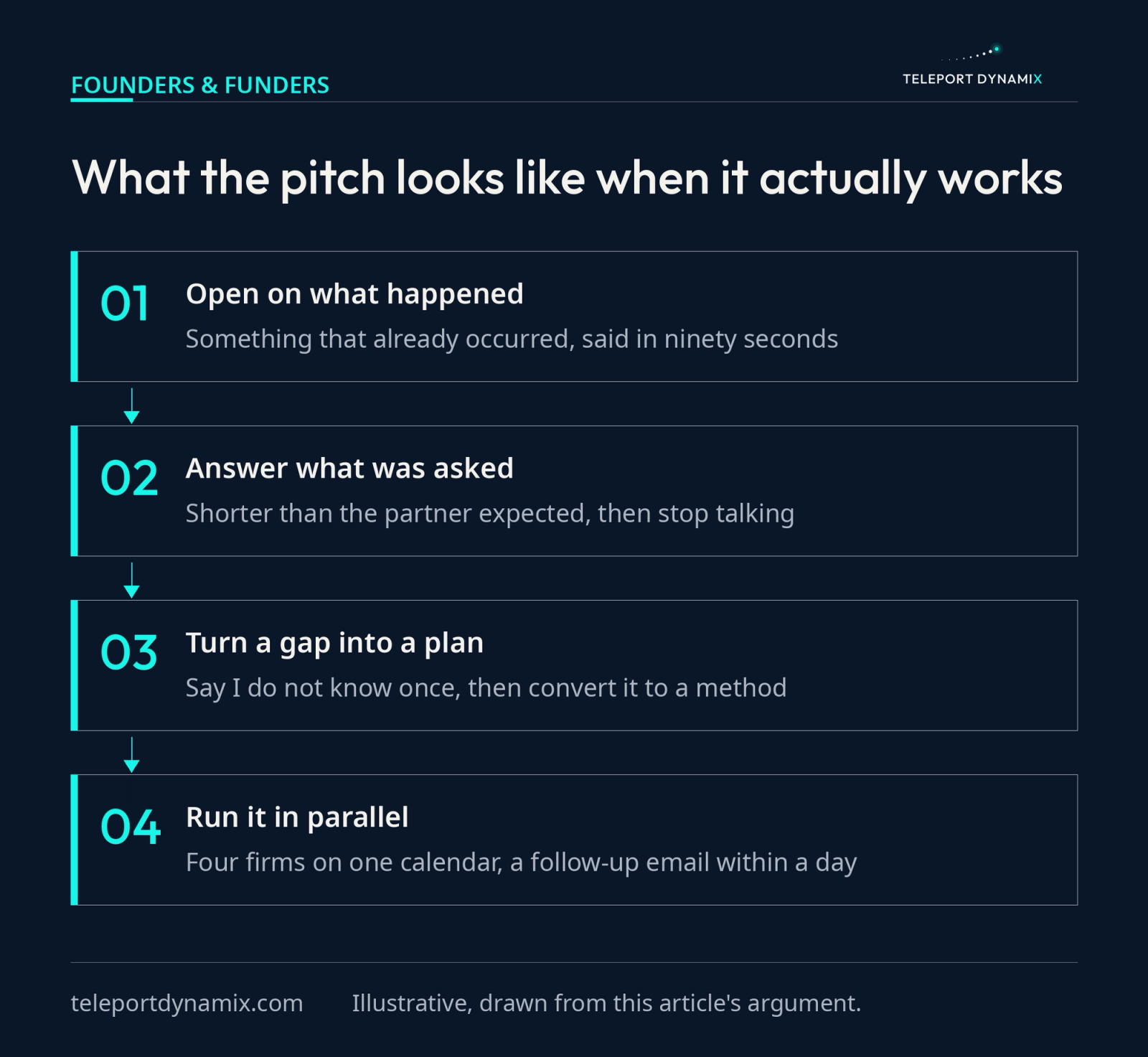
The term sheet arrives because the process created a market and the meetings created trust. Neither of those is a performance. Both of them are evidence, produced on purpose, months earlier, by someone who built to be investor-ready by month four rather than by someone who rehearsed in the taxi.
That is why we take equity instead of fees. Our equity model and our investor view are both public, because we sit on the same side of the table as the founder in the room. Whether that fit is right for you is worth answering before the meetings start.
Frequently Asked Questions
What is an investor pitch?
An investor pitch is a live conversation in which a founder asks a professional investor to spend more of the firm's time on their company. It is a triage decision, not a full evaluation. The company is assessed later, in diligence. The pitch decides whether diligence ever starts.
How long should an investor pitch be?
Assume thirty minutes, of which you speak for perhaps ten. Your uninterrupted opening should run ninety seconds and land what the company is, who it serves, and what has already happened. Everything after that is questions and answers, and the answers should be shorter than you think.
How do I prepare for an investor pitch?
Prepare the evidence, not the performance. Know your retention, your acquisition cost and your margins to the decimal, write down the three questions you cannot currently answer, and decide in advance how you will answer each with honesty and a method rather than a bluff.
What are 5 key elements of a pitch?
Clarity about what the company is, evidence that something has already happened, a credible mechanism for how the outcome gets large, honest handling of the weakest assumption, and a specific ask. Everything else in the meeting is packaging around those five, including the visual material.
What should I send after an investor meeting?
Send the answer to the question you could not answer in the room, within twenty-four hours, with the number and the method attached. Keep it to one screen. Then start a monthly update to every investor who passed, showing the number you said you would hit beside the number you actually hit.
How to pitch an idea for investors?
An idea alone is very difficult to fund, so convert it into evidence first. Talk to fifty real users with the problem, build something small they use, and pitch the behavior you observed. Our own line runs from idea to investor-ready in four months for exactly that reason. Start there.
Continue Reading:
More In This Series:
- Startup Fundraising Is a Purchase, Not a Milestone
- How to Raise a Seed Round Without Losing the Company
- Series A Fundraising Buys a Different Kind of Proof
- Pitch Deck Is a Trailer, Not the Film Investors Buy
- Startup Valuation Is a Price You Have to Grow Into
More from Teleport Dynamix:
- Hospitality Software Was Built for Someone Else
- Cloud Cost Optimization Is Engineering, Not Billing
- FinOps Is an Operating Discipline, Not a Cost Tool
- Hospitality Management Platform Built for the Shift
Explore the Insights Categories:


